What is astrocartography?
What is astrocartography? It is a way of drawing your birth moment on a world map. For each of 12 sky bodies it marks 4 lines, the places where that body was rising, setting, overhead or underfoot when you were born. Astrologers connect each line with a theme. This page explains the idea, how to read the lines, and what the map can and cannot tell you.
How it works
Enter your birth details
Type your birth date, birth time and birth place. The time zone is worked out for you, and no name or account is needed.Read your first city
See the city your lines point to first, then switch between overall, love, career and home to see how the answer changes with the goal.Look up a place you know
Select any place on the map to see the lines within 1,000 km, how far each one runs and what astrologers connect it with.
Astrocartography is the practice of placing your birth chart on a map of the world. Each of 12 bodies gets 4 lines, 48 in all, and astrologers read the places near a line as the ones where that body's theme stands out. The positions of the lines are astronomy and can be checked. Their meanings are a symbolic tradition without scientific evidence, so the map works best as a prompt for thinking about places.
The idea in one picture
Astrocartography takes the sky at the moment you were born and spreads it over a map of the whole world. At that moment every planet was somewhere above the Earth. Seen from one place it was climbing over the eastern horizon. Seen from another it was sinking in the west. Along one strip of the planet it stood at its highest point, and along the opposite strip it stood at its lowest. Join up the places that share each of those positions and you get lines. Each body gets 4: rising, setting, overhead and underfoot.
This map draws 12 bodies, which are the Sun, the Moon, the 8 planets from Mercury to Pluto, the North Node and Chiron. That gives 48 lines. Astrologers read a place on or near a line as somewhere that body's theme stands out. You may also see this called an astro map, locational astrology, or astrocartology, which is a spelling people search for. They all point at the same thing: a birth chart turned into a world map.
The name explains the method. It joins astrology to cartography, so the work is putting a chart onto a map. If you want to see one drawn for you, the map on the home page is free and needs no account.
Two halves with different standing
It helps to separate the two things astrocartography does, because they are not equally solid.
The first half is geometry. Where a body was rising, setting, overhead or underfoot at a given minute is a question about positions in the sky and the shape of the Earth. It has a right answer, and answers can be checked. When we compared this map with a standard astrology reference across 3,001 moments, the largest difference in line distance was 0.633 km (0.4 mi). The full test is on How we calculate.
The second half is meaning. What a line stands for comes from astrological tradition, and nothing scientific shows that living near a line changes anything in a life. So this site writes "astrologers connect this with" and stops there. That is the honest astrocartography meaning: a set of symbolic themes, offered as a prompt for thinking about places.
You can hold both ideas at once. The lines are placed correctly, and the themes are a tradition you may find useful, entertaining, or not for you.
What you need to make a map
Three details are enough: your birth date, your birth time and your birth place. The time zone is worked out for you from the place and the year, including the daylight saving rules in force then. You are not asked for a name or a gender.
The birth time matters more than people expect. The Earth turns about one degree every 4 minutes, and one degree is about 111 km at the equator. A time rounded to the nearest quarter hour can move every line by nearly 4 times that. If you do not know your birth time, there is an option for that. The lines are then drawn for 12:00 PM (noon) local time as an illustration only, and no city ranking is given.
Your map does not change when you move
Your map belongs to your birth moment and to nothing after it. The lines show where each body stood when you were born, so moving house does not redraw them. A birthday does not either. What changes is the place you look at. When you move, you stand near different lines, and the same map reads differently there.
The sky as it stands today, called transits, is a separate kind of astrology. The map itself does not use it. The full city report does look 12 months ahead for Jupiter and Venus, to suggest windows for a visit.
Someone else's map cannot explain a city for you. A friend can live in your city and sit near different lines, because each of you has your own birth moment. To read your own, always enter your own details.
Check that the map is yours
Enter your own birth record, not a place you want to visit. The birthplace is where you were born. The city you are curious about comes later, when you look it up on the finished map. Typing a destination into the birthplace box draws the map of someone born there.
Use the date and the local clock time on your birth record. Do not convert the time to the time zone where you live now, because the site works out the zone from the birthplace and the year. The form asks for month, day and year in that order, so check that you did not swap the month and the day.
When the map appears, look up one place you know, such as the city where you live. Read which lines run near it and how far away each one is. That first check shows the map was drawn from your details, and it gives you a base for reading other places. Your Sun sign alone cannot give you this map, because the lines depend on your date, time and place together.
What the 4 kinds of line mean
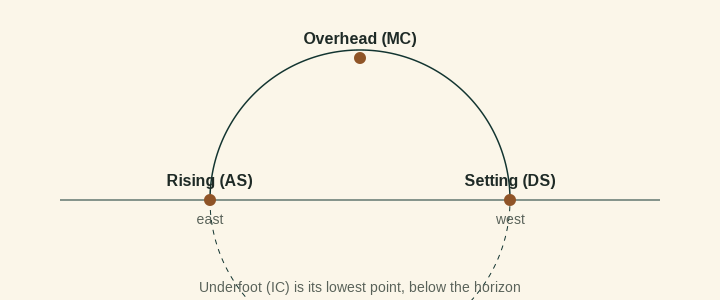
The body sets the subject, and the kind of line sets the part of life where it shows up. Here is how astrologers sort the 4:
- the rising line is about how you come across and how you meet new situations
- the setting line is about the people you draw close, one to one
- the overhead line is about your public side, such as reputation and the direction of your work
- the underfoot line is about home, roots and your private life
Put the two together and you get a short sentence. A Jupiter overhead line pairs growth and new chances with your public side. A Moon underfoot line pairs emotional safety with home. All 12 bodies are described in Line Meanings.
A real example: Maya
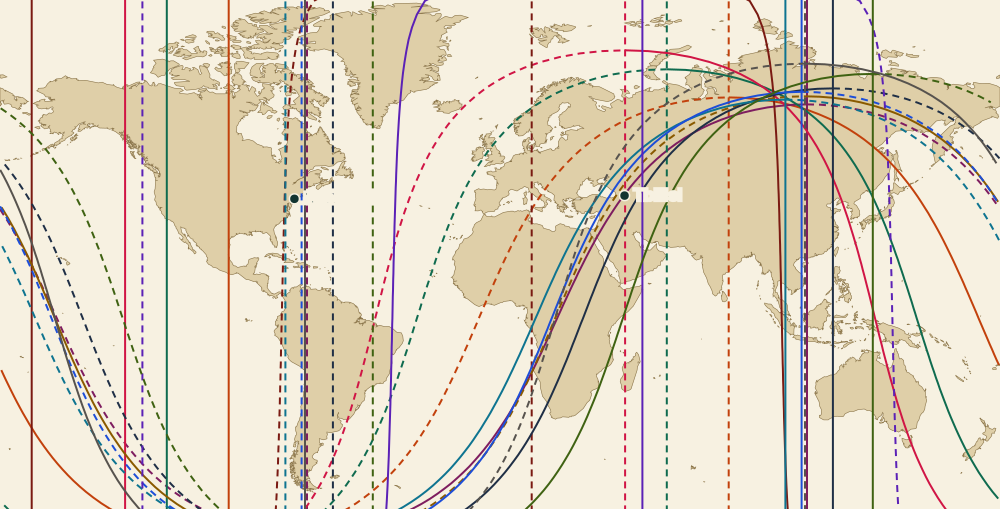
Maya is our sample person. She was born on June 10, 1990, at 2:30 PM in New York. The figures below are what the map returned for those details.
Her first city overall is Tbilisi, Georgia. Two lines pass close to it: Venus underfoot at 18 km (11 mi) and the Moon rising at 22 km (14 mi). Astrologers connect Venus underfoot with affection and enjoying life at home, and the Moon rising with emotional safety and daily habits. Change the goal to career and the first city becomes Boston, where the Jupiter overhead line runs 72 km (45 mi) away.
Notice what the example does and does not do. It does not tell Maya what to do. It gives her a short list of places to look into, with a reason attached to each. That is the practical use of astrocartography.
How to read a map once you have it
Start with one place instead of the whole picture. 48 lines crossing the world look like a tangle, and nobody reads them all at once. Pick a place you know, such as where you live now, and ask the map which lines run near it.
Every line near a place comes with its distance in kilometers. Read from nearest to furthest, because the nearest ones carry the most weight. Astrologers do not share one fixed cut-off, so this map shows every line within 1,000 km (621 mi) and counts closer lines for much more. A line right through a city counts in full, one at 350 km (217 mi) counts for about 37% of that, and past 1,000 km it is not counted.
There is a longer walk-through, with a worked reading of New York and Tokyo, in How to Read Your Map.
What astrocartography can help with
Used well, the map is a way to put a question to yourself. These are the ways people tend to use it:
- narrowing a long list of places down to a few worth a closer look
- choosing a first destination for a long stay
- looking at your current city and seeing which themes it carries
- comparing 2 places you are torn between by reading their nearest lines side by side
- adding one more angle to a decision that already rests on money, work and people
For the first of these, the tool sorts about 400 cities against your lines and names a first city for overall, love, career and home. The weights behind that ranking are published on How we calculate, so you can see the working and disagree with any part of it.
What astrocartography cannot do
The map does not predict what will happen to you in a place. It cannot say whether you will be happy in a city, and it knows nothing about cost of living, visas, climate, language or the people you would want nearby. It does not replace advice on immigration, tax or law.
It is also sensitive to its inputs. A wrong birth time or a wrong time zone moves the lines. When Maya's time is moved one hour later, to 3:30 PM, her first city changes from Tbilisi to Istanbul. That is why it is worth checking your time against a birth record before you read much into a result.
A few habits keep the map in proportion:
- treat each line as a theme to think about, not a verdict
- keep the same drawing method when you compare cities, because the 2 methods can differ by anything from nothing for the Sun to over 1,000 km for Pluto
- visit before you commit, since a short stay tells you more than any ranking
- weigh the map against your real list of practical needs
How it differs from a birth chart
A birth chart is the sky at your birth drawn for your birthplace. An astrocartography map is the same moment drawn as lines across the whole world. A relocation chart is the same moment redrawn for one other city, so it shows your rising sign and houses as they would be there.
The map is the place to start when you do not yet have a city in mind. Once you do, a relocation chart goes deeper on that one place.
Where to go next
If you are new to all this, a good order is simple. Make your map from the home page. Read the first city and its reasons. Then look up a place you already know and see whether the nearest lines ring true for you. If you want the meaning of a particular body, open Line Meanings. If you want to know how far the numbers can be trusted, read How we calculate.
FAQ
What is astrocartography in simple terms?
Astrocartography is your birth chart drawn as lines on a world map. Each line marks where a planet was rising, setting, overhead or underfoot when you were born. Astrologers connect each line with a theme, so a place near it is read as somewhere that theme stands out.
What is the astrocartography meaning of a line?
A line has 2 parts: the body gives the subject and the kind of line gives the area of life. A Venus underfoot line, for example, pairs affection with home. These meanings come from astrological tradition and are not scientific findings.
Is astrocartography the same as astrocartology?
Yes. Astrocartology is a less common spelling of the same word, and an astro map is another name for the map itself. Locational astrology is a wider name that also covers tools such as the relocation chart.
Is astrocartography accurate?
The line positions are accurate and can be tested. Ours differed from a standard reference by at most 0.633 km (0.4 mi) across 3,001 moments. What the lines mean cannot be tested. Your birth time has the biggest effect on how well the map fits you.
What do I need to make an astrocartography map?
You need your birth date, birth time and birth place. This map works out the time zone for you and asks for no name or gender. If you do not know the time, the map is drawn for 12:00 PM (noon) as an illustration and no city is ranked.
Do I need to know astrology to use it?
No. Select a place and the map writes out which lines are near it and what astrologers connect them with, in ordinary English. The lines page explains each of the 12 bodies if you want to read further.
How is it different from a birth chart?
A birth chart shows the sky at your birth for one place, your birthplace. An astrocartography map shows the same moment for the whole world at once. A relocation chart redraws it for one other city.
Can astrocartography tell me where to move?
It can suggest places to look into, but it cannot decide for you. It knows nothing about cost, paperwork, climate or the people in your life. Use it as one input and visit a place before making a big plan.
Is astrocartography free here?
Yes. All 48 lines, your first city with its reasons, the first city for each of 4 goals and a lookup for any place are free, with no account. A paid city report adds the top-20 lists if you want them.
Does my astrocartography map change when I move?
No. The map is fixed by your birth date, time and place. Moving changes which lines sit near you, not the lines. A new city can show different themes on the same map.
Can I find my astrocartography from my zodiac sign alone?
No. A Sun sign only says where the Sun stood in the zodiac, which is shared by about a twelfth of all people. The lines depend on your exact birth date, time and place.
Where should your next chapter unfold?
Match your current priorities with your natal planetary lines in under a minute.
What are you optimizing for right now?
Related tools
Line Meanings
Every line is a pairing of one body and one angle, and this page explains both halves, with examples from a real map.
How to Read Your Map
Draw your own map above, then follow 5 steps that turn a tangle of lines into a plain reading of any one place.
How we calculate
Here is how each line is calculated, what our tests found, and how a city earns its place, with the numbers left in.
Where Should I Live
Enter your birth date, time and place, and the map names the city your lines point to first, with the reasons behind it.
AC Lines
Each AC line marks the places where one planet was rising over the eastern horizon when you were born. Also called the Ascendant or rising line, it is one that astrologers connect with self-image, first impressions and how you start things. This page covers what each planet on the AC points to, how close a line has to run, and how AC lines count in the rankings. Draw your own map above to see where yours fall.
Astrocartography Calculator
This astrocartography calculator takes your birth date, time and place. It draws your 48 planetary lines on a world map and names the city your lines point to first, with the reasons. It is free and needs no account. You can also look up any place to see the lines near it.
Career Map
Enter your birth details and the map sorts cities by the lines astrologers tie to work, with the overhead line counting most. You do not need to know what any line means, because the result names your first city and the lines behind it.
Love Map
Enter your birth details and the map sorts itself by the lines astrologers tie to affection. You do not need to know what any line means.