Astrology travel: how to choose a destination from your birth chart
Astrology travel means picking a trip by where the lines of your birth chart fall on the map. Enter your birth details and see which lines run near a destination, how far away they are, and what astrologers connect them with. It is free, needs no account, and works as a prompt for ideas, not a forecast.
How it works
Enter your birth details
Give your birth date, time and birthplace. No name, gender or account is asked for, and your 48 lines are drawn on the map straight away.Look up the places you might visit
Search a city or click the map to see every line within 1,000 km (621 mi), how far away each one runs, and what astrologers connect it with.Keep 1 to 3 destinations
Match each line to what the trip is for, such as rest, romance or work, then keep the places that fit both the map and your practical plans.
Astrology travel is choosing a trip by the lines of your birth chart on a world map. Enter your birth details, search a destination, and see which lines run near it and how far away. Astrologers connect Venus with affection, Jupiter with openness and the Moon with comfort. It is a tool for ideas and reflection, not a prediction.
Why a trip is a good first test of your chart
Most guides to astrology travel start with your Sun sign and hand you a list of beaches. This page works differently. Your birth date, time and place give a map of 48 lines across the world, and each line passes near some cities and far from others. Astrologers who work with this method, which is the main method of locational astrology and is often called astro travel when used for trips, read a destination by which lines run close to it.
A trip is a gentle way to try that out. Moving to another country is a big commitment, and you only learn how a place sits with you after months or years. A week in a city costs a lot less, and the answer to "does this place suit me?" shows up in days. You can go to the place a line points to, notice how you feel, and decide for yourself whether the map said anything useful.
That is the honest frame for everything below. The positions of the lines are astronomy. The meanings come from astrological tradition, and nothing scientific shows that being near a line changes your trip. Think of it as a prompt for choosing where to look, in the same way a friend's recommendation is a prompt. It is a tool for reflection and ideas, not a forecast.
What an astrology travel chart is
An astrology travel chart, sometimes called a cosmic travel map, is your birth chart drawn onto a world map. For each of 12 bodies (the Sun, Moon and planets, plus the North Node and Chiron) there are 4 lines, one for each angle: rising, setting, overhead and underfoot. Each line marks the places where that body stood at that point in the sky when you were born.
If you are new to the idea, What is astrocartography explains how all 48 lines come from one birth moment. To read the lines on the map, see How to read an astrocartography map.
For travel, only two questions matter: which lines run near the place you are thinking of, and how far away are they. The tool answers both. You do not need to be able to draw a chart yourself.
How astrologers connect lines with travel
Every line has a theme, and the angle decides which part of a trip it touches. These are the pairings astrologers most often mention for travel. They are traditions, not facts, and different astrologers weigh them differently.
- Jupiter lines: astrologers connect Jupiter with growth, optimism and journeys that widen your world, so a Jupiter city is often suggested for a trip you want to feel open and generous. See Jupiter lines.
- Venus lines: Venus is tied to pleasure, beauty, taste and affection, so a Venus city is the traditional pick for a romantic trip, a food trip or a trip for art and design. See Venus lines.
- Sun lines: the Sun is tied to vitality and a sense of presence, so astrologers link a Sun line with places that feel bright and energizing. See Sun lines.
- Moon lines: the Moon is tied to comfort and what feels familiar, so a Moon city is the one astrologers suggest for a trip meant to rest and feel looked after. See Moon lines.
- Mercury lines: Mercury is tied to talking, learning and getting about, which makes a Mercury city a candidate for a study trip or a trip full of conversation. See Mercury lines.
- Mars lines: Mars is tied to energy and drive, so a Mars city suits an active trip, though astrologers also say the same line can feel restless. See Mars lines.
Lines for Saturn, Uranus, Neptune, Pluto and Chiron have their own pages in the line meanings guide. Astrologers usually describe these as heavier, sharper or more intense themes. Some travelers look for that, and others prefer a lighter trip. Neither is the wrong reading.
The angle matters as well. A rising line is tied to how you come across in the place, a setting line to the people you meet, an overhead line to your public side and what you get done, and an underfoot line to how settled you feel. On a short trip, many people care most about the rising and setting lines, because those are about meeting a place and meeting people in it.
How to check a destination on this site
You can evaluate any vacation or work destination in four quick steps using your birth details and the interactive map.
- Enter your birth date, time and birthplace. No name, gender or account is needed.
- Look at the first city the tool names, and at the first city for each of the 4 goals: balance, love, career and home.
- Click any point on the map, or search any city, to see every line within 1,000 km (621 mi), how far away each one runs, and what astrologers connect it with.
- Turn lines on and off by body, so you can look only at Venus and Jupiter if you are planning a holiday.
The lookup covers about 226,000 places, so it works for a small coastal town as well as a capital. That matters for travel, because many good trips go somewhere that would never appear in a ranking of large cities. The ranking itself looks at about 400 well-known cities. See Where should I live for how it chooses them, and How we calculate for the full detail.
If you do not know your birth time, the tool draws the lines for noon at your birthplace and treats them as an example only, with no ranking. The lines move about 1 degree every 4 minutes, which is about 111 km at the equator, so a time that is off by an hour can move a line a long way. Your birth certificate is the best place to find the time.
How close is close enough
Distance matters as much as the line. On this site a line through a city counts in full, and the share counted drops quickly as you move away. At 100 km (62 mi) it counts for 92%. At 350 km (217 mi) it counts for 37%, and past 1,000 km (621 mi) it is not counted at all.
For a trip, this gives a simple rule of thumb. If you want the line to be part of the experience, look for a destination where it runs within a few dozen kilometers of the city or the area you will stay in. A line 600 km (373 mi) away is a faint background note, and you can treat it that way.
An example: Maya's map
Take Maya, born on June 10, 1990, at 2:30 PM in New York. Her first city overall is Tbilisi, Georgia, with a Venus underfoot line at 18 km (11 mi) and a Moon rising line at 22 km (14 mi). In the astrologers' vocabulary, that is affection and comfort at the same place, which would make it a candidate for a restful trip with good food and slow evenings.
Her career list begins somewhere else. Boston, in the United States, has a Jupiter overhead line at 72 km (45 mi), and Austin has a Sun overhead line at 9 km (6 mi). For a work trip, such as a conference or a round of meetings, those are the places astrologers would point to for the public side of her chart.
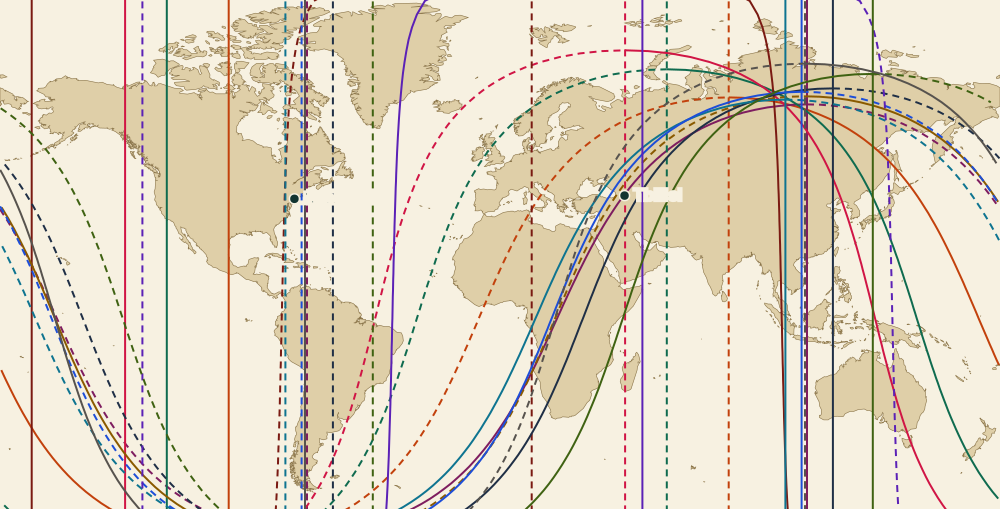
So the same person gets different suggestions for a holiday and for a work trip. That is the useful part. The map does not give one right answer. It gives you a reason to ask what you want from this particular trip.
How to choose 1 to 3 destinations
A short list is easier to compare than a long one. This is a way to get there.
- Write down what the trip is for: rest, romance, adventure, work, learning, or just curiosity.
- Match it to a theme from the list above. A rest trip points toward Moon and Venus, an open and exploratory trip toward Jupiter, a work trip toward Sun and Jupiter overhead.
- Look at the cities you were already considering, and check which of them have a matching line within a short distance.
- Keep the ones that fit both your practical needs and the map. The budget, the season, the time you have and the people you are traveling with count more than any line.
- Stop at 3. If two cities are close, pick the one you are more curious about.
You do not need a perfect match. A place that fits your plans and has a relevant line nearby is a good enough reason to go.
When the lines for a trip point in different ways
A destination can have a helpful line and a hard one near it. Say a Venus line runs 80 km from the city and a Saturn line runs 120 km away. Do not average them. Ask what the trip is for.
A trip for rest and company fits the Venus theme. A trip to work through something serious fits the Saturn theme. Then note the angle. Astrologers tie the rising line to how you come across and the underfoot line to private life.
If the mix feels too uncertain, keep the stay short. A week is an easy way to see whether either theme rings true, and it costs less than a move. Travel is not relocation, so a place that suits a holiday may not suit a year.
Steps before you go
Pair your astrocartography travel notes with practical checks on entry rules, safety advisories, health coverage, and trip costs.
- Check travel advice for your destination from your government's official source. The ranking leaves out countries and regions under a US State Department Level 4 travel advisory as of November 7, 2026. Looking up a place does not check its safety, your own situation may be different, and the map says nothing about entry rules or health advice.
- Book flights and rooms as you would for any trip. The lines are not a reason to skip the usual checks.
- Note the nearest lines and their distance in your phone, so you can compare them with what you actually feel.
- Pick one or two things to pay attention to, such as how rested you feel, how easy it is to talk to people, or whether you want to stay longer.
- After the trip, write a few lines on what you noticed. Over time you will see whether the themes that astrologers describe match your own experience, and that is more useful than any single reading.
What this can and cannot do
The tool can show you which lines run near any place on Earth, how far away they are, and what astrologers connect them with. It can give you a short list to start from and a vocabulary for thinking about what you want from a trip.
It cannot tell you what will happen on your trip, whether you will have a good time, or whether you should go. There is no scientific evidence that lines predict how a trip will go. Many people enjoy the exercise because it makes them think about what they are looking for, and that is a fine reason to use it. If a place appeals to you for ordinary reasons, go there, whatever the map says.
If a trip goes well and you wonder about staying longer, a longer stay is the next step to test, and Where should I live covers that.
Free map or full report
The map, the first city for each goal and the lookup for any place are free and need no account. If you want the top 20 cities for each goal, with up to 3 lines that count most for that goal and what they are tied to, those are in the city report. Most travelers do not need it. The free lookup is enough for choosing a destination or two.
FAQ
What is astrology travel?
It is choosing where to go by reading your birth chart. This site draws 48 lines on a world map from your birth details, and you see which lines run near a destination. Astrologers connect each line with a theme, but it is a symbolic tool, not a forecast.
How do I find my astrology travel chart?
Enter your birth date, time and birthplace on this site. The map appears with your lines, and you can click any point or search any city to see the lines within 1,000 km (621 mi). It is free and needs no account.
Is an astro travel map the same as astrocartography?
Mostly yes. Astro travel is a name for using astrocartography on a trip, and astrocartography is the main method of locational astrology. Both read where the lines of your birth chart fall on the Earth. This page focuses on using it for trips.
Which line is best for a holiday?
Astrologers most often mention Venus for pleasure and affection, Jupiter for a sense of openness, and the Moon for rest and comfort. There is no single best line, so choose the theme that fits what you want the trip to be for.
Why try astrology on a trip instead of a move?
A trip lets you test a place in days rather than years, and it costs far less if the place does not suit you. If a city feels good after a week, you have a real reason to think about a longer stay.
How close should a line be to my destination?
The closer the better. On this site a line within a few dozen kilometers counts almost in full, one at 100 km (62 mi) counts for 92%, and past 1,000 km (621 mi) it is not counted. A line 600 km (373 mi) away is a faint background note.
Can I use it if I do not know my birth time?
You can see example lines drawn for noon, but they are only an example and the tool gives no city ranking. The lines move about 1 degree every 4 minutes, so the time matters a lot. A birth certificate usually has it.
Does astrology travel really work?
There is no scientific evidence that living or traveling near a line changes your experience. The positions are astronomy, and the meanings are a tradition. It is best used for reflection and for ideas about where to go, not for predictions.
Is a good holiday place also a good place to live?
Not necessarily. A week is a different test from a year. A line that feels bright on a trip may feel tiring every day, and a hard line may be easy to enjoy for a short stay. Use a trip as a test, then judge a move on its own.
Where should your next chapter unfold?
Match your current priorities with your natal planetary lines in under a minute.
What are you optimizing for right now?
Related tools
Where Should I Live
Enter your birth date, time and place, and the map names the city your lines point to first, with the reasons behind it.
Jupiter Lines
Your Jupiter lines mark the places where Jupiter was rising, setting, overhead or underfoot at your birth. Astrologers connect them with growth, new chances and a wider outlook. This page explains each line, how far away it can be and still count, and how to read it next to a Venus or Sun line. Then you can draw your own map above.
Venus Lines
Your Venus lines mark the places where Venus was rising, setting, overhead or underfoot at your birth. Astrologers connect them with affection, attraction and enjoying life. This page explains each line, how far away it can be and still count, and how to read it next to a Moon or Jupiter line. Then you can draw your own map above.
How to Read Your Map
Draw your own map above, then follow 5 steps that turn a tangle of lines into a plain reading of any one place.
AC Lines
Each AC line marks the places where one planet was rising over the eastern horizon when you were born. Also called the Ascendant or rising line, it is one that astrologers connect with self-image, first impressions and how you start things. This page covers what each planet on the AC points to, how close a line has to run, and how AC lines count in the rankings. Draw your own map above to see where yours fall.
Astrocartography Calculator
This astrocartography calculator takes your birth date, time and place. It draws your 48 planetary lines on a world map and names the city your lines point to first, with the reasons. It is free and needs no account. You can also look up any place to see the lines near it.
Career Map
Enter your birth details and the map sorts cities by the lines astrologers tie to work, with the overhead line counting most. You do not need to know what any line means, because the result names your first city and the lines behind it.
Love Map
Enter your birth details and the map sorts itself by the lines astrologers tie to affection. You do not need to know what any line means.