How to Read Astrocartography Map Lines: Where Do You Start?
Draw your own map above, then follow five steps that turn a tangle of lines into a plain reading of any one place.
How it works
Draw your map
Enter your birth date, time and place. All 48 lines appear on the world map, and you can switch them on and off body by body.Tap one place
Choose somewhere that matters to you, like where you live or a city you are considering, and see the lines within 1,000 km.Read the closest line first
Take the body, then the line type, then the distance. The tool shows what astrologers connect them with.
How to read astrocartography map lines comes down to starting with one place, not the whole map. Pick a city, name the body on the nearest line, name the kind of line, check how far away it runs, then ask whether that theme is something you want. Five steps, and you can do them for any place on Earth. If you would rather skip the reading, tap a place and the tool writes it out for you in plain English.
Why the map looks like a mess at first
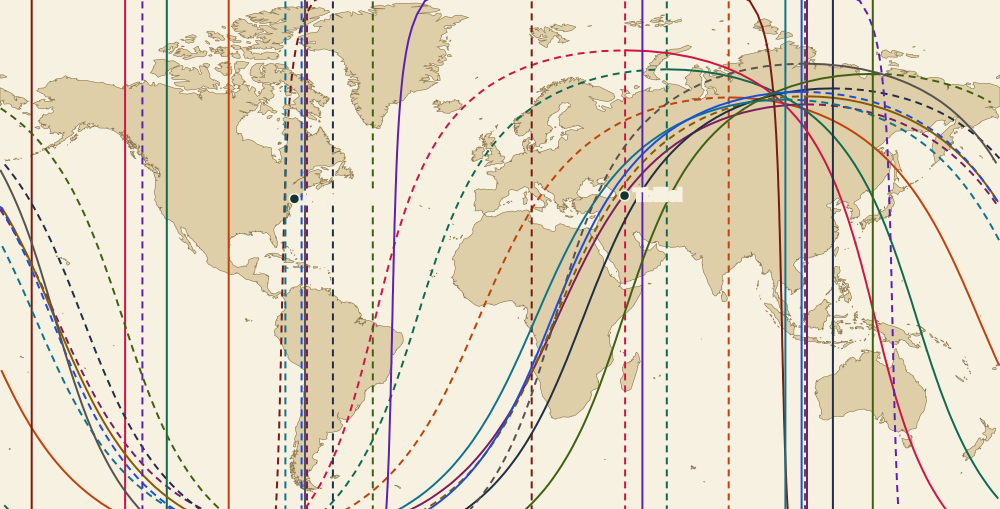
Twelve bodies with four lines each makes 48 lines, and they cross all over the world. Nobody reads that all at once, and you do not need to. The trick is to stop looking at the map as a picture and start asking it about one place at a time. If it still feels busy, switch off everything except the one or two bodies you are curious about.
The five steps
1. Pick a place you care about
Where you live, where you grew up, or a city you keep thinking about. A place you know well is the best way to start, because you can compare what you read with what you have actually lived.
2. Name the body
The body tells you the subject. Venus is about affection and enjoying life, Jupiter is about growth and new chances, and Saturn is about discipline and slow, lasting work. You do not have to memorise these. Each is written out when you tap the line, and the full list is in Line Meanings.
3. Name the kind of line
This is where in life that subject shows up. You can tell them apart by shape.
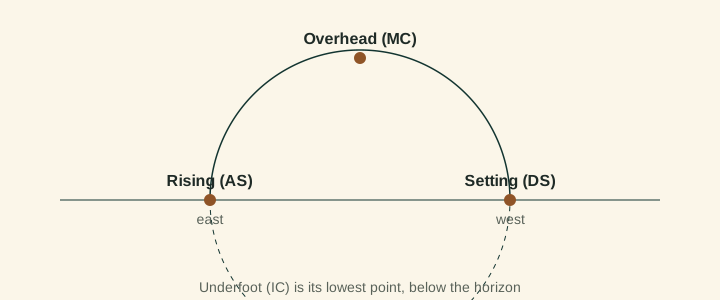
- Straight north-to-south lines are the overhead line (MC), tied to your public side, and the underfoot line (IC), tied to home and roots.
- Curving lines are the rising line (AS), tied to how you come across, and the setting line (DS), tied to the people you draw close.
The shape has a simple cause. A body reaches its highest point along one north-south strip of the Earth at any given moment. Rising and setting depend on the horizon, which sweeps around the globe in a curve.
4. Check the distance
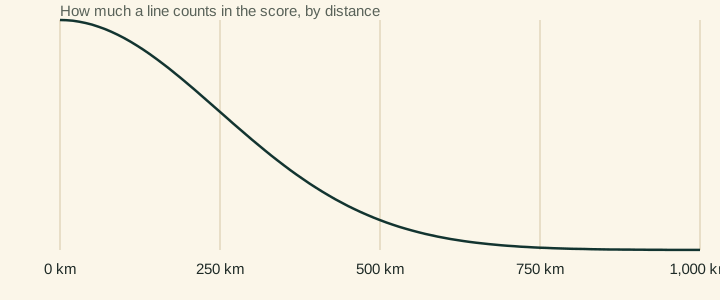
Every line near your place comes with its distance in kilometres. Read from nearest to furthest, as the nearest ones carry the most weight. A line at 18 km and a line at 826 km are very different things, even though both appear on the list.
5. Put it into a question
Join the two halves into one sentence and turn that into something you can check: "Moon underfoot, 13 km: astrologers connect this with emotional safety at home. Would I feel settled here?" A question is more useful than a verdict, because you are the one who can answer it.
A worked reading: Maya in New York
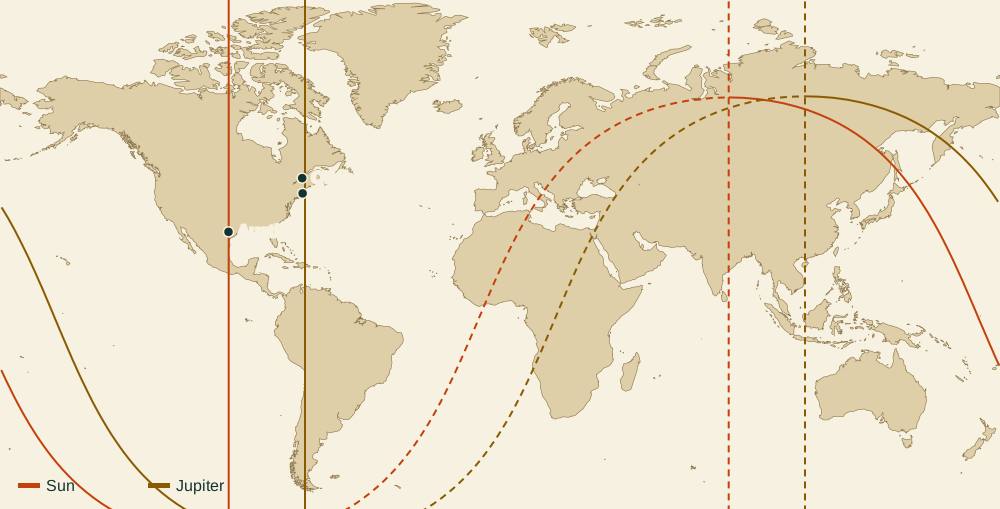
Here is Maya's chart (June 10, 1990, 2:30 pm local time, New York). Tapping New York and choosing Show all lines lists these six lines, nearest first (the first view shows the nearest four):
| Line | Distance | How to read it |
|---|---|---|
| Neptune underfoot | 218 km | Imagination and idealism, in home and private life |
| Uranus underfoot | 273 km | Independence and doing things your own way, also at home |
| Mars setting | 295 km | Drive and competition, in one-to-one dealings |
| Chiron overhead | 321 km | Tender spots, in your public side |
| Jupiter overhead | 322 km | Growth and new chances, in your public side |
| Moon underfoot | 381 km | Emotional safety, at home and in your roots |
No line runs right through the city, so a reader would describe a blend. Three of the six touch home and private life, which gives the reading its main theme. Two are overhead, one of them Jupiter, adding a career-and-reputation side. Mars on the setting line adds a competitive edge to dealings with others. None is close enough to dominate.
Now tap Tokyo with the same chart. Pluto setting is only 60 km away, so that one line leads the reading: deep change and intensity, in one-to-one ties. Mercury rising follows at 219 km, adding ideas and conversation to how Maya comes across. Same person, a much more focused reading.
When several lines stack up
Two or more lines close to one place are read together, as two themes in one spot. Boston for Maya has Chiron and Jupiter overhead at 71 and 72 km, so both speak to the public side at once: new chances, with some tender spots mixed in. Read them as a pairing and not as a contest. Where they point in opposite directions, the closer one usually gets more attention.
Habits that make your reading better
- Use the time on your birth record if you have it. Every four minutes moves the lines about 111 km at the equator.
- Keep one drawing method when comparing cities. In mundo is the default, and Zodiacal can shift a line by anything from nothing (the Sun) to over 1,000 km (Pluto).
- Read a few places you know before ones you do not.
- Do not stop at one line. Use Show all lines to see everything within reach before you form a view.
- To go deeper into a single city, open its relocation chart, which shows your full chart from there.
FAQ
Can I ask ChatGPT to read my map for me?
Yes, as long as you give it real data. Copy the line names and distances from your map into the chat and ask it to explain those, since asking it to work out your lines from your birth details alone can produce details that are made up.
What do AS, DS, MC and IC stand for?
AS is the Ascendant, the rising point on the eastern horizon. DS is the Descendant, the setting point on the western horizon. MC is the Midheaven, the highest point in the sky. IC is the Imum Coeli, the lowest point, below the horizon. Each planet has one line for each of the four.
Why are some lines straight and others curved?
Overhead and underfoot lines follow a north-south strip of the Earth, so they look straight. Rising and setting lines follow the edge of the horizon, which wraps around the globe at an angle, so on a flat map they curve.
Which line should I read first?
Start with the line closest to the place you tapped. After that, read in order of distance. If you have a goal in mind, such as love or home, also look for the bodies and kinds of line tied to that goal, even when they sit further away.
What does it mean when two lines cross?
A crossing means two themes meet at the same spot, so a place near it is close to both lines. Read each line's meaning, then think about how the two would sit together in your own life. The closer the place is to the crossing, the stronger both count.
Can I read a map without knowing any astrology?
Yes. Every line comes with a plain-English description, and the tool names a first city with its reasons, so you can get what you came for without knowing a single term. The steps on this page are there for anyone who wants to read deeper.
Related tools
Line Meanings
Every line is a pairing of one body and one angle, and this page explains both halves, with examples from a real map.
Relocation Chart
Add your birth details and a city to see your rising sign, Midheaven and planet houses redrawn for that place.
Where Should I Live
Enter your birth date, time and place, and the map names the city your lines point to first, with the reasons behind it.
How we calculate
Here is how each line is calculated, what our tests found, and how a city earns its place, with the numbers left in.
Love Map
Enter your birth details and the map sorts itself by the lines astrologers tie to affection, so you do not need to know what any line means.
City Report
The city report takes the map you draw for free and adds the top-20 lists, what the lines near each city mean, and your rising sign in each one.
Sites Compared
We read the public pages of five astrocartography sites on November 7, 2026, and set what each offers for free next to our own.
Rising Sign Calculator
Enter your birth details to get your rising sign, then pick any city to see the rising sign your chart would have there.