Where Should I Live Based on Astrology?
Enter your birth date, time and place, and the map names the city your lines point to first, with the reasons behind it.
How it works
Start with your birth moment
Type in your birthday, birth time and birthplace. The time matters most here, since it decides where every line falls and which city comes out first.Read your first city
See the city that comes first overall, then switch between love, career and home. Each one lists the lines that put it there and how many kilometres away they run.Check the places on your mind
Look up the cities you are already thinking about, including where you live now, and compare their lines with the ones on your first city.
Where should I live based on astrology comes down to one check: which cities sit close to the lines of your birth moment, and whether those lines match what you want from a place. This tool does the sorting for you. It checks about 400 cities against your 48 lines, then names the first city overall and for love, career and home, each with its reasons. It is free and needs no account. What you get is a short list to look into, and the choice stays yours.
What you get from one set of birth details
Most people arrive with a simple question and find a map full of crossing lines. So the tool answers first and shows the working afterwards. You see one city, the lines near it, what astrologers connect those lines with, and how far away each one runs. Then you can go wider: the top pick for all four goals, plus a lookup for any place on the map, all free. If you want the top 20 cities, goal by goal, those are in the city report.
Maya's answer depends on the goal
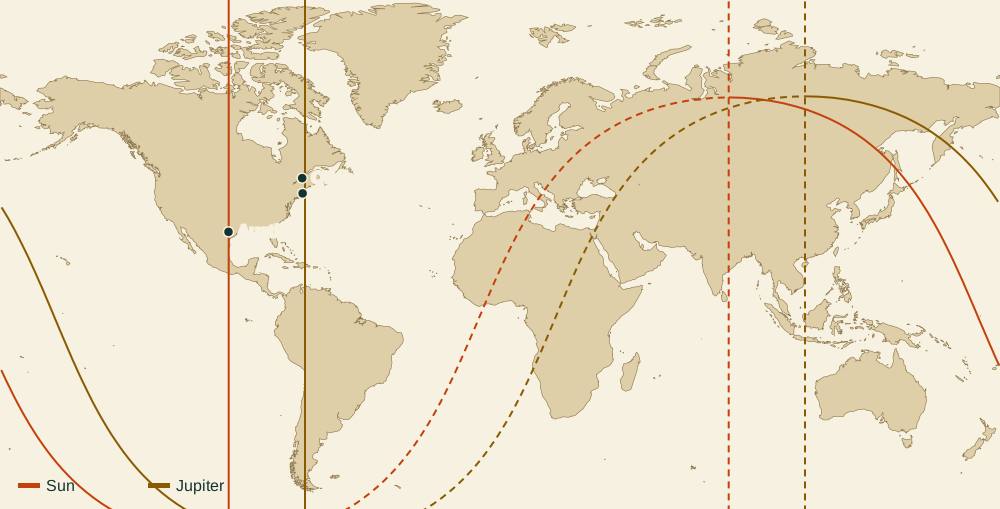
Take Maya, whose birth details are 2:30 pm on June 10, 1990, in New York. These are the real results:
| Goal | First city | Lines that put it first |
|---|---|---|
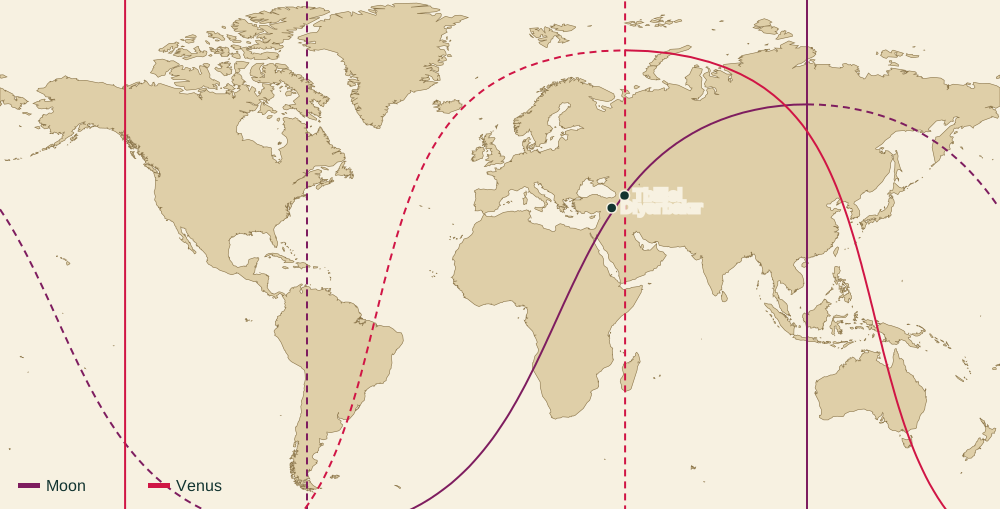
| Balanced | Tbilisi, Georgia | Venus underfoot at 18 km, Moon rising at 22 km |
| Love | Tbilisi, Georgia | Venus underfoot at 18 km, Moon rising at 22 km |
| Home | Tbilisi, Georgia | Moon rising at 22 km, Venus underfoot at 18 km |
| Career | Boston, United States | Jupiter overhead 72 km, Moon underfoot 130 km |
Three goals land on one city because Venus and the Moon score well for all of them. Career looks for something else. Jupiter counts most there, and the overhead line, which astrologers tie to your public side, carries the most weight, so the Jupiter overhead line, 72 km from Boston, puts it in the lead, and its fame lift keeps it just ahead of Québec and Santiago, which sit on the same line. After Boston, the career list runs to Québec in Canada, with the same Jupiter overhead line 78 km away, and then Austin in Texas, 9 km from the Sun overhead line.
Notice that the career answer sits in the same corner of the map as Maya's birthplace. A first city does not have to be far away. It only has to be near the right lines.
Which cities the tool considers
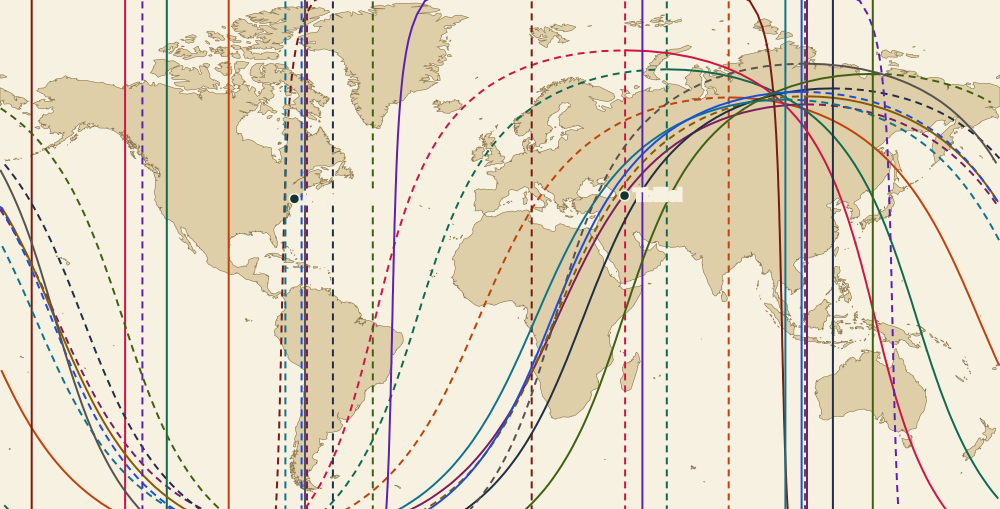
The ranking looks at about 400 cities: large or well-known places, plus a list of cities popular for long stays. A few rules keep the results practical.
- Countries and regions under a US State Department Level 4 travel advisory are left out, as of November 7, 2026, along with Western Sahara.
- If several cities sit within 250 km of each other, only one stays on the list.
- A country can hold at most two places, so you see real alternatives rather than one region repeated.
Everywhere else is still open to you. The lookup covers about 226,000 places, so a small town you love can be checked even though it would never appear in a ranking.
Where you live now
The most useful comparison is often the place you already know. For Maya, New York has six lines within 400 km: Neptune underfoot at 218 km, Uranus underfoot at 273 km, Mars setting at 295 km, Chiron overhead at 321 km, Jupiter overhead at 322 km and Moon underfoot at 381 km.
Try reading your own city against your experience of living there. If the themes attached to its nearest lines ring true, you will have a better feel for how much weight to give the rest of the map. If they do not, that is useful too.
Questions to ask of each city
The map tells you about one layer of a decision. These questions cover the rest, and only you can answer them.
- What would an ordinary Tuesday look like there, once the newness wears off?
- Can you afford the kind of life you want in that place?
- What does the paperwork involve? Check the official rules for your situation.
- How do you feel about the climate and the language?
- Who would you want within easy reach, and how far away would they be?
- Do the line themes match this stage of your life? Saturn, for example, is tied to discipline and slow, lasting work, which some people want more of and others want a break from.
Try a place before you decide
If you can, spend time in a city from your list before making any big plan. Go with one theme in mind, taken from its nearest line, and keep a few notes on what you notice. Then look up the next place and repeat. Two or three short stays will teach you more than any ranking, and the map gives you a reason to pick one destination over another.
To see how your chart itself reads in a particular city, open a relocation chart for it.
FAQ
Where am I meant to live?
Astrology cannot settle that for you. What it offers is a set of places where certain themes are said to stand out. Enter your birth details to see your first few options, then treat them as starting points to research and visit, alongside everything else you know about your own life.
Where should I live according to astrocartography for free?
You can get a real answer for free here. Your first city overall and the first city for love, career and home all come with reasons, and you can look up any other place. Only the top-20 lists sit in the paid report.
Should I move based solely on my map?
No. Use it as one input. Astrologers treat the lines as symbolic themes, and a move also rests on money, paperwork, people and how a place feels day to day. Visiting first is a good way to test what the map suggests.
Why is my first city somewhere I have never considered?
The ranking only sees your lines, plus a small lift for well-known places, so it can surface somewhere new. Treat it as a suggestion to look into. If you would rather stay with your own candidates, look each one up and compare their lines.
Can I check a city that is not on the list?
Yes. Tap anywhere on the map or search for a place, and you will see every line within 1,000 km, how far each one runs and what astrologers connect it with. The search covers about 226,000 places worldwide.
Why did a friend born the same day get different cities?
Birth time and birth place both shift the lines. Each four-minute difference moves them about 111 km at the equator, so even two people born on one day can end up with different maps and different first cities.
Does this work for a long trip rather than a move?
Yes. The lookup works the same way for a trip, a season abroad or a permanent home, and a stay of a few weeks is an easy way to try a line's theme for yourself.
Related tools
Love Map
Enter your birth details and the map sorts itself by the lines astrologers tie to affection, so you do not need to know what any line means.
Relocation Chart
Add your birth details and a city to see your rising sign, Midheaven and planet houses redrawn for that place.
Line Meanings
Every line is a pairing of one body and one angle, and this page explains both halves, with examples from a real map.
City Report
The city report takes the map you draw for free and adds the top-20 lists, what the lines near each city mean, and your rising sign in each one.
Sites Compared
We read the public pages of five astrocartography sites on November 7, 2026, and set what each offers for free next to our own.
How to Read Your Map
Draw your own map above, then follow five steps that turn a tangle of lines into a plain reading of any one place.
How we calculate
Here is how each line is calculated, what our tests found, and how a city earns its place, with the numbers left in.
Rising Sign Calculator
Enter your birth details to get your rising sign, then pick any city to see the rising sign your chart would have there.