Astrocartography calculator: your 48 lines and first city
This astrocartography calculator takes your birth date, time and place. It draws your 48 planetary lines on a world map and names the city your lines point to first, with the reasons. It is free and needs no account. You can also look up any place to see the lines near it.
This astrocartography calculator takes your birth date, time and place. It draws your 48 planetary lines on a world map and names the city your lines point to first, with the reasons. It is free and needs no account. You can also look up any place to see the lines near it.
How it works
Enter your birth details
Type your birth date, birth time and birth place. The time zone and past daylight saving rules are worked out for you. Choose the not-knowing option if you have no time.Read your lines and first city
See the 48 lines on the map, then your first city with the lines that put it there. Switch between overall, love, career and home to compare.Look up the places on your mind
Select a point on the map or search for a city. You see every line within 1,000 km (621 mi), the distance to each and what astrologers connect it with.
An astrocartography calculator turns your birth moment into lines on a world map. This one takes 3 details: birth date, time and place. It works out 4 lines for each of 12 bodies, 48 in all, then names your first city overall and for love, career and home. All of that is free. The paid report adds the top-20 lists. If you do not know your birth time, the map is drawn as an illustration and no city is ranked.
What the calculator works out
Give it a moment and a place, and it returns a full set of lines. For each of 12 bodies (the Sun, the Moon, the 8 planets from Mercury to Pluto, the North Node and Chiron), it finds 4 lines: where on Earth that body was rising, setting, overhead or underfoot when you were born. That is 48 lines in all, drawn on one world map. If you want the idea behind them first, the home page explains what an astrocartography map is, and Line Meanings covers each body.
The calculator does not stop at drawing. It also measures. For any place you select, it lists every line within 1,000 km (621 mi), the distance to each, and what astrologers connect that line with. Then it goes one step further and sorts about 400 cities against your lines to name a first city. So you get a map, a set of numbers and a short list from one set of details.
What you need to fill in
There are 3 boxes, and nothing else:
- your birth date
- your birth time, as the local clock showed it, or the option for not knowing it
- your birth place, which you pick from a list as you type
You are not asked for a name or a gender, and you do not need an account. You also do not look up a time zone. The calculator works it out from your birth place and the year, including daylight saving rules that were in force then. If your birth time fell in the hour when the clocks went back, so that the same clock time happened twice, the calculator asks which one you mean. If it fell in an hour that did not exist, it tells you so. Dates from 1900 to today work.
Your details are not written into the web address. The server does not keep them once the calculation is done, and your browser saves them so you do not have to type them again next time.
If your birthplace is not on the list
Type the first letters of your birthplace and pick it from the list. If the field shows no match, it suggests trying the nearest larger city. That works for most small towns. The nearby city usually shares your time zone, and its longitude is close to yours.
A town 30 km east or west of the one you pick moves each line by roughly that distance. That is small next to the effect of a birth time that is off by an hour. Choose a city in the same time zone, and in the same country where you can, because the time zone rules for your birth year come from the place you pick.
If your birthplace sat near a time zone border, check a birth record before you rely on a close ranking.
What you see after the calculation
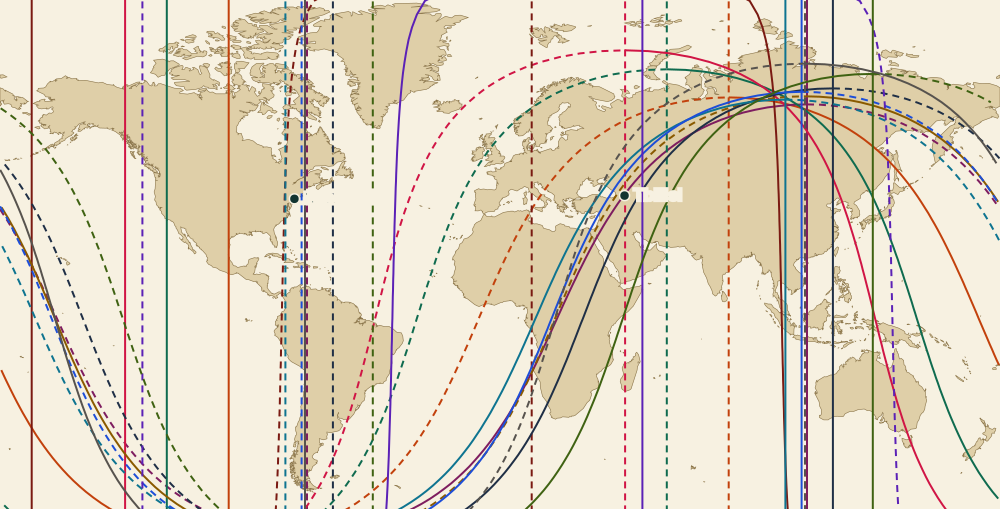
The result page has 4 parts, and all of them are free.
Your first city and the reason
At the top is the city your lines point to first, along with the lines that put it there and how far away each one runs. For Maya (born June 10, 1990, at 2:30 PM in New York), that is Tbilisi, Georgia, with Venus underfoot at 18 km (11 mi) and the Moon rising at 22 km (14 mi). Astrologers connect Venus underfoot with affection and enjoying life at home, and the Moon rising with emotional safety and daily habits.
A first city for each of 4 goals
The same lines can point to different places depending on what you want. You can switch between overall, love, career and home. Maya's love and home answers are also Tbilisi, while her career answer is Boston, where the Jupiter overhead line runs 72 km (45 mi) away. If you want to see how the weights behind this work, How we calculate lists all of them.
The map itself
Pick a body under the map to see only its lines, instead of all 48 at once. The default drawing method follows where each body really stood in the sky (in mundo), and you can change to the Zodiacal method to compare. Select any point on the map to read the lines near it.
A lookup for any place
Type a city, town or village, and you see its nearest lines. The search covers about 226,000 places, far more than the 400 or so cities used for the rankings. You can also see your rising sign in any city, and a full relocation chart for it.
Goals: what each one looks at and how the calculator helps
Pick the goal first, because the same lines are weighed differently for each one. The weights are our own and are all listed on How we calculate.
| Goal | What it looks at | How this calculator helps |
|---|---|---|
| Overall | The average of love, career and home | Names one first city across all three, then lets you switch goals to compare |
| Love | Venus counts most, then the Moon, and the setting line (DS) counts most among the 4 kinds | Names the first city for love, with the lines behind it and their distances |
| Career | Jupiter counts most, then the Sun, and the overhead line (MC) counts most among the kinds | Names the first city for career. For Maya it is Boston, with Jupiter overhead 72 km (45 mi) away |
| Home | The Moon counts most, then Jupiter and Venus, and the underfoot line (IC) counts most among the kinds | Names the first city for home. For Maya it is Tbilisi, with Venus underfoot at 18 km (11 mi) and the Moon rising at 22 km (14 mi) |
A few bodies count against a goal. Saturn and Pluto, for example, lower a city's love score when their lines run close. The paid city report lists 20 cities for each of the 4 goals, where the free calculator names the first.
How to read distances, crossings and range
How strongly a planetary line applies to a city depends on kilometer distance, nearby line crossings, and the full range of lines around that spot.
Distance in kilometers
Select a place on the map or search for a city. Each line near it appears as a name and a distance, such as Venus underfoot: 18 km. The name is the body and the kind of line. The distance is the shortest route from the place to the line. What each line stands for is in Line Meanings, and how to read an astrocartography map walks through a whole map.
How far a line reaches
Astrologers do not share one range, so the calculator works with numbers. It lists every line within 1,000 km (621 mi) of the place. When it picks a first city, a line counts in full at 0 km, 92% at 100 km (62 mi), 37% at 350 km (217 mi) and 2% at 700 km (435 mi). Past 1,000 km it counts for nothing. If no line is within 1,000 km, the place says so and adds that this is not bad: it has no strong pull either way.
Crossings
Two lines can run near each other, and a city close to both lists both, each with its distance. In the map options there is also a switch for crossings, called parans. It lists latitudes where 2 of your highlighted planets reach their lines at the same moment, all the way around the world. It shows latitudes and the 2 planets, not cities.
The calculator does not score a crossing as better. The first-city score adds up every line by its weights, and since some bodies count against a goal, 2 lines together can lower a score as well as raise it.
When your birth time is only close
In the map options you can say how sure you are of your birth time: exact, or within 15 minutes, 30 minutes, 1 hour or 2 hours. The map then shades bands to show where each line could sit, and your best city can change inside that range.
Free map and paid report
Everything above is free. You do not need to sign in.
The paid city report is a different product. It gives you the lists behind each first city: 20 ranked cities for each of overall, love, career and home. For every city it explains the lines that count most for that goal, and it shows your rising sign and Midheaven there. You can save it as a PDF. It is a one-time payment, and the price is shown in your currency before you pay.
A simple way to decide: if you came to check a few places, the free calculator is enough. If you want to compare many options side by side or keep a copy, the report is for that.
If you do not know your birth time
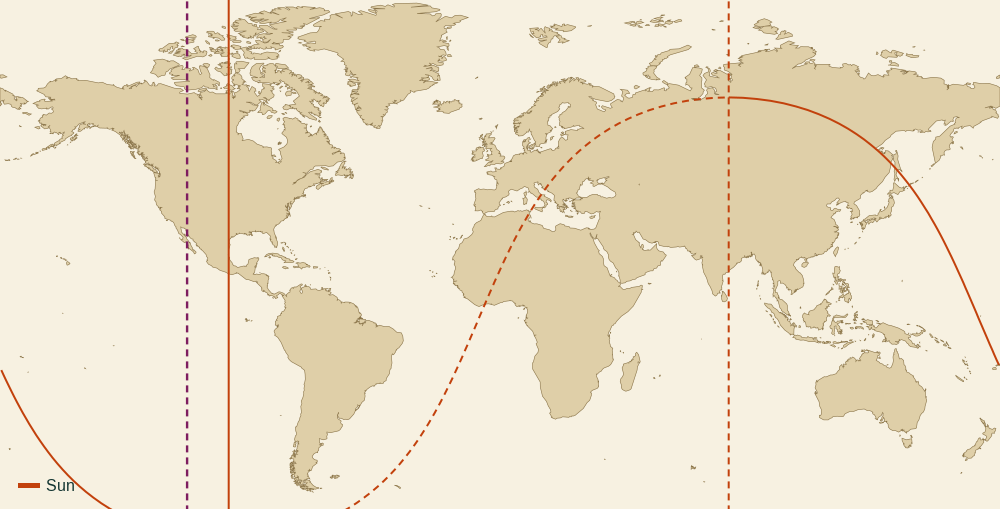
Choose the option for not knowing it. The calculator then draws the lines for 12:00 PM (noon) local time and treats the map as an illustration. It does not name a first city, because a name would suggest more certainty than the data holds. Lines move about 1 degree for every 4 minutes of birth time, which is about 111 km at the equator, so a wrong guess can shift a whole map.
Some ways to get closer to the real time:
- look for a birth certificate or a hospital record, which often has the time
- ask a parent or relative who was there
- if all you have is a time that looks rounded, such as exactly 2:00 PM, treat it as an estimate and try a few times on either side
Try 2 or 3 nearby times and watch what holds. Every line moves with the birth time, because the Earth turns about 15° of longitude in one hour. In Maya's case, changing the time by one hour moves the first city from Tbilisi to Istanbul. If your first city stays the same across your range of guesses, you can trust it more. If it jumps, treat the result as a prompt for exploring several places.
When to trust the result
The two parts of the result deserve different kinds of trust. The positions of the lines are astronomy. Compared with a standard reference across 3,001 moments, the largest difference in line distance was 0.633 km (0.4 mi), and the full test is on the accuracy page. Their meanings are a symbolic tradition, without scientific evidence. That is why the calculator says "astrologers connect this with" and does not claim that a place will change your life.
What the result needs from you is an accurate birth time and a correct birth place. If a line sits near a city by only a few hundred kilometers, it can easily slip to the other side with a small change in time. So read the closest lines first, and give less weight to those far away.
Then use the result as a starting point for your own research. The calculator can say which places sit near which lines. It cannot say what a place costs, what its rules are for newcomers, or whether you would like the weather. Those parts are yours to check, ideally with a short visit.
Calculator or consultation
This calculator works out the lines and writes each note from a fixed set of line meanings. No person reads your map, and there is no conversation. That keeps the result the same each time you enter the same details.
A consultation with an astrologer works differently. The person can ask about your situation and weigh the lines against your life. If you want one, prepare 3 things first: your birth record, your map and a single question. Ask about one place at a time.
A calculator result is a fair starting point for that talk. It does not replace it, and neither one can promise an outcome.
Ways to use it
Beyond finding your own best cities, the calculator works for comparing partners, testing short trips, and checking specific neighborhoods or target regions.
Compare two or more people
Because no account is needed, you can run the calculator for a partner, a friend or a family member and compare the first cities. Each person gets their own map from their own birth moment. Do not expect the lists to match even for people born on the same day, since time and place both move the lines.
Check a trip, not only a move
You can look up a city you plan to visit for a week or a season. A short stay is an easy way to test whether the theme of a nearby line rings true.
Check where you live now
Look up your current city and see what the nearest lines are. If none run close, that is normal, since 48 lines leave plenty of space between them. Astrologers would read it as no one theme standing out, not as a bad sign.
FAQ
Is this astrocartography calculator free?
Yes. The map with all 48 lines, your first city and its reasons, the first city for each of 4 goals and the lookup for any place are free, and you need no account. An optional paid report adds the top-20 city lists for each goal.
What do I need to enter?
Your birth date, birth time and birth place. That is all. No name or gender is asked for, and you do not need to find your time zone, because the calculator works it out from the place and year.
What is an astrocartography chart calculator doing differently from a birth chart calculator?
A birth chart is drawn for your birthplace only. This calculator uses the same birth moment and draws it across the whole world as 48 lines. Then you can read the lines near any city. For one city's chart, use the [relocation chart](/relocation-chart).
Does it work as an astrocartography map generator?
Yes. It generates a map with 4 lines for each of 12 bodies, and you can switch bodies on and off. You can also choose between 2 drawing methods, in mundo and Zodiacal. In mundo is the default.
What if I do not know my birth time?
Choose the not-knowing option. The map is then drawn for 12:00 PM (noon) local time and works only as an illustration, so it does not rank cities. Lines move about 111 km at the equator for every 4 minutes, so a close guess helps.
How many cities does it check?
The rankings look at about 400 cities that are large or well known, plus a list of popular long-stay places. The lookup is wider and covers about 226,000 places, so you can check a small town that never appears in a ranking.
Is my birth information saved?
If you are not signed in, the server does not keep your birth details after the calculation. They are not put in the web address. Your browser saves them so you do not have to type them again next time.
Is astro mapping the same as astrocartography?
Yes. Astro mapping, astromap and astromapping usually mean astrocartography: drawing the planet lines from your birth moment onto a world map. This calculator does exactly that.
How accurate is the calculation?
The line positions matched a standard astrology reference to within 0.633 km (0.4 mi) across 3,001 moments. What the lines mean is a symbolic tradition without scientific evidence, so use the result as a starting point. See [How we calculate](/method) for the tests.
How close do I need to be to a line?
There is no single distance that astrologers agree on. The calculator lists every line within 1,000 km (621 mi) of a place, with its distance. For the first-city score, a line counts in full at 0 km, 37% at 350 km (217 mi) and nothing past 1,000 km. See [How we calculate](/method).
What are crossings (parans) on the map?
Parans are latitudes where 2 of your highlighted planets reach their lines at the same moment. You can switch them on in the map options, and they show latitudes and the 2 planets. They are not scored as better than other places. The score adds up each line by its own weight.
What if my birthplace is not in the list?
Pick the nearest larger city in the same time zone. A town 30 km away moves each line by roughly that distance, which is small next to a birth time that is wrong by an hour. If your birthplace sat near a time zone border, check a birth record first.
Related tools
Line Meanings
Every line is a pairing of one body and one angle, and this page explains both halves, with examples from a real map.
How to Read Your Map
Draw your own map above, then follow 5 steps that turn a tangle of lines into a plain reading of any one place.
How we calculate
Here is how each line is calculated, what our tests found, and how a city earns its place, with the numbers left in.
City Report
The city report takes the map you draw for free and adds the top-20 lists. It also explains what the lines near each city mean, and gives your rising sign in each one.
Career Map
Enter your birth details and the map sorts cities by the lines astrologers tie to work, with the overhead line counting most. You do not need to know what any line means, because the result names your first city and the lines behind it.
Love Map
Enter your birth details and the map sorts itself by the lines astrologers tie to affection. You do not need to know what any line means.
Sites Compared
We read the public pages of 5 astrocartography sites on November 7, 2026, and set what each offers for free next to our own.
Where Should I Live
Enter your birth date, time and place, and the map names the city your lines point to first, with the reasons behind it.