Sun line in astrocartography: what each of the 4 lines points to
Your Sun lines mark the places where the Sun was rising, setting, overhead or underfoot at your birth. Astrologers connect them with identity, self-expression, vitality and being seen. This page explains each line, how near it must be to count, and how this site's rankings weigh the Sun, mostly for career. Then you can draw your own map above.
How it works
Draw your map
Enter your birth date, time and place. All 48 lines appear, and you can switch the lines on and off body by body to leave only the Sun.Select a place and read the nearest line
Choose a city that matters to you. See which Sun line is closest, which angle it is and how many kilometers away it runs.Compare with the other lines nearby
Check for a Jupiter, Venus or Moon line close to the same place, and read the closest line first. The tool writes out what astrologers connect each one with.
A Sun line in astrocartography marks places where the Sun was on one of the 4 angles at your birth. Astrologers connect these lines with identity, self-expression and vitality. Sun rising points to presence and confidence, Sun setting to close one-to-one ties, Sun overhead to visibility and a leading role at work, and Sun underfoot to feeling at ease at home. On this site the Sun has the second largest career weight of any body, behind Jupiter.
What a Sun line is
The Sun has 4 lines on your map, one for each angle: rising, setting, overhead and underfoot. Each line traces the places on Earth where the Sun stood at that point of the sky at the moment you were born. Where the lines run is astronomy. What they mean comes from astrological tradition, and nothing scientific shows that living near one changes your life.
Astrologers treat the Sun as the centre of a chart. They connect it with identity, self-expression, vitality and the wish to be seen for who you are. A Sun line, in that tradition, marks places where those themes are said to come forward. Some people describe a place like that as bright and energizing. Others find the attention and pace tiring, and would sooner be somewhere less exposed. Both are fair readings of the same line.
This page does not tell you what will happen. It sets out what astrologers connect each Sun line with and how this site counts it, so you can decide how much weight to give it.
The 4 Sun lines, one at a time
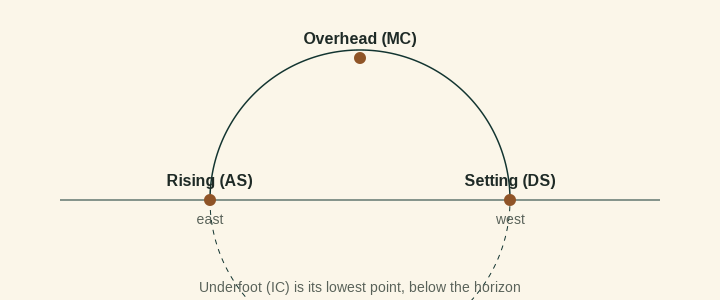
The Sun supplies the theme, and the angle decides which part of life it is tied to. Astrologers link the four Sun lines with these things:
- Sun rising: how you come across, with a strong sense of presence, confidence and a wish to start things in your own way
- Sun setting: close one-to-one ties, such as partners, clients and collaborators, where the other person tends to be seen as bringing out your own light
- Sun overhead: a public side, with visibility, recognition and a leading role at work, which is why this line comes up so often in career readings
- Sun underfoot: a private base, where the Sun's warmth is tied to home, roots, family and feeling at ease as yourself
Astrologers do not all agree on which of the four is the easiest to live with. Many look at the overhead line first, because it is the one most tied to being seen. The underfoot line is the quietest, since it shows up in private life more than in anything other people notice. For the other eleven bodies, Line Meanings covers all 12 in the same way, and the MC line page looks at the overhead angle for every body.
How near a Sun line has to be
Distance matters as much as the line itself. This site counts a line that passes through a city in full, and the share falls off fast as you move away. A line 100 km (62 mi) off still counts for 92%, and one 350 km (217 mi) off counts for 37%. Beyond 1,000 km (621 mi) it is dropped.
So a Sun line 20 km (12 mi) from a city is, as astrologers see it, part of that city's character. A Sun line 600 km (373 mi) away is a faint background note, counted at about 5%. When you look at a place, start with the nearest line and check how far away it really is. How we calculate has the full table.
How the Sun counts in your city ranking
The Sun carries real weight in the site's rankings, and most of it lands on career. Its career weight of 0.8 is the second largest of any body, behind only Jupiter. Its love and home weights are smaller. The weights are our own, set with astrological tradition as the guide, and the method page publishes them in full:
| Goal | Sun weight |
|---|---|
| Love | 0.3 |
| Career | 0.8 |
| Home | 0.3 |
The angle then scales that weight. For love the angle weights are 1 for rising, 1.2 for setting, 0.5 for overhead and 0.7 for underfoot. For career they are 0.8, 0.5, 1.3 and 0.3, and for home 0.8, 0.6, 0.3 and 1.3. Multiplying body weight by angle weight gives the most a Sun line can add to a city before distance is applied:
| Line | Love | Career | Home |
|---|---|---|---|
| Sun rising | 0.3 | 0.64 | 0.24 |
| Sun setting | 0.36 | 0.4 | 0.18 |
| Sun overhead | 0.15 | 1.04 | 0.09 |
| Sun underfoot | 0.21 | 0.24 | 0.39 |
Read the table one goal at a time. For career, Sun overhead is the biggest entry at 1.04, in line with the habit of looking at that angle for public life and work. For love, the setting line leads at 0.36, because astrologers tie that angle to one-to-one ties. For home, the underfoot line leads at 0.39. The overall ranking averages the three goals, so a Sun line near a city lifts it most on the career list.
This is a scoring choice, not a promise about any place. A city that the ranking puts lower can still suit you better, and the list works best as a set of themes to think over.
An example from Maya's map
Maya was born on June 10, 1990, at 2:30 PM in New York. Her Sun overhead line passes 9 km (6 mi) from Austin in Texas. At that distance the line counts for about 100%, so on the career goal it adds roughly 0.8 × 1.3 × 1.0 = 1.04. On the love goal the same line adds about 0.3 × 0.5 = 0.15, and on the home goal about 0.3 × 0.3 = 0.09. Austin comes third on her career list, after Boston and Québec, which sit near her Jupiter overhead line.
Her map also shows how little a far-off line counts. If Maya lived in Chicago, the closest line there would be Sun overhead at 826 km (513 mi). At that distance it counts for well under 1%, so it barely touches the score. A line can be the nearest one to a place and still say very little about it.
One more point is easy to mix up. A Sun line is not the same as your Sun sign. Maya's Sun is in Gemini in every city on Earth, because the sign depends on the date you were born, not on the place. The lines show where on the map the Sun was on an angle, and the relocation chart shows what changes in the houses. In Tokyo, for example, Maya's Sun moves into house 1.
When a Sun line sits next to other lines
Sun lines often share a place with other lines, and it helps to read them as a pair. A few common pairings, as astrologers describe them:
- Sun with Jupiter on the overhead angle: confidence meets growth and wider chances, which astrologers read as a visible role that has room to expand
- Sun with Venus: self-expression joins warmth and enjoyment, a mix tied to charm, creative work and easy company
- Sun with Mercury: your own voice joins quick thinking and talk, so speaking or writing may be how you become known
- Sun with Saturn: a strong wish to lead meets patience and structure, which astrologers read as a place for steady work on something that lasts
- Sun with Pluto: identity meets intensity and change, which some people find energizing and others find heavy
When two lines sit at about the same distance, give each one equal weight. If one runs much closer, it leads and the other is a background note. The Jupiter lines and Saturn lines pages cover two of those partners in more depth.
Why your Sun lines match across maps
The Sun is the easiest body to compare between sites. This site draws lines in mundo by default, which follows the body's real position in the sky, and it can switch to Zodiacal, which uses only the degree along the zodiac. For the Sun the two agree exactly. If another site draws your Sun line somewhere different, the cause is usually a different birth time, a time zone slip, or a different date, not the drawing method.
Birth time is the biggest lever. The Earth turns about 15° of longitude in one hour, and every line moves with it, so a time that is off by even a few minutes shifts a Sun line. A difference of 4 minutes moves each line by about one degree, roughly 111 km (69 mi) at the equator. That is enough to carry a Sun line past a city. If your time is only a guess, try a few times on either side and see which cities hold.
Reading a Sun line with care
Sun themes sound flattering, so they are easy to overread. Confidence, visibility and vitality sound good in almost any city. A Sun line is not proof that you will feel more confident there. It is a theme astrologers pay attention to, and it gives you a question to carry, not a forecast.
It also helps to keep a theme apart from a plan. A Sun line near a city is a reason to look at that city more closely. It does not replace what you know about work, cost of living, language, visas and the people around you. A map of lines cannot see those things, and they usually matter more than any line.
Having no Sun line near a place tells you only that Sun themes are not especially stressed there. Astrologers would not read that as good or bad. Your birth chart is the same wherever you stand.
Where a Sun line asks you to be seen
The Sun is the body of identity, so astrologers read its lines as places where self-expression comes forward. At home, the underfoot line is tied to roots. They connect it with feeling at ease as yourself among family, and with a wish to build a home that reflects who you are. A person who has always lived to meet family expectations may notice this more.
Among other people, the setting line is read as meeting those who reflect your own light back to you. The risk astrologers mention is leaning on a partner for your sense of self, so they suggest asking what you bring to the tie.
In public, the overhead line gets most of the attention, with recognition, leading roles and putting your name on what you make. The rising line is read as a taste for starting things your own way, which suits people who work for themselves.
A short stay on a Sun line is often described as bright and lively. Some people come home refreshed, and others find the pace tiring after a week. Astrologers also mention these lines for a place where you want to stand out in a program or a competition.
Comfort with being seen
Every Sun line carries some sense of visibility, so it helps to ask how you feel about attention. Some people thrive when others notice them. Others work best out of sight, and a place where they would be asked to lead may feel like a burden.
A simple test is to picture a normal week in the city. If it includes presenting, meeting strangers or taking the first step, would that feel like fun or like a chore? Your reaction tells you more about a Sun line than the line does.
Sun ASC and Sun MC
The rising and overhead lines both carry visibility, but in different ways. The Sun rising line is about how you come across in person, with presence, a clear first impression and a wish to act on your own. The Sun overhead line is about your public role, with standing, reputation and the part you play in work.
Put simply, rising is who you seem to be to the people in front of you, and overhead is what you are known for. A person with both lines near one city may find the two blend. Someone with only the overhead line may find the work side leads while daily life stays quieter.
Your natal Sun and the line
The line tells you where, and your natal Sun tells you what kind of Sun you bring. Your sign and house of birth stay the same on every map, so a Sun in a quiet, private sign still carries that tone near a Sun line. Astrologers say the line turns up the volume on what is already there.
What changes with place is the house your Sun falls in, which a relocation chart shows for any city. If a Sun line runs near a city and the Sun lands in a house about work there, astrologers read the two as pointing the same way.
Sun lines and parans
If you switch on crossings in the map options, horizontal dashed lines mark parans, the latitudes where two highlighted bodies reach their lines together. A paran with the Sun is read as the Sun theme meeting another body across a whole band of latitude, not just along a single line.
Astrologers who use parans treat them as a second layer. They are not a replacement for lines, and you can read your Sun lines without them. The reading guide shows how to tell a paran from a line.
Living on a Sun line for the long term
Nothing in the tradition says you cannot. Most astrologers see a Sun line as a place that feels most natural when you are doing work you care about, and flatter when you have no direction there. Over years, the place also changes with you, so a city that felt lively at 25 may feel loud at 45.
If you are thinking about a move for good, try a long stay of a few months first. Notice whether you feel more like yourself or more on show, and use your answer to decide.
How to look at your own Sun lines
To see where yours run, you need your birth date, time and place. Then:
- Draw your map and turn on only the Sun lines, using the switch for each body. The Sun is drawn in burnt orange
- Select a city that matters to you, such as where you live now or a place you are thinking about
- Check which Sun line is closest, which angle it is, and how many kilometers away it runs
- Read what astrologers connect that line with, and ask whether the theme fits what you want
- Look at the Jupiter, Venus and Moon lines nearby to see what else is in the picture
If you are mostly after a place for work and visibility, the career side of the guide to choosing where to live compares the goals, and the reading guide walks through a full example.
Questions to ask yourself
A line gives you a theme. These questions turn it into something you can use:
- do I want a place where I am seen and noticed, or one where I can keep a lower profile?
- is there a role, project or goal where I want more visibility?
- how do I feel in bright, busy places where people expect me to take the lead?
- would I want a Sun city for a visit, for a year or for good?
- when I visit, do I feel more like myself, or more on show?
Your answers matter more than the line does. If you want a place that supports a visible role, a Sun overhead line near a city may be a reason to visit and take a look. If you want rest and ease, you may lean toward a Moon or Venus line instead, and the Venus lines page shows how those are weighed.
FAQ
What does a Sun line mean in astrocartography?
Astrologers connect it with identity, self-expression, vitality and being seen. The angle decides the part of life: rising for how you come across, setting for one-to-one ties, overhead for public life and work, underfoot for home. It is a symbolic theme, not a forecast.
What is the Sun MC line?
It is the Sun overhead line, the places where the Sun stood at the top of the sky at your birth. Astrologers link it with visibility, recognition and a leading role at work. On this site it is the Sun's biggest entry for career, at 1.04 before distance.
Is a Sun line good for career?
Astrologers often look at Sun overhead first when they think about visible work. On this site the Sun has a career weight of 0.8, the second largest of any body after Jupiter. That is a scoring choice, not a promise about any place.
How much does the Sun count in the city rankings?
The Sun has a weight of 0.3 for love, 0.8 for career and 0.3 for home. The angle then scales it, from 0.09 for Sun overhead on home up to 1.04 for Sun overhead on career. The method page publishes every weight.
How close does a Sun line need to be?
The closer, the more it counts. A line through a city counts in full, one 100 km (62 mi) away counts for 92%, and one 350 km (217 mi) away for 37%. Past 1,000 km (621 mi) it is not counted at all.
Is a Sun line the same as my Sun sign?
No. Your Sun sign comes from your birth date and is the same in every city. A Sun line shows where on the map the Sun stood on one of the 4 angles at your birth, so it depends on your date, time and place.
Why does another site show my Sun line somewhere else?
The drawing method is not the cause for the Sun, because in mundo and Zodiacal agree for it. Look at the birth time and time zone first. Every line moves about 15° in one hour, and 4 minutes moves it about 111 km (69 mi) at the equator.
Which Sun line is strongest for love and home?
For love, Sun setting leads at 0.36 before distance, since astrologers tie that angle to one-to-one ties. For home, Sun underfoot leads at 0.39. Both numbers are modest next to the career figure for Sun overhead.
Can I see only my Sun lines on the map?
Yes. Lines can be switched on and off body by body, so you can leave just the Sun, or the Sun and Jupiter. Selecting a place also lists every line within 1,000 km (621 mi) with its distance.
What is the difference between Sun ASC and Sun MC?
Astrologers tie the Sun rising line to how you come across in person, with presence and a clear first impression. The Sun overhead line is tied to your public role, with standing and reputation at work. Rising is who you seem to be, and overhead is what you are known for.
Can I live on a Sun line long term?
The tradition does not forbid it. Astrologers say a Sun line suits people who like being visible and have work they care about there. Others find the attention tiring. Try a stay of a few months first and notice whether you feel more like yourself or more on show.
What does a Sun DSC line mean?
The Sun setting line is tied to close one-to-one ties, such as partners, clients and collaborators. Astrologers say people met there tend to be seen as bringing out your own light. The caution they give is to avoid leaning on others for your sense of self.
Does my natal Sun position change how a Sun line feels?
Astrologers say it does, since the line turns up the volume on what is already in your chart. Your Sun sign stays the same in every city. What changes is the house the Sun falls in there, which a relocation chart shows.
Where should your next chapter unfold?
Match your current priorities with your natal planetary lines in under a minute.
What are you optimizing for right now?
Related tools
Line Meanings
Every line is a pairing of one body and one angle, and this page explains both halves, with examples from a real map.
MC Lines
Your MC lines mark the places where each planet stood at its highest point in the sky when you were born. Astrologers, who also call this the Midheaven line, connect it with career, public image and reputation. This page covers what each planet on the MC points to, how close a line has to run, and how MC lines count in the rankings. Then you can draw your own map above.
How to Read Your Map
Draw your own map above, then follow 5 steps that turn a tangle of lines into a plain reading of any one place.
How we calculate
Here is how each line is calculated, what our tests found, and how a city earns its place, with the numbers left in.
AC Lines
Each AC line marks the places where one planet was rising over the eastern horizon when you were born. Also called the Ascendant or rising line, it is one that astrologers connect with self-image, first impressions and how you start things. This page covers what each planet on the AC points to, how close a line has to run, and how AC lines count in the rankings. Draw your own map above to see where yours fall.
Astrocartography Calculator
This astrocartography calculator takes your birth date, time and place. It draws your 48 planetary lines on a world map and names the city your lines point to first, with the reasons. It is free and needs no account. You can also look up any place to see the lines near it.
Career Map
Enter your birth details and the map sorts cities by the lines astrologers tie to work, with the overhead line counting most. You do not need to know what any line means, because the result names your first city and the lines behind it.
Love Map
Enter your birth details and the map sorts itself by the lines astrologers tie to affection. You do not need to know what any line means.