DC line astrocartography: what each planet's Descendant line points to
Your DC lines mark the places where each planet was setting on the western horizon when you were born. Astrologers, who also call this the Descendant or setting line, connect it with partners, one-to-one ties and working together. This page covers what each planet on the DC points to, how close a line has to run, and how DC lines count in the rankings. Then you can draw your own map above.
How it works
Draw your map
Enter your birth date, time and place. All 48 lines appear, and the dashed, curved ones are your DC lines.Select a place and read the nearest DC line
Choose a city that matters to you. See which DC line is closest, which body it belongs to and how many kilometers away it runs.Switch to the love goal
See which cities your DC lines lift in the love list, with the lines and distances behind each one.
A DC line in astrocartography, also called a Descendant or setting line, is a curved line that marks where a body was setting on the western horizon at your birth. Astrologers connect it with partners, one-to-one ties and working together. Venus on the DC points to affection, the Moon to closeness and Saturn to serious commitment. On this site the DC counts most for love, at 1.2, and how close the line runs matters.
What a DC line is
A DC line is a curved line on the map. DC is short for Descendant, and astrologers also call it the setting line. It is the line that astrocartography draws for the western edge of the sky. For each body, it marks every place on Earth where that body was going down below the western horizon at the moment you were born. Each of the 12 bodies has one, so your map has 12 DC lines out of 48 lines in all. On this site the code is DS, and the line is dashed.
The positions are astronomy. The meanings come from a symbolic tradition, and no scientific evidence shows that living near a line changes anything in your life.
Astrologers connect the Descendant with other people: partners, close friends, clients and anyone you deal with one to one. They also tie it to the seventh house, the house of partnership. So a DC line is read as a place where a planet's theme comes into your closest dealings with others. This page covers the theme of each body on the DC, how close a line has to run, how the site counts DC lines in its rankings, and how to find yours.
DC line, Descendant sign and the AC line
Three things are easy to mix up:
- the Descendant sign is one sign and degree on the western horizon for one place, such as your birthplace
- a DC line is a curve across the whole map for one body
- the AC line is the matching line for the eastern horizon, where that same body was coming up
The Descendant sign sits opposite your rising sign, and you can look up your rising sign with the rising sign calculator. A DC line is a different thing. It follows one body, such as Venus, around the globe. The AC line is the other half of the pair, and astrologers connect it with first impressions and how you meet new situations. For that line, see AC line astrocartography. For how all four line codes fit together, see Map Symbols.
The four angles as a frame
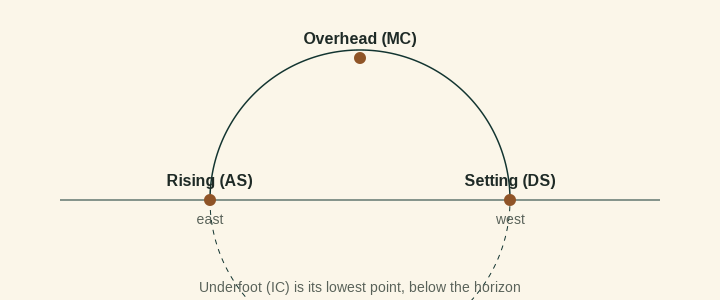
Astrologers sometimes describe the 4 angles as the frame of a chart. The horizon splits the sky into a part above you and a part below. The meridian splits it into an east side and a west side.
The DC sits on the western horizon, exactly opposite the rising point. The MC marks the top of the sky and the IC the bottom. Read this way, the rising and setting angles are a pair, and so are the overhead and underfoot angles.
The traditional reading says the rising side is about you, and the setting side is about the person across from you. That is why a DC line is read for partners, clients and close friends, and not for how you come across.
How to find your Descendant sign
Your Descendant sign is the sign opposite your rising sign. If your rising sign is Aries, your Descendant sign is Libra. The pairs are Aries and Libra, Taurus and Scorpio, Gemini and Sagittarius, Cancer and Capricorn, Leo and Aquarius, and Virgo and Pisces.
Your birth time decides it. The rising sign changes about every 2 hours as the Earth turns, so a time that is a few hours off can give a different Descendant. You can look up your rising sign with the rising sign calculator, then take the opposite sign.
Astrologers call the Descendant the cusp of the 7th house, the house of one-to-one partnerships. They read it for what you look for in others, such as a marriage partner or a business partner. The sign gives the style, and a DC line then shows where on the map that setting is strongest.
The pairs of angles also split the sky in 2 ways. The rising and setting angles divide the chart into an upper half, read as your dealings with the world, and a lower half, read as your inner life. The overhead and underfoot angles divide it into an east side, read as your own actions, and a west side, read as the influence of other people. These are traditional readings and not measurements.
The DC line of each planet
The body gives the theme and the DC gives the setting, which is the space between you and one other person. Here is what astrologers connect each pairing with:
- Sun on the DC: identity and confidence shown through close ties, with a pull toward partners who stand out
- Moon on the DC: care and closeness in one-to-one ties, with a wish for a partner who feels like emotional safety
- Mercury on the DC: talking things through, with partners and clients who are good conversation, and agreements made by discussion
- Venus on the DC: affection, charm and a pull toward harmony with others, which is why this is often the first line astrologers check for love
- Mars on the DC: energy and competition in one-to-one dealings, with a lively give and take and sometimes disagreement
- Jupiter on the DC: generous, encouraging partners and room for ties to grow
- Saturn on the DC: serious commitment, boundaries and duty in a relationship, with ties that are built slowly
- Uranus on the DC: unusual, independent or sudden ties, and a need for freedom inside a partnership
- Neptune on the DC: idealism and deep sympathy toward others, with a risk of blurred boundaries
- Pluto on the DC: intense, transforming ties, with strong feelings about closeness and control
The North Node and Chiron also have DC lines. The North Node is not a planet but a calculated point. It sits where the Moon's orbit crosses the ecliptic as the Moon moves north, and astrologers read it as a direction you are invited to grow in. On the DC, astrologers connect it with growing through the people you meet. Chiron is a small object whose orbit lies mostly between Saturn and Uranus, and astrologers connect it with tender spots and the understanding that can come from them. On the DC, that points to old feelings about closeness. For the other three angles of each body, see Line Meanings.
Astrologers do not all agree on how to rank these. Some call Venus and Jupiter the warmest DC lines, and Saturn and Pluto the most demanding. Treat that as an opinion, since what a line feels like depends on you.
How close a DC line has to be
A DC line only matters for a city if it runs near it. On this site, a line through a city counts in full, and the share falls off quickly with distance. At 100 km (62 mi) it still counts for 92%. At 350 km (217 mi) it counts for 37%, and past 1,000 km (621 mi) it is not counted at all.
A DC line bends, so the gap is the shortest distance from the city to the curve, not an east-west distance. A Venus DC line 20 km (12 mi) from a city is part of that city's character, as astrologers see it. The same line 600 km (373 mi) away is a faint background note. The full table is on How we calculate.
How DC lines count in the rankings
Each city gets a score for love, career and home. One line adds the body weight times the angle weight times the distance share. These are the DC weights:
| Goal | DC weight |
|---|---|
| Love | 1.2 |
| Career | 0.5 |
| Home | 0.6 |
For love, the DC is the largest angle weight there is, which matches the astrological habit of looking at the setting line for partners. For career, the DC is second to last of the four angles, and the overhead line leads. For home it is third of the four, and the underfoot line leads.
Because the body weight multiplies the angle weight, each body's DC line adds a different amount. This table shows a line right through a city, for each goal:
| Body on the DC | Love | Career | Home |
|---|---|---|---|
| Sun | 0.36 | 0.40 | 0.18 |
| Moon | 0.60 | 0.05 | 0.60 |
| Mercury | 0.12 | 0.225 | 0.06 |
| Venus | 1.20 | 0.10 | 0.36 |
| Mars | 0.30 | 0.20 | -0.36 |
| Jupiter | 0.54 | 0.50 | 0.42 |
| Saturn | -0.72 | 0.175 | -0.24 |
| Uranus | -0.24 | 0.05 | -0.30 |
| Neptune | -0.24 | -0.10 | -0.15 |
| Pluto | -0.60 | -0.05 | -0.36 |
| North Node | 0.24 | 0.125 | 0.09 |
| Chiron | -0.24 | -0.075 | -0.12 |
Venus leads in the love column, followed by the Moon and Jupiter. Those three add most to a city in the love list, while Saturn, Pluto, Uranus, Neptune and Chiron count against it. These are our own scoring choices, set with astrological tradition as the guide, and they are not warnings about any place. A Saturn DC line may suit someone who wants a serious, lasting tie, and that person may reasonably like a city that the list puts lower. The full weights are on the method page. The overall ranking is the average of the three goals.
An example from Maya's map
Maya was born on June 10, 1990, at 2:30 PM in New York. Several of her DC lines show up in the sample figures on this site.
Her Venus DC line is 107 km (66 mi) from Brasília, which is second on her love list. The body weight for Venus in love is 1, the DC weight is 1.2, and at 107 km the distance share is about 91%, so the line adds about 1.09 to Brasília. Montevideo is third, with the same Venus line at 113 km (70 mi), and it adds about 1.08. Seen by an astrologer, Venus on the DC pairs affection with one-to-one ties.
Her Pluto DC line is 60 km (37 mi) from Tokyo. At that distance the line counts for about 97%, and with a love body weight of -0.5 it takes about 0.58 off Tokyo in the love list. Astrologers connect Pluto on the DC with intense, transforming ties, and that is a theme, not a warning. Tokyo can still suit someone who wants that kind of depth.
Her Jupiter DC line runs 214 km (133 mi) from Tbilisi, Georgia, her first city overall. At that distance it adds about 0.37 in the love list. Her Mars DC line is 295 km (183 mi) from New York, where it is one of the 6 lines in the list for that city. Its share is about 49%, so it adds about 0.15 for love and takes about 0.18 off for home.
Notice that one city can carry several lines at once. Looking up any city lists them with their distances, so you can see which DC lines are close and which are only in the background.
Reading several lines near one city
Two or more lines can sit near the same city. Here is a way to read a DC line next to others:
- Venus DC with the Moon on another angle: affection and emotional comfort together, which many astrologers read as one warm theme
- Jupiter DC with a Saturn line nearby: a generous tie held in check by duty, so read the closer line first
- a DC line next to an AC line of another body: how you meet people on one side and what you do with them on the other
- a DC line next to an IC line: ties and home in the same place, so ask which one you want to lead
Where two themes pull in different directions, ask which line is closer and treat the further one as a background note. When both are about the same distance, give them equal weight. It helps to ask what kind of closeness you want in that place.
How to find your own DC lines
You need your birth date, time and place. The time matters, because the Earth turns one degree every 4 minutes and the whole map slides with it. That is about 111 km (69 mi) at the equator, so a rounded birth time can carry a DC line across a city.
Then follow these steps:
- Draw your map and use the switch for each body to leave only the lines you want to study
- Pick the dashed, curved lines, which are the DC lines. The solid curved lines are the AC lines
- Select a city that matters to you, such as where you live now or a place you are thinking about
- Read which DC line is closest, which body it belongs to and how many kilometers away it runs
- Switch to the love goal to see which cities your DC lines lift in the list
If you do not know your birth time, the map draws the lines for 12 noon as an example only and does not rank cities. If no DC line is near a place, that tells you only that no body's theme is especially stressed in your one-to-one ties there. Astrologers would not read that as good or bad.
Questions to ask yourself
Use these questions to turn a line's theme into a decision aid:
- what do I want from the people closest to me in a place like this?
- am I looking for a partner, a business partner, a circle of friends, or none of these?
- when I visit, do the people I meet feel easy or draining?
- do I want a place that stretches me or one that steadies me?
- would I want this place for a year, for a season or for good?
Your answers matter more than the line does. If you want a place that supports your one-to-one ties, a DC line near a city may be a reason to visit and look around. For a longer look at love across the whole map, see astrocartography chart for love, and to compare goals, see the guide to choosing where to live.
FAQ
What is the DC line in astrocartography?
It is a curved line that marks the places where a body was setting on the western horizon at your birth. Astrologers connect it with partners and one-to-one ties. On this site it is called the setting line, and each of the 12 bodies has one.
Is the DC line the same as the Descendant line?
Yes, they are the same line. DC is short for Descendant, and some maps write DS instead. The Descendant sign is different. It is one sign for one place, while a DC line is a curve across the whole map for one body.
What does a DC line mean for love?
Astrologers look at the DC line first for love, since they tie it to partners. Venus, the Moon and Jupiter on the DC are the ones read most for warmth and closeness. It is a symbolic theme, not a forecast, and no line can choose a partner for you.
What is the best DC line?
There is no best one, because it depends on what you are after. In this site's love ranking, Venus counts most, followed by the Moon and Jupiter. Saturn or Pluto on the DC can suit people who want serious commitment or deep change. Test the theme against your own sense of a place.
How close does a DC line need to be?
The closer, the more it counts. On this site a line through a city counts in full, 100 km (62 mi) away it counts for 92%, and 350 km (217 mi) away for 37%. Past 1,000 km (621 mi) it is not counted at all.
What is the difference between a DC line and an AC line?
They belong to the same body, but the AC line marks where that body was rising on the eastern horizon. Astrologers connect the AC with first impressions and the DC with one-to-one ties. See [AC line astrocartography](/astrocartography-ac-line) for the rising side.
How is the DC counted for career and home?
The DC weight is 0.5 for career and 0.6 for home, against 1.2 for love. It counts for a lot less in those two lists. The overhead line leads for career, and the underfoot line leads for home.
How do I find my DC lines?
Enter your birth date, time and place in the map on this page. The dashed, curved lines are the DC lines. Select a city to see the closest one, its body and its distance, and switch to the love goal to see the ranking it affects.
Does my birth time change my DC line?
Yes. The line slides across the map as the birth time changes, by about 1 degree for every 4 minutes. That is roughly 111 km (69 mi) at the equator. Use the most exact time you can find, and try a few minutes either side if you are unsure.
Does a DC line matter only for romance?
No. Astrologers tie the setting angle to one-to-one ties of every kind, such as partners in work, clients, close friends and rivals. Love is one common use, so the DC line for Venus gets the most attention there.
How do I find my Descendant sign?
It is the sign opposite your rising sign. If your rising sign is Aries, your Descendant sign is Libra. Astrologers also call it the cusp of the 7th house, the house of one-to-one partnerships.
Where should your next chapter unfold?
Match your current priorities with your natal planetary lines in under a minute.
What are you optimizing for right now?
Related tools
Line Meanings
Every line is a pairing of one body and one angle, and this page explains both halves, with examples from a real map.
Love Map
Enter your birth details and the map sorts itself by the lines astrologers tie to affection. You do not need to know what any line means.
Map Symbols
Each line on an astrocartography map is a pairing of a body and an angle, and the symbols tell you which. On this map, color names the body, solid or dashed names the angle, and AS, DS, MC and IC are the 4 angle codes. Draw your own map to see them on your birth details.
Venus Lines
Your Venus lines mark the places where Venus was rising, setting, overhead or underfoot at your birth. Astrologers connect them with affection, attraction and enjoying life. This page explains each line, how far away it can be and still count, and how to read it next to a Moon or Jupiter line. Then you can draw your own map above.
AC Lines
Each AC line marks the places where one planet was rising over the eastern horizon when you were born. Also called the Ascendant or rising line, it is one that astrologers connect with self-image, first impressions and how you start things. This page covers what each planet on the AC points to, how close a line has to run, and how AC lines count in the rankings. Draw your own map above to see where yours fall.
Astrocartography Calculator
This astrocartography calculator takes your birth date, time and place. It draws your 48 planetary lines on a world map and names the city your lines point to first, with the reasons. It is free and needs no account. You can also look up any place to see the lines near it.
Career Map
Enter your birth details and the map sorts cities by the lines astrologers tie to work, with the overhead line counting most. You do not need to know what any line means, because the result names your first city and the lines behind it.
Chiron Lines
Your Chiron lines mark the places where Chiron, a small body between Saturn and Uranus, was rising, setting, overhead or underfoot at your birth. Astrologers connect them with sensitive spots and what you learn from them. This page explains each line, how far away it can be and still count, and why this site's rankings count Chiron a little against a city. Then you can draw your own map above.