Local space astrology: which way each planet points from you
Enter your birth details. See the compass direction of every planet at the moment you were born, drawn as lines from your birthplace or from where you live now.
Your local space chart
How it works
Enter your birth details
Add your birth date, time and place. If you have used the map before, your details are already filled in.Pick where to measure from
Start from your birthplace, add where you live now, or tap any spot on the map.Read the directions
See each planet's compass direction and altitude, its line on the map and the cities it points toward.
Local space astrology records the compass direction of each planet at your birth and draws it as a line from one spot. You get 12 directions with their altitude, the lines on a world map and the large cities each line points toward. It is free, needs no account and needs a birth time.
What local space astrology shows
Local space astrology turns your birth chart into compass directions. At the moment you were born, each planet stood somewhere in the sky above your birthplace. A local space chart records that direction for each one and draws it as a line that leaves the place and runs on around the Earth.
This page gives you 12 of these lines, one each for the Sun, the Moon, the planets from Mercury to Pluto, the North Node and Chiron. You get them as a compass, as a table and as lines on a world map. The table also lists the large cities that each line points toward.
Two kinds of people use it:
- people who want to know which way a planet points from their home, a room or a street
- people who want to know which cities lie in the direction of their Venus, their Jupiter or their Saturn
How to read direction and altitude
Each row of the table has two numbers. The direction is a compass bearing, called the azimuth. North is 0°, east is 90°, south is 180° and west is 270°. The table shows the nearest of 16 compass points and the exact degree, so "NE 47°" means a little east of north-east.
The altitude is how high the planet stood. A planet above the horizon has a positive altitude, so "20° above" means it stood 20° over the horizon. A planet below the horizon is shown as "below", such as "7° below". The Earth was in the way at that moment.
A planet below the horizon still has a direction. Its line is drawn the same way as the others. The compass only moves it to the inner ring, so you can see at a glance which planets were up and which were down.
Reading the compass
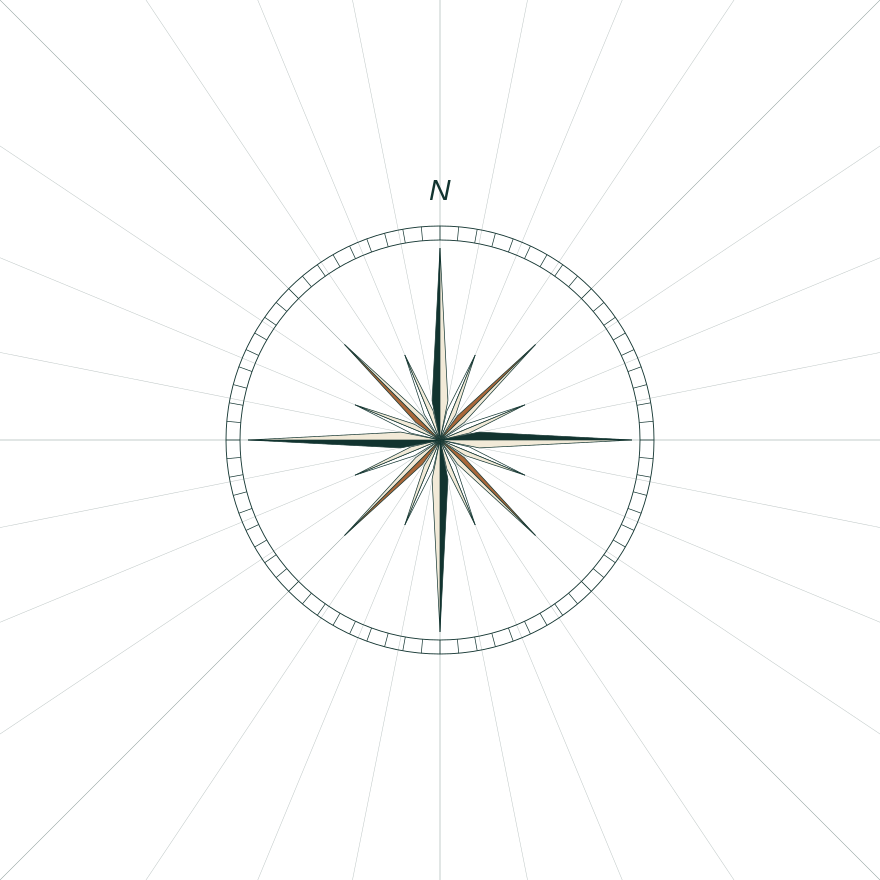
The compass card shows all 12 directions at once, with north at the top. Each planet has a spoke in its own colour. A filled dot on the outer ring means the planet was above the horizon at birth. A hollow dot with a dashed spoke on the inner ring means it was below.
Planets that stood close together in the sky sit close together on the ring, and their lines run side by side on the map. On a computer, hover over a dot to see which planet it is. You can also match its colour to the dot in the first column of the table.
Where you measure from
A local space line starts at a point and radiates out from it, like a spoke of a wheel. Change the point and every direction changes with it, even though the birth moment stays the same. The chart gives you 3 starting points:
- your birthplace, which is the default
- where you live now, if you fill in the optional field
- any spot on the map, by tapping it
The tabs above the map switch between these. Tap the map and a tab for that spot appears, and the compass, the lines and the table are drawn again from there. Your birthplace shows what the sky looked like where you were born. Your home shows which way each planet points from where you spend your days.
Local space compared with an astrocartography map
An astrocartography map asks where on Earth each planet was rising, setting, overhead or underfoot. Its lines are fixed to the globe, so your Venus line runs through the same cities wherever you live. Local space asks a different question: which way did each planet stand from here?
Move house and your astrocartography lines stay where they were. Your local space lines move with you, because they are measured from wherever you are. That makes local space the better fit for a home, a neighbourhood or a trip from where you live, while an astrocartography map suits a choice between countries. The two work well together, and the astrocartography calculator draws the fixed lines.
The lines on the map
On the map each line is a great circle, the straightest path on a sphere. Over a few kilometres it looks like a straight bearing. Over thousands of kilometres a flat map has to bend it, which is why the lines curve and why two lines that start together can end up far apart.
The solid part of a line runs in the direction the planet points. The faint dashed part runs the opposite way, and many astrologers read it as part of the same line. Each line goes all the way round the Earth and comes back to where it started.
The dot marks the point you are measuring from. Drag the map to move around it and use the + and − buttons to zoom.
The cities each line points toward
The last column of the table lists the large cities that lie close to each line. A city is listed when it is within 50 km of the line and in the direction the planet points. The nearest comes first, with its distance from your starting point in km.
The list is drawn from about 400 large cities around the world. Each row shows the first 3, and a "+" link opens the rest. A line can pass over open ocean for thousands of kilometres, so some rows have only a few cities and a row can have none at all. An empty row does not mean anything is wrong. It only means no large city lies on that line.
The same planet can point at very different places from different starting points. A Venus line that crosses central Europe from one city may cross the Atlantic from another. That is why the chart is worth running again from where you live now.
A worked example
Take someone born in Barcelona, Spain, on June 14, 1991, at 7:30 AM. Measured from the birthplace, the Sun points ENE at 69° and stood 11° above the horizon. Saturn points SW at 218° and stood 20° above the horizon. Pluto points WNW at 287° and stood 21° below it.
Venus points NE at 36°, 20° below the horizon, and its line runs to Bern, Zürich and Nuremberg, in that order. The Moon points NE at 52°, and its line reaches Marseille at 338 km, Nice at 489 km and Milan at 724 km. Saturn's line runs south-west and reaches Valencia at 300 km.
Enter the same details and you get the same table, apart from small rounding differences. Then add a place where you live now and compare how the lines change.
What each planet's direction stands for
These are traditional readings. Treat them as prompts, not rules.
- Sun: recognition, confidence and feeling like yourself
- Moon: comfort, family and rest
- Mercury: talking, writing, study and short trips
- Venus: love, friendship, beauty and ease
- Mars: energy, drive and sometimes conflict
- Jupiter: growth, luck and opportunity
- Saturn: work, duty and structure, often hard going
- Uranus: change, freedom and the unexpected
- Neptune: imagination and retreat, and also confusion
- Pluto: intensity and deep change
- North Node: the direction a life tends to grow toward
- Chiron: old hurts and the healing that can follow
Using local space at home
Stand in the middle of your home with a compass and you can map each planet onto a room, a wall or a corner. Measure from where you live now, not from your birthplace. The directions are measured from true north, so use a compass app with a true north setting.
A common approach is to match a room to the planet that suits it. A desk or study goes with the Sun, Mercury or Jupiter, and a bedroom or sitting room goes with the Moon or Venus. Mars and Saturn are read as active and demanding, so people tend to keep them away from the bed.
Treat this as a way to arrange a space with intention, like any other design choice. It does not replace light, safety or comfort, and no direction is bad enough to give up a room you love.
Using local space for travel and moving
The table is also a list of travel ideas. A city on your Jupiter line is read as a place that tends to bring opportunity, and a city on your Saturn line as a place that asks for effort. Because the lines are measured from your starting point, the list tells you which way to go from here.
Measure from where you live now for a trip, and from your birthplace if you are curious about the place you grew up. If you are choosing a city to live in, use local space alongside the relocation chart, which shows how your chart changes in a city you pick.
How much the birth time matters
The sky turns about 1° every 4 minutes, so a different birth time turns every line. Close to your starting point the effect is small. Far away it grows, because a small turn at the centre becomes a wide gap at a distance.
In the Barcelona example above, a birth time 10 minutes later turns the planet directions by 1.5° to 2.3°, and 30 minutes later by about 4.5° to 6.7°. A 2° turn moves a line by about 35 km at 1,000 km from the start, and about 3.5 km at 100 km. So a birth time that is close is good enough for arranging a flat. It is worth checking before you plan a trip around a city list.
If you do not know your birth time at all, the lines cannot be placed. The sky turns all day, so each planet points a different way from one hour to the next. The chart needs a birth time for that reason, and it does not give a result without one.
Tips for a good result
Local space compass directions shift noticeably with birth minutes and starting location, so confirm both your birth time and reference city.
- Use the birth time from a birth certificate or a hospital record, not a rounded guess.
- Run the chart from your birthplace first, then add where you live now and compare.
- Tap the spot on the map nearest your home to measure from there.
- Read the distances in the table, not only the city names, because a city at 40 km is on the edge of its line.
- Look at the whole row. A planet that points at no large city can still say something about your home.
What local space cannot tell you
It describes directions, not outcomes. The lines are symbolic, and there is no scientific evidence that a planet's direction changes what happens to you. A chart also knows nothing about rent, visas, work or the people who live in a place, so use it to decide which directions and places deserve a closer look.
FAQ
Do I need an exact birth time for local space astrology?
You need a birth time, and the closer it is the better. The sky turns about 1° every 4 minutes, so a time that is off by 10 minutes turns each line by 1.5° to 2.3° in the example chart on this page. At 1 km from the start that is about 35 metres, and at 1,000 km it is about 35 km. Without any birth time the lines cannot be placed.
What does it mean when a planet is below the horizon?
The planet still has a direction, and its line is drawn the same way as the others. It was hidden by the Earth at the moment of your birth. The compass shows these planets on the inner ring with a hollow dot, and the table says how many degrees below the horizon they were.
How is local space different from an astrocartography map?
Astrocartography lines are fixed to the globe and show where each planet was rising, setting, overhead or underfoot. Local space lines start from a point and show which way each planet stood from there, so they move when you move.
Can I measure from where I live now?
Yes. Fill in the optional field for where you live now and a tab for it appears above the map. You can also tap any spot on the map and every direction is measured again from that spot. Where you live now is not saved.
Why do the lines curve on the map?
Each line is a great circle, the straightest path on a sphere. A flat map has to bend it, so it looks straight for a few kilometres and curves over longer distances. It goes all the way round the Earth and comes back to where it started.
Which cities does the table list?
The table lists large cities within 50 km of the line, in the direction the planet points, nearest first with the distance in km. They come from a list of about 400 large cities, so a row can have none. A line through the ocean or a quiet region simply has no large city on it.
Does a line through a city mean I should move there?
No. A line is a symbolic direction, and there is no scientific evidence that it changes what happens to you. Use it to decide which places deserve a closer look, and weigh rent, work, visas and people as well.
Are my birth details saved?
They are used for the calculation only. If you sign in, your birth details are also synced to your account. Your birth details stay in your browser so the form is filled in next time. The place where you live now is not saved.
Related tools
Relocation Chart
Add your birth details and a city to see your rising sign, Midheaven and planet houses redrawn for that place.
Astrocartography Calculator
This astrocartography calculator takes your birth date, time and place. It draws your 48 planetary lines on a world map and names the city your lines point to first, with the reasons. It is free and needs no account. You can also look up any place to see the lines near it.
Line Meanings
Every line is a pairing of one body and one angle, and this page explains both halves, with examples from a real map.
How to Read Your Map
Draw your own map above, then follow 5 steps that turn a tangle of lines into a plain reading of any one place.
AC Lines
Each AC line marks the places where one planet was rising over the eastern horizon when you were born. Also called the Ascendant or rising line, it is one that astrologers connect with self-image, first impressions and how you start things. This page covers what each planet on the AC points to, how close a line has to run, and how AC lines count in the rankings. Draw your own map above to see where yours fall.
Career Map
Enter your birth details and the map sorts cities by the lines astrologers tie to work, with the overhead line counting most. You do not need to know what any line means, because the result names your first city and the lines behind it.
Love Map
Enter your birth details and the map sorts itself by the lines astrologers tie to affection. You do not need to know what any line means.
Chiron Lines
Your Chiron lines mark the places where Chiron, a small body between Saturn and Uranus, was rising, setting, overhead or underfoot at your birth. Astrologers connect them with sensitive spots and what you learn from them. This page explains each line, how far away it can be and still count, and why this site's rankings count Chiron a little against a city. Then you can draw your own map above.