Astrocartography career: which cities stand out for your work
Enter your birth details and the map sorts cities by the lines astrologers tie to work, with the overhead line counting most. You do not need to know what any line means, because the result names your first city and the lines behind it.
Enter your birth details and the map sorts cities by the lines astrologers tie to work, with the overhead line counting most. You do not need to know what any line means, because the result names your first city and the lines behind it.
How it works
Enter your birth details
Give your birthday, birth time and birthplace. No name or job details are asked for, and your results open straight on the career list.See your first city for career
Read which city comes first and which lines put it there, such as a Jupiter overhead line a few dozen kilometers away.Check the places you care about
Select a city you live in or are thinking of, to see which work lines run close to it and how far away each one is.
An astrocartography career map is your world map read for work. Astrologers look first at the overhead line, also called the MC or Midheaven line, and at the Sun and Jupiter. Enter your birth details and the tool names your first city for career, the lines behind it and how far away each one runs. These are symbolic themes, and the result is free with no account.
What astrocartography career means
There is no single career line on the map, and no separate technique with that name. Astrologers mean the lines that they connect with work, visibility and reputation, and the places where those lines run close to a city.
The line most tied to work is the overhead line, also called the MC or Midheaven line. It marks every place where a body was at its highest point in the sky when you were born. Astrologers connect that top point of the chart with career, public role and how others see your work.
The positions are astronomy. The meanings come from a symbolic tradition, and no scientific evidence shows that living near a line changes your career.
What the career goal does
When you enter your birth details here, the results open on your career list. The map sorts about 400 candidate cities by the lines astrologers tie to work, and it names your first city for career free. It also lists the lines behind each city and how far away each one runs. Each city gets a small lift for being well known, which the method page explains.
Your map highlights the Sun and Jupiter for this goal, along with the body behind your first city's top line, and the other lines fade. All 48 lines are still there. You can select any city to see every line within 1,000 km (621 mi) of it.
Which lines count most for career
Each line is weighed by 2 things: the body and the kind of line. Here are the body weights for career:
| Body | Career weight |
|---|---|
| Jupiter | 1 |
| Sun | 0.8 |
| Mercury | 0.45 |
| Mars | 0.4 |
| Saturn | 0.35 |
| North Node | 0.25 |
| Venus | 0.2 |
| Moon, Uranus | 0.1 |
| Pluto | -0.1 |
| Chiron | -0.15 |
| Neptune | -0.2 |
Jupiter leads because astrologers tie it to growth and opportunity. The Sun is next, for recognition and leadership. Mercury covers communication and Mars covers drive, and Saturn counts in favor here for structure and staying power. It counts against a city in the love list.
The kind of line matters just as much. The weights for career are 1.3 for the overhead line, 0.8 for rising, 0.5 for setting and 0.3 for underfoot. All of them are on the method page. These are our own scoring choices, set with astrological tradition as the guide, and not measurements.
What each angle says about work
The same body gives 4 lines, and each one speaks to a different side of work:
- overhead line (MC): career direction, reputation and being visible, and the angle with the highest weight
- rising line (AC): how you come across and how you start things in a place
- setting line (DC): clients, partners and one-to-one dealings with colleagues
- underfoot line (IC): your home base, focus and the private ground your work stands on
Astrologers read a Sun rising line as presence and a Mercury setting line as conversations and deals. So read the angle together with the body. For the setting side, see the DC line page, and for the overhead side, the MC line page.
What an overhead line adds to a city
This table shows how much one line adds to a career score when it runs right through a city. Each number is the body weight times 1.3:
| Body on the overhead line | Adds to career |
|---|---|
| Jupiter | 1.30 |
| Sun | 1.04 |
| Mercury | 0.585 |
| Mars | 0.52 |
| Saturn | 0.455 |
| North Node | 0.325 |
| Venus | 0.26 |
| Moon | 0.13 |
| Uranus | 0.13 |
| Pluto | -0.13 |
| Chiron | -0.195 |
| Neptune | -0.26 |
A Jupiter or Sun line through a city adds the most. The few negative lines are a scoring choice and not a warning. An astrologer might read a Neptune overhead line as imaginative and a Pluto one as powerful, and some people choose a place for exactly that.
Maya's career list
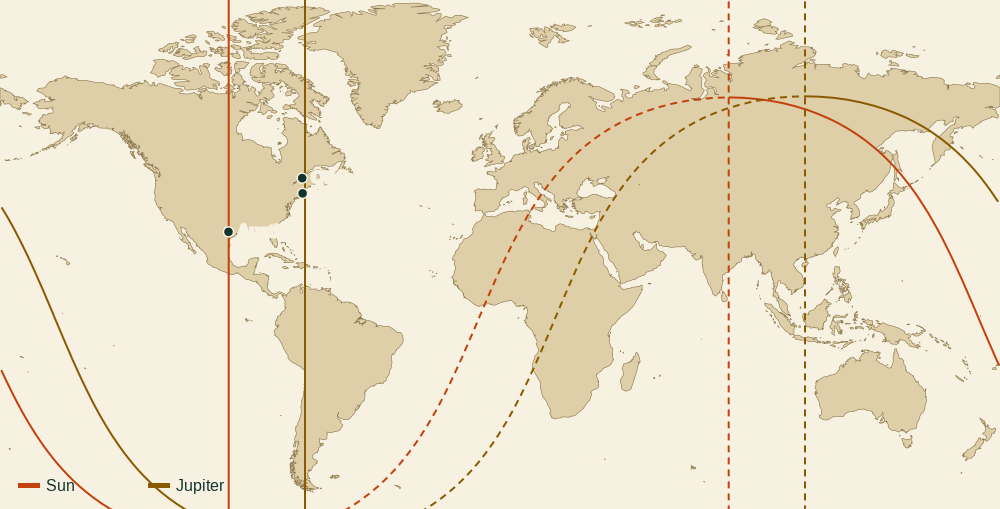
Maya was born in New York on June 10, 1990, at 2:30 PM. Her career list starts with these 3 cities:
| Rank | City | Closest career lines |
|---|---|---|
| 1 | Boston, United States | Jupiter overhead 72 km (45 mi), Moon underfoot 130 km (81 mi) |
| 2 | Québec, Canada | Jupiter overhead 78 km (48 mi) |
| 3 | Austin, United States | Sun overhead 9 km (6 mi) |
Boston and Québec sit on the same Jupiter overhead line, so astrologers would read both as places of growth and wider reach in public life. Austin is different. It is on her Sun overhead line, which astrologers tie to recognition and leadership, and the line runs only 9 km (6 mi) away. The same overhead angle gives 2 different work themes.
Reading the planet on the overhead line
Here is what astrologers connect with each of the main bodies on the overhead line, and what to ask yourself:
- Sun: recognition and leadership, so ask whether you want to be seen
- Jupiter: growth, teaching and opportunity, so ask whether you want more room to expand
- Mercury: communication, ideas and contacts, so ask whether your work is about talk
- Mars: drive and competition, so ask whether you want a faster pace
- Saturn: structure and long-term building, so ask whether you can live with slower progress
- Venus: appeal and cooperation, so ask whether your work depends on people liking it
- Pluto: power and deep change, so ask whether you want intense work
No body is best for everyone. The better question is what pattern of work a place seems to emphasize, and whether you want it. The pages for each body, such as the Sun lines and Jupiter lines, go deeper.
How close a career line has to run
A line only counts if it runs near the city. A line through a city counts in full. At 100 km (62 mi) it counts for 92%, at 350 km (217 mi) for 37%, and past 1,000 km (621 mi) not at all.
So a Jupiter overhead line 20 km (12 mi) away is a main feature of a city, as astrologers see it. The same line 600 km (373 mi) away is a faint note. The line distance page explains how this works and how to use it.
If your birth time is not exact
Lines move with your birth time. The Earth turns one degree every 4 minutes, which is about 111 km (69 mi) at the equator. An overhead line can shift past a city with a time that is off by a few minutes.
Try your career list with a few minutes either side. If the same cities stay near the top, the result is steady. If a city drops out, treat it as a soft pick. Without a birth time, the map shows lines for 12 noon as an example only and does not rank cities.
A career line is not where to live
A career list answers one question: where do lines tied to work run close to a city. It says nothing about pay, housing, visas, language or the people in your life. Those matter far more than any line.
Use the list to pick a few places to look into, then check the practical side. For a mix of love, career and home together, see the guide on where to live.
How to use your career list
To use your career list:
- Enter your birth details above, and your results open on the career list
- Read your first city and the lines behind it, starting with the overhead line
- Select a city you know well, such as where you live now, and see whether the lines match your experience there
- Compare 2 or 3 cities, and note which body sits on the overhead line in each
- Visit before you decide anything, since a trip is the easiest way to test a theme
FAQ
What is astrocartography for career?
It is a way to read your astrocartography map for work. Astrologers look at the lines tied to career, mostly the overhead line, and at which cities sit close to them. This tool sorts cities for you and lists the lines behind each one.
Which line is best for career?
There is no best line for everyone. In this tool the Jupiter overhead line counts most for career, followed by the Sun overhead line. The rising line comes next in weight. Pick by the kind of work you want, since each body suits a different pattern.
What is the MC line in astrocartography?
A straight north-to-south line that marks where a body was at its highest point in the sky when you were born. MC means Midheaven, and astrologers connect it with career and public role. The MC line page covers each body.
Is there a separate career line on the map?
No. Your map has 48 lines and none of them is called a career line. The career goal weighs all of them for work. The overhead lines carry the most weight, and Jupiter and the Sun count most among the bodies.
Do I have to move to a career line for it to work?
No. Astrologers see these lines as themes you may notice in a place, and a visit is an easy way to test one. Moving involves money, visas and the people in your life, and a map cannot weigh those for you.
Does my birth time change my career map?
Yes. Each line moves by about 1 degree for every 4 minutes of birth time, roughly 111 km (69 mi) at the equator. Try a few minutes either side. If your top cities stay the same, the result is steady. Without a time, the map cannot rank cities.
Does Saturn on my career line mean a hard job?
Astrologers connect Saturn with structure, duty and slow, lasting work. In this tool Saturn counts for a city on the career list, since long-term building suits work, and against it on the love list. Whether it suits you depends on the pace you want.
Can I check how a specific city scores for career?
Yes. Search for any city or select it on the map to see all the lines within 1,000 km and their distances. Look for Jupiter and Sun overhead lines first, then compare the city with your first city.
Is the career map free?
Yes. You get your first city for career and the lines behind it free, with no account. The full city report adds the top 20 cities for each goal and a reading of every line near your top 5 cities.
Related tools
MC Lines
Your MC lines mark the places where each planet stood at its highest point in the sky when you were born. Astrologers, who also call this the Midheaven line, connect it with career, public image and reputation. This page covers what each planet on the MC points to, how close a line has to run, and how MC lines count in the rankings. Then you can draw your own map above.
Sun Lines
Your Sun lines mark the places where the Sun was rising, setting, overhead or underfoot at your birth. Astrologers connect them with identity, self-expression, vitality and being seen. This page explains each line, how near it must be to count, and how this site's rankings weigh the Sun, mostly for career. Then you can draw your own map above.
Jupiter Lines
Your Jupiter lines mark the places where Jupiter was rising, setting, overhead or underfoot at your birth. Astrologers connect them with growth, new chances and a wider outlook. This page explains each line, how far away it can be and still count, and how to read it next to a Venus or Sun line. Then you can draw your own map above.
Where Should I Live
Enter your birth date, time and place, and the map names the city your lines point to first, with the reasons behind it.
Line Distance
A line counts in full when it runs through a city, about 92% at 100 km (62 mi), about 37% at 350 km (217 mi), and not at all past 1,000 km (621 mi). Enter your birth details to see how far each of your lines runs from any city.
Astrocartography Calculator
This astrocartography calculator takes your birth date, time and place. It draws your 48 planetary lines on a world map and names the city your lines point to first, with the reasons. It is free and needs no account. You can also look up any place to see the lines near it.
Love Map
Enter your birth details and the map sorts itself by the lines astrologers tie to affection. You do not need to know what any line means.
Line Meanings
Every line is a pairing of one body and one angle, and this page explains both halves, with examples from a real map.