Venus line astrocartography: what each of the 4 lines points to
Your Venus lines mark the places where Venus was rising, setting, overhead or underfoot at your birth. Astrologers connect them with affection, attraction and enjoying life. This page explains each line, how far away it can be and still count, and how to read it next to a Moon or Jupiter line. Then you can draw your own map above.
How it works
Draw your map
Enter your birth date, time and place. All 48 lines appear, and you can switch the lines on and off body by body to leave only Venus.Select a place and read the nearest line
Choose a city that matters to you. See which Venus line is closest, which angle it is and how many kilometers away it runs.Compare with the other lines nearby
Check for a Moon or Jupiter line close to the same place, and read the closest line first. The tool writes out what astrologers connect each one with.
An astrocartography Venus line marks places where Venus was on one of the 4 angles at your birth. Astrologers connect these lines with affection, attraction and enjoying life. Venus rising points to charm in how you come across, Venus setting to close one-to-one ties, Venus overhead to being liked in public life and Venus underfoot to comfort at home. How close the line runs matters, and a Moon or Jupiter line nearby adds comfort or room to grow.
What a Venus line is
Venus has 4 lines on your map, one for each angle: rising, setting, overhead and underfoot. Each one marks the places on Earth where Venus was at that point in the sky when you were born. The positions are astronomy. The meanings come from astrological tradition, and nothing scientific shows that living near a line changes anything in your life.
Astrologers connect Venus with affection, attraction, taste and enjoying life, and with the way you bond with other people. Near a Venus line, they tend to say, those themes come forward. People often describe the feeling as warmer or easier than usual. Others notice little at all, and that is a fair reading of the same line.
Nothing on this page says what will happen to you. It tells you what astrologers connect each line with, so that you can decide how much weight to give it.
The 4 Venus lines, one at a time
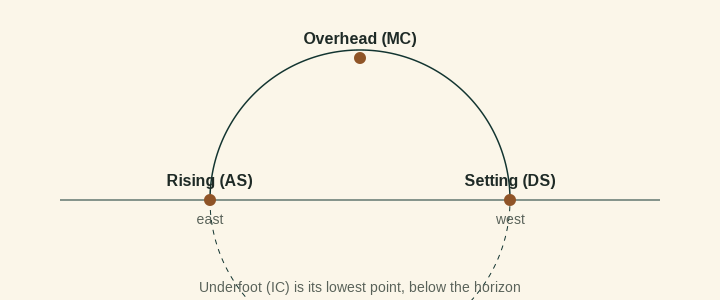
The body sets the theme, and the angle sets the part of life where it shows up. For Venus, astrologers tie the four angles to these things:
- Venus rising: charm in how you come across, so people may find you easy to approach in a new place
- Venus setting: affection and attraction in close one-to-one ties, and the qualities you look for in a partner, friend or collaborator
- Venus overhead: being liked in public life, with a link to the arts, design and partnerships in what you do
- Venus underfoot: comfort, beauty and affection at home, in the private part of your life
Some astrologers call the setting line the one most tied to relationships, which is why it carries the biggest angle weight in the love ranking on this site. Others pay more attention to the rising or underfoot line. Your own reaction to a place counts for more than any ranking.
For the other eleven bodies, see Line Meanings, which covers all 12 in the same way.
How close a Venus line has to be
Distance matters as much as the line itself. A line passing through a city counts in full, and the share counted falls quickly as you move away. At 100 km (62 mi) it still counts for 92%. At 350 km (217 mi) it counts for 37%, and past 1,000 km (621 mi) it is not counted at all.
So a Venus line 20 km (12 mi) from a city is part of that city's character, as astrologers see it. A Venus line 600 km (373 mi) away is a faint background note. When you read a place, take the closest line first and ask how far away it really is. How we calculate shows the full table.
How Venus lines count in your rankings
Venus is the heaviest body in the love ranking on this site. The weights are our own, set with astrological tradition as the guide, and they are published in full on the method page:
| Goal | Venus weight |
|---|---|
| Love | 1 |
| Career | 0.2 |
| Home | 0.6 |
The angle then adjusts how much that weight matters. For love, the setting angle counts most at 1.2, then rising at 1, underfoot at 0.7 and overhead at 0.5. For home, the underfoot angle counts most at 1.3. For career, the overhead angle counts most at 1.3, though Venus itself carries only a small career weight.
The overall ranking is the average of the three goals. A Venus line close to a city therefore helps it most in the love list, helps it a fair amount in the home list and adds only a little to the career list. The love chart page explains the love list in more detail.
An example from Maya's map
Maya was born on June 10, 1990, at 2:30 PM in New York. Two of her Venus lines show up in the sample figures on this site.
Her Venus underfoot line passes 18 km (11 mi) from Tbilisi, Georgia, her first city for love. Moon rising at 22 km (14 mi) sits beside it. Astrologers would read the pair as affection tied to home and private life, plus emotional ease in how she comes across.
Her Venus setting line is 107 km (66 mi) from Brasília, Brazil, which is second on her love list. It is her only strong love line there, but it is the pairing that astrologers tie most directly to partnership. Montevideo, Uruguay, is third, with the same Venus setting line at 113 km (70 mi).
The same body can read quite differently from one angle to the next. Underfoot points to the home side of affection, and setting points to the one-to-one side. That is why it helps to look at the angle and not just the name of the body.
When a Venus line meets a Moon line or a Jupiter line
Venus rarely sits alone. Here is how astrologers tend to read it next to the two bodies that people ask about most.
The Moon is tied to feeling safe, to daily habits and to what makes a place feel like home. Venus with the Moon, both close to the same city, reads as warmth that is also comfortable. Maya's Tbilisi is an example, with Venus underfoot and Moon rising on the map almost on top of the city.
Jupiter is tied to growth, generosity and a wider outlook. Venus with Jupiter reads as affection with room to grow, or as new chances that come through people. In Maya's map, Jupiter setting at 214 km (133 mi) from Tbilisi adds a note of this kind, further off than the other two.
A few ways to read the pairs:
- Venus and Moon on the same angle: comfort and affection together, and a place that may feel easy to settle into
- Venus setting with Jupiter setting: warm one-to-one ties with a sense of opening up, which astrologers sometimes link with meeting people
- Venus underfoot with Jupiter overhead: a pleasant home life next to a growing public side
- lines at different distances: read the closer one first and treat the further one as a background note
When two lines are about the same distance away, give them equal weight and ask a practical question. Would you like a place that feels cozy, a place that feels open, or both? There is no right answer, only your own preference.
Venus lines across areas of life
The angle decides where the Venus theme shows up. Here is how astrologers tend to describe each area.
Family and home: the underfoot line is the one tied to a pleasant household. Astrologers link it with a home that is tidy, warm and pleasing to the eye, and with affection among people who live together. Some people feel like entertaining more in such a place.
Love: the setting line is the one most tied to partnership. Astrologers describe it as a pull toward warm, loyal, easygoing ties. The rising line is read a little differently, as an ease in how you meet people, which may help you start conversations.
Friendship: Venus is tied to liking and being liked, so a line near a city is often read as a place where friendships form without much effort. It may suit people who want to widen their circle.
Work: the overhead line is the one for career. Astrologers connect it with the arts, design, fashion, hospitality and any job where charm and good taste count. Others link it with collaborations that go smoothly.
Travel: a stay near a Venus line is often described as relaxed, with good meals, pleasant company and a wish to linger. That is why some people use these places as a break.
Attractive is not the same as a good fit
A Venus line tells you where a place may feel pleasant to you. It does not tell you whether the place suits your daily life. A city can feel warm and beautiful on a visit and still be expensive, far from family or short on work in your field.
Astrologers make this point themselves. They suggest asking two questions. The first is whether you enjoy being there, which is the Venus question. The second is whether you could live there, and the answer comes from money, language, visas and the people around you. Venus helps with the first. You have to supply the second.
Venus lines and your social life
A Venus line near a city is often read as a social theme more than a romantic one. Astrologers connect it with being at ease at parties, being invited, getting along with neighbors and finding people who share your taste. It is the line they look at for a place where you want to feel included.
If you are shy, a Venus line may be read as a gentle setting for practicing company, since the tone is warm rather than sharp. If you already have a full social calendar, it may mean you feel you have more time for the people you like. As with every line, the effect is symbolic, and your own response counts more than the reading.
When a Venus line is easy and when it is too easy
Ease is a gift when you are tired, grieving or starting over, and many people choose a Venus city for those reasons. The trouble comes when comfort replaces effort. Astrologers mention that a pleasant place can make you slow to ask for more of yourself, or slow to leave a situation that is no longer right.
A practical check is to look at what you do there. If the city lifts your mood and helps you do what you care about, the line fits. If you find yourself putting off plans, you may like it more as a place to visit.
What you may notice near a Venus line
People describe a few common things near a Venus line, though none of them is a promise:
- a wish to dress up, cook or decorate a little more than usual
- easier small talk with shopkeepers, neighbors and colleagues
- a stronger taste for music, art and good food
- a warmer mood in a new place, with less of the usual guard up
If you notice none of these, the line may simply be quiet for you. Venus themes are subtle, and a few days is a short time to judge.
How to look at your own Venus lines
To see where yours run, you need your birth date, time and place. The time matters here. A difference of 4 minutes moves every line by about one degree, roughly 111 km (69 mi) at the equator, so a rounded birth time can move a Venus line past a city.
Then follow these steps:
- Draw your map and turn on only the Venus lines, using the switch for each body
- Select a city that matters to you, such as where you live now or a place you are thinking about
- Check which Venus line is closest, which angle it is and how many kilometers away
- Read what astrologers connect that line with, and ask whether the theme fits what you want
- Look at the Moon and Jupiter lines nearby to see what else is in the picture
If you have no Venus line near a place, that tells you only that Venus's themes are not especially stressed there. Astrologers would not read it as good or bad.
Venus lines are not only about romance
Venus covers affection, taste and pleasure in general. A Venus line can be a prompt to think about where you might make close friends, enjoy daily life more or feel at ease with others. If you do not have a partner or are not looking for one, read the themes in whatever way fits you.
Astrologers also point out that ease can be a mild trap. A place that feels pleasant may make it harder to ask for more of yourself, and some people use a Venus city as a break and not a base. That is one more reason to visit before deciding anything.
Questions to ask yourself
A line gives you a theme. These questions turn it into something you can use:
- what do I want more of right now, such as affection, beauty, company or comfort?
- do I want that in close one-to-one ties, in public life or at home?
- how far is the line from the city I have in mind?
- when I visit, do I feel at ease with people here?
- would I want this city for a trip, for a season or for good?
Your answers matter more than the line does. For the full picture of a city, a relocation chart shows your new rising sign and houses there.
FAQ
What does a Venus line mean in astrocartography?
Astrologers connect it with affection, attraction, taste and enjoying life. The angle decides the part of life: rising for how you come across, setting for close ties, overhead for public life, underfoot for home. It is a symbolic theme, not a forecast.
Which Venus line is best for love?
Many astrologers look at the setting line first, since they tie it to close one-to-one ties. In this site's love ranking, Venus counts most of all bodies and the setting angle counts most of the four. Opinions differ, so test it against your own experience.
How close does a Venus line need to be?
The closer, the more it counts. On this site a line through a city counts in full, 100 km (62 mi) away it counts for 92%, and 350 km (217 mi) away for 37%. Past 1,000 km (621 mi) it is not counted at all.
How do I read a Venus line next to a Moon line?
Read the closer one first, then the other as a background note. Astrologers tie the Moon to feeling safe and at home, and Venus to affection. Together they can read as a place that feels warm and comfortable.
What does a Venus line with a Jupiter line mean?
Astrologers tie Jupiter to growth and a wider outlook, so Venus with Jupiter reads as affection with room to grow. In Maya's map, Jupiter setting is 214 km (133 mi) from Tbilisi and adds a note of this kind to the nearer lines.
Do Venus lines matter for career?
A little. On this site Venus carries a weight of 0.2 for career, against 1 for love and 0.6 for home. Astrologers tie the overhead Venus line to being liked in public life and to the arts, design and partnerships.
Why is a Venus line in my first city?
Venus carries the biggest weight in the love ranking, so a close Venus line often helps a city rise. Select the city to see every line within 1,000 km (621 mi) and its distance.
Can I see only my Venus lines on the map?
Yes. Lines can be switched on and off body by body, so you can leave just Venus, or just Venus and the Moon. Selecting a place also lists every line within 1,000 km (621 mi) with its distance.
Does a Venus line mean I will find love there?
No. Astrologers connect Venus with affection and attraction, and read the setting line as the one tied to partnership. That is a theme, not a forecast. Whether you meet someone depends on how you live and who is around you.
Can a Venus line help with friendships?
Astrologers tie Venus to liking and being liked, so a line near a city is often read as a place where friendships form with little effort. It is a social theme as much as a romantic one. Your own response counts more than the reading.
Is a Venus line always a good sign?
Astrologers read it as a pleasant theme, but not a complete answer. A city can feel warm and still be a poor fit for money, work or family reasons. Some people also find that ease makes them slow to ask more of themselves.
What does a Venus line feel like?
People describe a warmer mood, easier small talk and a stronger taste for food, music and art. None of this is a promise, and some people notice nothing. A few days is a short time to judge a subtle theme.
Where should your next chapter unfold?
Match your current priorities with your natal planetary lines in under a minute.
What are you optimizing for right now?
Related tools
Love Map
Enter your birth details and the map sorts itself by the lines astrologers tie to affection. You do not need to know what any line means.
Line Meanings
Every line is a pairing of one body and one angle, and this page explains both halves, with examples from a real map.
How to Read Your Map
Draw your own map above, then follow 5 steps that turn a tangle of lines into a plain reading of any one place.
How we calculate
Here is how each line is calculated, what our tests found, and how a city earns its place, with the numbers left in.
AC Lines
Each AC line marks the places where one planet was rising over the eastern horizon when you were born. Also called the Ascendant or rising line, it is one that astrologers connect with self-image, first impressions and how you start things. This page covers what each planet on the AC points to, how close a line has to run, and how AC lines count in the rankings. Draw your own map above to see where yours fall.
Astrocartography Calculator
This astrocartography calculator takes your birth date, time and place. It draws your 48 planetary lines on a world map and names the city your lines point to first, with the reasons. It is free and needs no account. You can also look up any place to see the lines near it.
Career Map
Enter your birth details and the map sorts cities by the lines astrologers tie to work, with the overhead line counting most. You do not need to know what any line means, because the result names your first city and the lines behind it.
Chiron Lines
Your Chiron lines mark the places where Chiron, a small body between Saturn and Uranus, was rising, setting, overhead or underfoot at your birth. Astrologers connect them with sensitive spots and what you learn from them. This page explains each line, how far away it can be and still count, and why this site's rankings count Chiron a little against a city. Then you can draw your own map above.