IC line astrocartography: what each planet's underfoot line points to
Each IC line marks the places where one planet sat at its lowest point, under your feet, when you were born. In IC line astrocartography, also called the Imum Coeli line, astrologers connect this with home, family and roots. This page covers what each planet on the IC points to, how close a line has to run, and how IC lines count in the rankings. Draw your own map above to see where yours fall.
How it works
Draw your map
Enter your birth date, time and place. All 48 lines appear, and the dashed, straight ones are your IC lines.Select a place and read the nearest IC line
Choose a city that matters to you. See which IC line is closest, which body it belongs to and how many kilometers away it runs.Switch to the home goal
See which cities your IC lines lift in the home list, with the lines and distances behind each one.
An IC line in astrocartography, also called an Imum Coeli or underfoot line, is a straight north-to-south line that marks where a body stood at its lowest point at your birth. Astrologers connect it with home, family and roots. The Moon on the IC points to emotional safety, Jupiter to a roomy home life and Saturn to serious foundations. On this site the IC counts most for home, at 1.3, and how close the line runs matters. The MC line is its public opposite.
What an IC line is
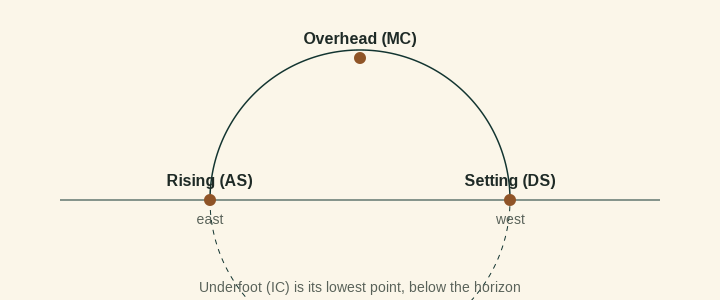
An IC line is a straight north-to-south line on the map. IC is short for Imum Coeli, Latin for the bottom of the sky, and some astrologers call it the Nadir line or the underfoot line. The phrase imum coeli line astrocartography means the same thing. On this site it is called the underfoot line. For each body, it marks each place where that body sat at its lowest point under the horizon, opposite the overhead point, when you were born. Every body has one, so your map has 12 IC lines out of 48 lines in all.
The positions are astronomy. The meanings are a symbolic tradition, and there is no scientific evidence that living near a line changes your life.
Astrologers connect the IC with your private side. That covers home, family, roots and the base you come back to when nobody is watching. So an IC line is read as a place where a planet's theme comes into your private life. This page covers the theme of each body on the IC, how close a line has to run, how the site counts IC lines in its rankings, and how to find yours.
IC line, IC sign and the MC line
Three things share the letters IC or MC, and they are easy to mix up:
- the IC sign is one sign and degree at the bottom of the sky for one place, such as your birthplace
- an IC line is a line across the whole map for one body
- the MC line is the opposite, the places where that same body was at its highest point overhead
The IC and the MC sit on opposite sides of the sky, which is why the two kinds of line pair up. Each body has both lines on your map. For public life, goals and career, see MC line astrocartography. To find the sign at the top of your sky, see What Is My Midheaven. Your IC sign is the sign opposite your Midheaven sign.
For how the four line codes fit together, see Map Symbols.
The home line and what to do when it is far away
Some sites call the IC line the home line, and the 2 names mean the same line. Astrologers tie it to roots, family and the place where you feel settled when no one is watching.
If your closest IC line is far from any city you know, that is normal. 48 lines leave a lot of open space, and many of them cross oceans. On this site the lookup shows every line within 1,000 km of a place, and a place with none nearby is not a bad sign.
Look at the lines of the other 3 angles instead, or at a nearby city that does have an IC line. A Moon or Venus underfoot line is read as comfort and ease at home. A Saturn underfoot line is read as slow, serious building of a home. Use these as prompts, and test them with a visit.
The IC line of each planet
The body gives the theme and the IC gives the setting, which is your private base. Here is what astrologers connect each pairing with:
- Sun on the IC: a strong sense of who you are at home, with a link to family pride and to being the center of the household
- Moon on the IC: emotional safety, belonging and comfort at home, which is why many astrologers look here first for a place to settle
- Mercury on the IC: talking, reading and learning at home, with a busy household or a study full of books
- Venus on the IC: warmth, beauty and affection in the home, and a wish to make the space pleasant
- Mars on the IC: energy and restlessness at home, with a push to rebuild or to defend your space, and sometimes friction with family
- Jupiter on the IC: a roomy, generous home life, with growth in family and in the sense of having a base
- Saturn on the IC: serious foundations at home, with family duties and a private life that asks for steady care
- Uranus on the IC: an unusual or changeable home life, with a taste for independence from where you came from
- Neptune on the IC: a dreamy, idealistic idea of home, with a link to quiet, water and art, and a risk of blurred boundaries
- Pluto on the IC: deep change in family and roots, with intense feelings about the past
The North Node and Chiron also have IC lines. The North Node is not a planet but a calculated point. It sits where the Moon's orbit crosses the ecliptic as the Moon moves north, and astrologers read it as a direction you are invited to grow in. On the IC, astrologers connect it with growing into a sense of roots. Chiron is a small object whose orbit lies mostly between Saturn and Uranus, and astrologers connect it with tender spots and the understanding that can come from them. On the IC, that points to family history and old feelings about home.
Astrologers do not all agree on how to rank these. Some call the Moon the most comfortable IC line and Saturn or Pluto the most demanding. Treat that as an opinion, since what a line feels like depends on you. For the other three angles of each body, see Line Meanings.
How close an IC line has to be
A line only matters for a city if it runs near it. On this site, a line through a city counts in full, and the share falls off fast with distance. At 100 km (62 mi) it still counts for 92%. At 350 km (217 mi) it counts for 37%, and past 1,000 km (621 mi) it is not counted at all.
Because an IC line is straight, you can picture the gap as the east-west distance from the city to the line. A Moon IC line 13 km (8 mi) from a city is part of that city's character, as astrologers see it. The same line 600 km (373 mi) away is a faint background note. The full table is on How we calculate.
How IC lines count in the rankings
Each city gets a score for love, career and home. One line adds the body weight times the angle weight times the distance share. These are the IC weights:
| Goal | IC weight |
|---|---|
| Love | 0.7 |
| Career | 0.3 |
| Home | 1.3 |
For home, the IC is the largest angle weight there is, which matches the astrological habit of looking at the underfoot line for roots and home. For career, the IC is the smallest of the four angles, and the overhead line leads. For love, the IC is the third of the four, behind the setting and rising lines.
Since the body weight multiplies the angle weight, each body's IC line adds a different amount. This table shows a line right through a city, for home:
| Body on the IC | Home body weight | Score at 0 km |
|---|---|---|
| Sun | 0.3 | 0.39 |
| Moon | 1 | 1.3 |
| Mercury | 0.1 | 0.13 |
| Venus | 0.6 | 0.78 |
| Mars | -0.6 | -0.78 |
| Jupiter | 0.7 | 0.91 |
| Saturn | -0.4 | -0.52 |
| Uranus | -0.5 | -0.65 |
| Neptune | -0.25 | -0.325 |
| Pluto | -0.6 | -0.78 |
| North Node | 0.15 | 0.195 |
| Chiron | -0.2 | -0.26 |
The Moon leads, followed by Jupiter and Venus. Mars, Pluto, Uranus, Saturn, Neptune and Chiron count against a city in the home list. These are our own scoring choices, set with astrological tradition as the guide, and they are not warnings about any place. A Pluto IC line may suit someone who wants to work through family history, and that person may reasonably like a city that the list puts lower. The full weights are on the method page. The overall ranking is the average of the three goals.
An example from Maya's map
Maya was born on June 10, 1990, at 2:30 PM in New York. Her map has several IC lines that show up in the sample figures on this site.
Her Moon IC line passes 13 km (8 mi) from Barquisimeto, and it is 130 km (81 mi) from Boston. At 13 km the line counts almost in full, about 1.30 for home. At 130 km the share is lower, and the same line is worth about 1.13. It is 381 km (237 mi) from New York, so it sits in the background of her home city.
Her Venus IC line passes 18 km (11 mi) from Tbilisi. Together with her Moon rising line, 22 km (14 mi) away, it puts Tbilisi first on her list for home, and for love and overall too. Seen by an astrologer, Venus on the IC pairs affection with home, and the Moon rising pairs emotional safety with daily habits.
Not every IC line adds to a city. Her Neptune IC line is 16 km (10 mi) from Québec and 218 km (135 mi) from New York, and her Uranus IC line is 273 km (170 mi) from New York. At that distance the Uranus line is worth about -0.35 for home. Her North Node IC line is 167 km (104 mi) from São Luís.
Notice that the Moon IC line also runs near Boston, a city that the same page of results ranks first for career. One city can sit near the lines of more than one goal.
Reading several IC lines near one city
Two or more IC lines can sit near the same city, when the bodies stood under your feet at similar longitudes. Here is a way to read them:
- Moon and Venus together: comfort, affection and a warm home, which many astrologers read as one theme
- Moon and Jupiter together: a generous, roomy sense of belonging
- Saturn with any other body: the other theme, tied to family duties and a more serious tone
- an IC line next to an MC line of another body: private foundations on one side and public goals on the other, so read the closer one first
Where the lines point in different directions, ask which of the two is closer, and treat the further one as a background note. When both are about the same distance, give them equal weight. It helps to ask what kind of home you want in that place.
How to find your own IC lines
You need your birth date, time and place. The time matters a lot for a straight line like this one, because the Earth turns one degree every 4 minutes and the line shifts east or west with it. That is about 111 km (69 mi) at the equator, so a rounded birth time can carry an IC line across a city.
Then follow these steps:
- Draw your map and use the switch for each body to leave only the lines you want to study
- Pick the dashed, straight lines, which are the IC lines. The solid straight lines are the MC lines
- Select a city that matters to you, such as where you live now or a place you are thinking about
- Read which IC line is closest, which body it belongs to and how many kilometers away it runs
- Switch to the home goal to see which cities your IC lines lift in the list
If you do not know your birth time, the map draws the lines for 12 noon as an example only and does not rank cities. If no IC line is near a place, that tells you only that no body's theme is especially stressed in the private side there. Astrologers would not read that as good or bad. Your birth chart carries on as it always has.
Questions to ask yourself
Use these questions to turn a line's theme into a decision aid:
- what makes a place feel like home to me?
- do I want a busy household, or a quiet one?
- is there family or history that I would like to be near, or to stay away from?
- when I visit, does the place make me feel settled, or restless?
- would I want this place for a year, for a season or for good?
Your answers matter more than the line does. If you want a place that supports your private life, an IC line near a city may be a reason to visit and take a look. If you want a place for a visible career, you may prefer an MC line, and the guide to choosing where to live shows how the goals compare.
FAQ
What is the IC line in astrocartography?
It is a straight north-to-south line that marks the places where a body stood at its lowest point, under your feet, at your birth. Astrologers connect it with home, family and your private base. On this site it is called the underfoot line, and each of the 12 bodies has one.
What does imum coeli line mean?
Imum Coeli is Latin for the bottom of the sky, and IC is its short form. An imum coeli line in astrocartography is the same line as the IC line or the underfoot line. Your IC sign is different. It is one sign for one place, while an IC line is a line across the whole map for one body.
What does an IC line mean for home?
Astrologers look at the IC line first for home, since they tie it to roots and family. The Moon, Jupiter and Venus on the IC are the ones read most for comfort and belonging. It is a symbolic theme, not a forecast, and no line can choose a home for you.
What is the best IC line?
There is no best one, because it depends on what you are after. In this site's home ranking, the Moon counts most, followed by Jupiter and Venus. Saturn, Uranus or Pluto on the IC can suit people who want steady foundations, independence or deep change. Test the theme against your own sense of a place.
How close does an IC line need to be?
The closer, the more it counts. On this site a line through a city counts in full, 100 km (62 mi) away it counts for 92%, and 350 km (217 mi) away for 37%. Past 1,000 km (621 mi) it is not counted at all.
What is the difference between an IC line and an MC line?
They belong to the same body, but the MC line marks where that body was at its highest point overhead. Astrologers connect the MC with public life and the IC with home and roots. Both are straight north-to-south lines, and the IC line is dashed on this map. See the MC line page for the public side.
How is the IC counted for love and career?
The IC weight is 0.7 for love and 0.3 for career, against 1.3 for home. It counts for a lot less in those two lists. The overhead line leads for career, and the setting line leads for love.
How do I find my IC lines?
Enter your birth date, time and place in the map on this page. The dashed, straight lines are the IC lines. Select a city to see the closest one, its body and its distance, and switch to the home goal to see the ranking it affects.
Does my birth time change my IC line?
Yes. An IC line moves east or west as the birth time changes, by about 1 degree for every 4 minutes. That is roughly 111 km (69 mi) at the equator. Use the most exact time you can find, and try a few minutes either side if you are unsure.
Is the IC line the same as the home line?
Yes. Some sites call the IC line the home line. It is the straight north-to-south line where a body stood at the bottom of the sky when you were born. Astrologers tie it to roots, family and a settled private life.
Where should your next chapter unfold?
Match your current priorities with your natal planetary lines in under a minute.
What are you optimizing for right now?
Related tools
Line Meanings
Every line is a pairing of one body and one angle, and this page explains both halves, with examples from a real map.
MC Lines
Your MC lines mark the places where each planet stood at its highest point in the sky when you were born. Astrologers, who also call this the Midheaven line, connect it with career, public image and reputation. This page covers what each planet on the MC points to, how close a line has to run, and how MC lines count in the rankings. Then you can draw your own map above.
Map Symbols
Each line on an astrocartography map is a pairing of a body and an angle, and the symbols tell you which. On this map, color names the body, solid or dashed names the angle, and AS, DS, MC and IC are the 4 angle codes. Draw your own map to see them on your birth details.
What Is My Midheaven
What is my Midheaven? It is the zodiac sign at the very top of the sky at the moment and place you were born, and astrologers link it with your public side and your goals. Enter your birth date, time and place in the rising sign calculator to see yours, and then to see it in any other city. It is free and needs no account.
AC Lines
Each AC line marks the places where one planet was rising over the eastern horizon when you were born. Also called the Ascendant or rising line, it is one that astrologers connect with self-image, first impressions and how you start things. This page covers what each planet on the AC points to, how close a line has to run, and how AC lines count in the rankings. Draw your own map above to see where yours fall.
Astrocartography Calculator
This astrocartography calculator takes your birth date, time and place. It draws your 48 planetary lines on a world map and names the city your lines point to first, with the reasons. It is free and needs no account. You can also look up any place to see the lines near it.
Career Map
Enter your birth details and the map sorts cities by the lines astrologers tie to work, with the overhead line counting most. You do not need to know what any line means, because the result names your first city and the lines behind it.
Love Map
Enter your birth details and the map sorts itself by the lines astrologers tie to affection. You do not need to know what any line means.