Mercury line in astrocartography: what each of the 4 lines points to
Your Mercury lines mark the places where Mercury was rising, setting, overhead or underfoot at your birth. Astrologers connect them with thinking, learning, writing and talking. This page explains each line, how far away it can be and still count, and how this site's rankings weigh Mercury. Then you can draw your own map above.
How it works
Draw your map
Enter your birth date, time and place. All 48 lines appear, and you can switch the lines on and off body by body to leave only Mercury.Select a place and read the nearest line
Choose a city that matters to you. See which Mercury line is closest, which angle it is and how many kilometers away it runs.Compare with the other lines nearby
Check for a Sun, Jupiter, Venus or Saturn line close to the same place, and read the closest line first. The tool writes out what astrologers connect each one with.
A Mercury line in astrocartography marks places where Mercury was on one of the 4 angles at your birth. Astrologers connect these lines with thinking, learning, writing and talking. Mercury rising points to a curious way of meeting new situations, Mercury setting to conversation in one-to-one dealings, Mercury overhead to work built on words and ideas, and Mercury underfoot to a busy mind at home. How close the line runs matters, and this site's rankings give Mercury its largest weight for career.
What a Mercury line is
Mercury has 4 lines on your map, one for each angle: rising, setting, overhead and underfoot. Each marks the places on Earth where Mercury was at that point in the sky when you were born. The positions are astronomy. The meanings come from astrological tradition, and nothing scientific shows that living near a line changes anything in your life.
Astrologers connect Mercury with how you think, learn, talk and write, and with everyday curiosity, short trips and the exchange of ideas. Near a Mercury line, they tend to say, those themes come forward. People often describe such a place as busy, chatty or good for study. Others find the same pace tiring and prefer somewhere quieter. Both are fair readings of the same line.
Nothing on this page says what will happen to you. It tells you what astrologers connect each line with, so that you can decide how much weight to give it.
The 4 Mercury lines, one at a time
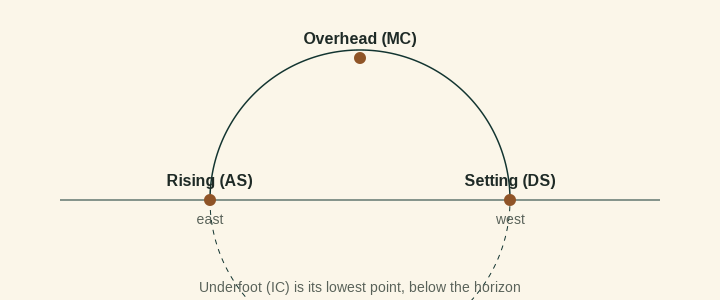
The body sets the theme, and the angle sets the part of life where it shows up. For Mercury, astrologers tie the four angles to these things:
- Mercury rising: coming across as curious and talkative, with a pull toward new ideas and quick starts
- Mercury setting: conversation in one-to-one dealings, such as clients, partners and collaborators, with a lot of exchanging of views
- Mercury overhead: talking, writing, teaching and ideas as the way you become known, which is why this line comes up for work
- Mercury underfoot: a mind that is busy at home, with reading, study, family talk and a private base that doubles as a workroom
Astrologers do not all agree on which of the four is easiest to live with. The overhead line is the one many look at first for work that depends on words, and the underfoot line is the quietest. It is felt in your private life more than in anything other people see. For the other eleven bodies, see Line Meanings, which covers all 12 in the same way.
Mercury lines for business and trade
Astrologers have long tied Mercury to trade as well as speech. The old image is the messenger who carries news and goods between people. That is why a Mercury line comes up for sales, negotiation, contracts, consulting and any job that rests on clear terms.
Two angles get the most attention here. Mercury overhead is linked with being known for what you say, write or sell. Mercury setting is linked with dealing with one person at a time, such as a client, a supplier or a business partner, and with talking until both sides agree. On this site, Mercury overhead adds at most 0.585 to the career goal and Mercury setting adds 0.225. For love, the setting line is Mercury's largest entry, at 0.12, which is still small.
A Mercury line does not make a deal go well. It marks a theme of more talk, more messages and more meetings. Some people find a place like that useful for building contacts. Others find the pace short on depth. If you work with information for a living, such as research, editing or analysis, the same question applies. Would you like the daily talk in that city?
Mercury lines for writers, students and language learners
Astrologers connect Mercury rising and Mercury overhead with writing and speaking, for different reasons. Rising is about how your voice comes across when you meet someone. Overhead is about a name built on what you say or publish. Writers often look at both. The MC line page shows how the overhead angle compares across all 12 bodies.
For study, many astrologers look at Mercury underfoot instead. It is tied to reading and learning done at home, in a private base with books and quiet. A student who needs a place to sit with a long reading list may find that a better question than the career line.
Language learning fits Mercury because it is made of words, listening and short talks with strangers. A Mercury line near a city is no shortcut to fluency. It gives you a question to ask. Would you enjoy the everyday talk in that place enough to keep practicing?
Mercury lines for remote workers and long stays
Mercury is the body astrologers tie to movement, short trips and connections, which is why people who work online and travel often check it first. A Mercury line near a place where you plan to work for a few months is a reason to ask what the work really is. Calls and messages sit with the setting line. Writing and study at a desk sit with the underfoot line.
Practical matters carry more weight than any line here. Look at your time zone overlap with clients, the internet connection and the length of stay your visa allows. The guide to astrology and travel covers how to use lines for a trip, and the guide to choosing where to live covers a longer move.
How close a Mercury line has to be
Distance matters as much as the line itself. On this site, a line passing through a city counts in full, and the share counted falls quickly as you move away. At 100 km (62 mi) it still counts for 92%. At 350 km (217 mi) it counts for 37%, and past 1,000 km (621 mi) it is not counted at all.
So a Mercury line 20 km (12 mi) from a city is part of that city's character, as astrologers see it. A Mercury line 600 km (373 mi) away is a faint background note, counted at about 5%. When you read a place, take the closest line first and ask how far it really is. How we calculate shows the full table.
How Mercury lines count in your city ranking
Mercury is a mild helper in all 3 of the site's rankings. Its career weight is the third largest of any body, behind Jupiter and the Sun. Its love and home weights are small. The weights are our own, set with astrological tradition as the guide, and they are published in full on the method page:
| Goal | Mercury weight |
|---|---|
| Love | 0.1 |
| Career | 0.45 |
| Home | 0.1 |
The angle then adjusts how much that weight matters. The angle weights are 1 for rising, 1.2 for setting, 0.5 for overhead and 0.7 for underfoot on love; 0.8, 0.5, 1.3 and 0.3 on career; and 0.8, 0.6, 0.3 and 1.3 on home. Multiply the two numbers and you get the most a Mercury line can add to a city before distance is taken into account:
| Line | Love | Career | Home |
|---|---|---|---|
| Mercury rising | 0.1 | 0.36 | 0.08 |
| Mercury setting | 0.12 | 0.225 | 0.06 |
| Mercury overhead | 0.05 | 0.585 | 0.03 |
| Mercury underfoot | 0.07 | 0.135 | 0.13 |
Read the table by goal. For career, the overhead line is the largest entry, at 0.585, which matches the astrological habit of looking at the overhead line for work and public life. For love, the setting line leads, since astrologers tie that angle to one-to-one ties. For home, the underfoot line leads. Even so, the love and home numbers are small. A single Mercury line moves those two lists very little, and the overall ranking is the average of the three goals.
This is a scoring choice, not a promise about any place. A city that the ranking puts lower may still suit you better, and the list works best as a set of themes to think about. For the career side in more detail, the MC line page compares all 12 bodies on the overhead line.
An example from Maya's map
Maya was born on June 10, 1990, at 2:30 PM in New York. Her Mercury rising line is 219 km (136 mi) from Tokyo, and that is the Mercury line that shows up in the sample figures on this site.
At 219 km, the line counts for about 68%. On the career goal that comes to roughly 0.45 × 0.8 × 0.68 = 0.24. On the love goal it comes to roughly 0.1 × 1 × 0.68 = 0.07, before the other lines near Tokyo are added. In the reading guide, Pluto setting at 60 km (37 mi) leads the reading for Tokyo, with deep change and intensity in one-to-one ties. Mercury rising follows it, adding ideas and conversation to how Maya comes across.
The example shows what a Mercury line usually does in a reading. It is rarely the loudest voice, and it adds a second note to a place where a nearer line sets the tone. Do not stop at whether a Mercury line is present. Read how far away it runs and which goal you care about.
When a Mercury line sits next to other lines
Mercury often shares a place with other lines, and the combination is worth reading as a pair. Here is a way to read a few common pairings, one at a time:
- Mercury with Jupiter on the overhead angle: talking and writing meet growth and new chances, which astrologers read as ideas finding a wider audience
- Mercury with the Sun on the same angle: thinking and speaking join confidence and feeling like yourself, so your own voice may stand out
- Mercury with Venus: ideas and conversation meet charm and enjoyment, a mix astrologers tie to friendly talk, design and the arts
- Mercury with Saturn: quick thinking beside patience and structure, which astrologers read as a good fit for careful study and long projects
- Mercury with Neptune: a lively mind beside a dreamy, imaginative one, which some people find inspiring and others find vague
When the two lines are about the same distance from a city, give each equal weight. If one is much nearer, it leads and the other is a background note. The Jupiter lines and Saturn lines pages cover two of those partners at length.
Why your Mercury lines can differ between maps
This site draws lines in mundo by default, which follows the body's real position in the sky. The other method, Zodiacal, uses only its degree along the zodiac. For the Sun the two agree. For Mercury and the other bodies from the Moon through Mars, the gap on our sample map is usually under about 300 km (186 mi).
That is small next to a distance table that falls from 92% at 100 km (62 mi) to 37% at 350 km (217 mi), but it can still move a Mercury line past a city. Another site may show your Mercury line in a slightly different place even if both are correct for the method each uses. Pick one method and keep it when you compare cities. You can switch between the two on this site and see the gap for yourself. How we calculate explains the difference.
When a Mercury line feels like too much
Mercury themes can show up as a restless mind. Astrologers describe overthinking, too many messages and trouble switching off. Nothing scientific shows that a line causes this, and a busy feeling is not a diagnosis of anything. It is a theme to notice, and some people enjoy it.
If a Mercury line runs close to a place where you feel scattered, check the angle and the distance first. A line 20 km (12 mi) away speaks louder than one 600 km (373 mi) away. Then test the feeling in the real world. Spend a few quiet days there before you decide. If the busy feeling eases, the place may suit you. If it stays, a Moon or Venus line nearby is what astrologers look at for calm.
Reading a Mercury line with care
Mercury themes are easy to misread, because talk, study and writing sound useful in almost any place. A Mercury line is not a sign that you will learn faster or write better there. It is a theme that astrologers pay attention to, and it gives you a question to hold, not a prediction.
It also helps to separate a theme from a plan. A Mercury line near a city is a reason to look at it more closely. It does not replace what you know about work, cost of living, language, visas and the people you would live near. Those things are outside what a map of lines can see, and they matter more than any line.
If you have no Mercury line near a place, that tells you only that Mercury's themes are not especially stressed there. Astrologers would not read it as good or bad. Your birth chart carries on as it always has.
How to look at your own Mercury lines
To see where yours run, you need your birth date, time and place. The time matters. A difference of 4 minutes moves every line by about one degree, roughly 111 km (69 mi) at the equator, so a rounded birth time can move a Mercury line past a city.
Then follow these steps:
- Draw your map and turn on only the Mercury lines, using the switch for each body. Mercury is drawn in green
- Select a city that matters to you, such as where you live now or a place you are thinking about
- Check which Mercury line is closest, which angle it is, and how many kilometers away
- Read what astrologers connect that line with, and ask whether the theme fits what you want
- Look at the Sun, Jupiter and Venus lines nearby to see what else is in the picture
If you are more interested in how your chart changes in a new city, a relocation chart shows your new rising sign and houses there.
Questions to ask yourself
A line gives you a theme. These questions turn it into something you can use:
- do I want a place that gives me plenty of people to talk to, or a place that gives me quiet to think?
- is there something I want to study, write or teach, and would a change of setting help?
- how do I feel in busy places full of news, talk and short trips?
- would I want a Mercury city for a visit, for a year or for good?
- when I visit, do I feel curious and clear, or scattered?
Your answers matter more than the line does. If you want a place that supports work built on words, a Mercury overhead line near a city may be a reason to visit and take a look. If you want rest and ease, you may prefer a Moon or Venus line, and the guide to choosing where to live shows how the goals compare.
FAQ
What does a Mercury line mean in astrocartography?
Astrologers connect it with how you think, learn, talk and write. The angle decides the part of life: rising for how you come across, setting for one-to-one dealings, overhead for work and public life, underfoot for home. It is a symbolic theme, not a forecast.
Is a Mercury line good for work?
Astrologers often look at Mercury overhead first for work built on talking, writing, teaching or ideas. On this site Mercury has a career weight of 0.45, and the overhead line is its largest at 0.585 before distance. It is a scoring choice, not a promise.
How much does Mercury count in the city rankings?
Mercury has a weight of 0.1 for love, 0.45 for career and 0.1 for home. Only the career weight is large, and it is the third biggest of any body, behind Jupiter and the Sun. The weights are our own and are published on the method page.
How close does a Mercury line need to be?
The closer, the more it counts. On this site a line through a city counts in full, 100 km (62 mi) away it counts for 92%, and 350 km (217 mi) away for 37%. Past 1,000 km (621 mi) it is not counted at all.
Which Mercury line is the strongest in the rankings?
For career, Mercury overhead, at 0.585 before distance is applied. For love, Mercury setting, at 0.12. For home, Mercury underfoot, at 0.13. The love and home numbers are small, so one Mercury line moves those lists very little.
Why do other sites show my Mercury line somewhere else?
This site draws in mundo by default and can switch to Zodiacal. For Mercury the two usually differ by under about 300 km (186 mi) on our sample map. A rounded birth time can also shift a line. Keep one method when you compare cities.
Does the angle change what a Mercury line means?
Yes. The body gives the theme and the angle gives the setting. Mercury rising is about how you come across, Mercury setting about one-to-one dealings, Mercury overhead about work and reputation and Mercury underfoot about home.
Can I see only my Mercury lines on the map?
Yes. Lines can be switched on and off body by body, so you can leave just Mercury, or just Mercury and Jupiter. Selecting a place also lists every line within 1,000 km (621 mi) with its distance.
Is a Mercury line good for business?
Astrologers tie Mercury to trade, negotiation and clear dealings, so for business they often look at Mercury overhead for a public name and Mercury setting for deals with clients, suppliers and partners. A business depends on money, contracts and demand far more than on any line. The question on work above shows how this site weights the lines.
Can a Mercury line cause anxiety or overthinking?
Astrologers say Mercury themes can show as a busy, restless mind near the line. Nothing scientific shows that a line changes how anxious you feel. If a place leaves you scattered, check the distance and spend a few quiet days there before you decide.
What does Mercury setting mean for relationships and partners?
Astrologers connect Mercury setting with talk in one-to-one dealings, such as partners, clients and collaborators. It points to a lot of exchanging of views. On this site its love weight is small, 0.12 before distance, so it moves the love list very little.
Is a Mercury line a good fit for digital nomads?
Astrologers tie Mercury to movement, short trips and connections, so remote workers often look at it. Time zones, internet and visa rules matter more than any line. Use a Mercury line near a city as one reason to visit and test the place.
Where should your next chapter unfold?
Match your current priorities with your natal planetary lines in under a minute.
What are you optimizing for right now?
Related tools
Line Meanings
Every line is a pairing of one body and one angle, and this page explains both halves, with examples from a real map.
MC Lines
Your MC lines mark the places where each planet stood at its highest point in the sky when you were born. Astrologers, who also call this the Midheaven line, connect it with career, public image and reputation. This page covers what each planet on the MC points to, how close a line has to run, and how MC lines count in the rankings. Then you can draw your own map above.
How to Read Your Map
Draw your own map above, then follow 5 steps that turn a tangle of lines into a plain reading of any one place.
How we calculate
Here is how each line is calculated, what our tests found, and how a city earns its place, with the numbers left in.
AC Lines
Each AC line marks the places where one planet was rising over the eastern horizon when you were born. Also called the Ascendant or rising line, it is one that astrologers connect with self-image, first impressions and how you start things. This page covers what each planet on the AC points to, how close a line has to run, and how AC lines count in the rankings. Draw your own map above to see where yours fall.
Astrocartography Calculator
This astrocartography calculator takes your birth date, time and place. It draws your 48 planetary lines on a world map and names the city your lines point to first, with the reasons. It is free and needs no account. You can also look up any place to see the lines near it.
Career Map
Enter your birth details and the map sorts cities by the lines astrologers tie to work, with the overhead line counting most. You do not need to know what any line means, because the result names your first city and the lines behind it.
Love Map
Enter your birth details and the map sorts itself by the lines astrologers tie to affection. You do not need to know what any line means.