AC line astrocartography: what each planet's Ascendant line points to
Each AC line marks the places where one planet was rising over the eastern horizon when you were born. Also called the Ascendant or rising line, it is one that astrologers connect with self-image, first impressions and how you start things. This page covers what each planet on the AC points to, how close a line has to run, and how AC lines count in the rankings. Draw your own map above to see where yours fall.
How it works
Draw your map
Enter your birth date, time and place. All 48 lines appear, and the solid, curved ones are your AC lines.Select a place and read the nearest AC line
Choose a city that matters to you. See which AC line is closest, which body it belongs to and how many kilometers away it runs.Switch to the love goal
See which cities your AC lines lift in the love list, with the lines and distances behind each one.
An AC line in astrocartography, also called an Ascendant or rising line, is a curved line that marks where a body was coming up over the eastern horizon at your birth. Astrologers connect it with self-image, first impressions and how you start things. Venus on the AC points to charm, Jupiter to an optimistic presence and Saturn to a reserved one. On this site the AC counts at 1 for love and 0.8 for career and home, and how close the line runs matters.
What an AC line is
An AC line is a curved line on the map. AC is short for Ascendant. On this site it is called the rising line, and it is also called the Ascendant line. For each body, it marks every place on Earth where that body was coming up over the eastern horizon at the moment you were born. Every body has one, so your map has 12 AC lines out of 48 lines in all.
The positions are astronomy. The meanings come from astrological tradition, and nothing scientific shows that living near a line changes anything in your life.
Astrologers connect the Ascendant with how you come across: your self-image, your first impressions and the way you start things. So an AC line is read as a place where a planet's theme comes to the front of how you meet the world. This page covers the theme of each body on the AC, how close a line has to run, how the site counts AC lines in its rankings, and how to find yours.
AC line, rising sign and the DC line
Three things get mixed up with the AC line, so here is how they differ:
- your rising sign, or Ascendant sign, is one sign and degree on the eastern horizon for one place, such as your birthplace
- an AC line is a curve across the whole map for one body
- the DC line is the opposite, the places where that same body was going down in the west
Your rising sign changes as you move, because the horizon changes with you. An AC line is how astrocartography follows that change for one body at a time. To see your rising sign in any city, use the rising sign calculator. For the setting side, see DC line astrocartography. For how the four line codes fit together, see Map Symbols.
The AC line of each planet
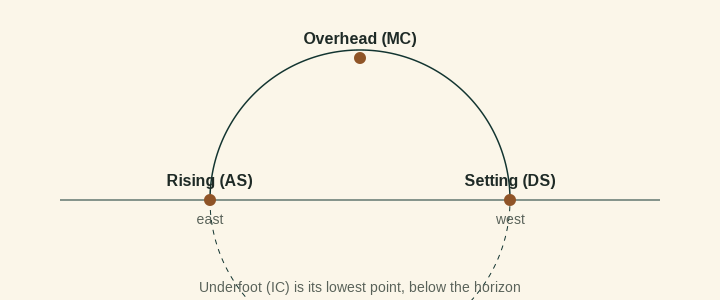
The body gives the theme and the AC gives the setting, which is how you present yourself. Here is what astrologers connect each pairing with:
- Sun on the AC: a strong sense of self, confidence and being noticed when you walk in
- Moon on the AC: a sensitive, open side that shows feeling, with a link to comfort and daily habits
- Mercury on the AC: a talkative, curious way of coming across, with ideas and conversation at the front
- Venus on the AC: charm, warmth and a wish for things to look and feel pleasant
- Mars on the AC: energy, directness and a push to start things first
- Jupiter on the AC: an optimistic, generous way of coming across, and a sense of room to grow
- Saturn on the AC: a serious, reserved first impression, with a link to responsibility and steady effort
- Uranus on the AC: an independent, unusual side that stands apart, with sudden changes in how you present yourself
- Neptune on the AC: a soft, imaginative way of coming across, with a link to art and to blurred edges between you and others
- Pluto on the AC: an intense presence, with a link to deep change in how you see yourself
The North Node and Chiron also have AC lines. The North Node is not a planet but a calculated point. It sits where the Moon's orbit crosses the ecliptic as the Moon moves north, and astrologers read it as a direction you are invited to grow in. On the AC, that points to growing into a new way of presenting yourself. Chiron is a small object whose orbit lies mostly between Saturn and Uranus, and astrologers connect it with tender spots and the understanding that can come from them. On the AC, that points to feelings about how you are seen.
Astrologers do not all agree on how to rank these. Some call Jupiter, Venus and the Sun the easiest AC lines and Saturn, Mars and Pluto the most demanding. Treat that as an opinion, since what a line feels like depends on you. For the other three angles of each body, see Line Meanings.
Easier and harder ways an AC line can read
Astrologers describe most themes with two sides. An AC line is no different. The same body can show up as a strength in one person and as a strain in another.
Here is how some of them are described for the pairings above:
- Venus on the AC: easy charm and warmth, or a habit of smoothing things over to keep the peace
- Jupiter on the AC: a generous, welcoming manner, or taking on more than you can finish
- Sun on the AC: natural confidence, or a need to be the center of the room
- Saturn on the AC: a calm and dependable manner, or a guarded one that others find hard to read
- Mars on the AC: a bold start to things, or a sharp edge that comes across as impatience
- Pluto on the AC: a strong presence that people remember, or an intensity that feels like too much
Which side you notice depends on you and on the rest of your chart. A hard-sounding line can be just what a person wants. Someone who needs to look more serious at work may enjoy a Saturn AC line. Treat these as questions to hold, not as a verdict on a place.
How close an AC line has to be
A line only matters for a city if it runs near it. On this site, a line through a city counts in full, and the share falls off fast with distance. At 100 km (62 mi) it still counts for 92%. At 350 km (217 mi) it counts for 37%, and past 1,000 km (621 mi) it is not counted at all.
An AC line curves, so the gap to a city is the shortest distance from the city to the line, which is not always east or west. A Moon AC line 22 km (14 mi) from a city is part of that city's character, as astrologers see it. The same line 600 km (373 mi) away is a faint background note. The full table is on How we calculate.
Visiting or living near an AC line
Astrologers do not agree on how long to stay near a line. Some say a short trip is the best way to meet a theme, since you can test how it feels and leave. Others say the theme grows clearer over months, when daily routine begins to show it.
Living there is a bigger step. Rent, work, visas and the people around you will shape your days far more than a line does. If a trip leaves you curious, you can look at the same city on the relocation chart, which shows your rising sign for that place. For ideas on how to use a line when you plan a trip, see astrology travel.
How AC lines count in the rankings
The site scores each city for three goals: love, career and home. A line's score is the body weight times the angle weight times the distance share. The AC weight in each goal is:
| Goal | AC weight |
|---|---|
| Love | 1 |
| Career | 0.8 |
| Home | 0.8 |
For love, the AC is the second largest of the four angles, behind the setting line at 1.2. For career, it is the second largest, behind the overhead line at 1.3. For home, it is also the second largest, behind the underfoot line at 1.3. So the AC is not the top angle for any goal, but it counts for a good amount in all three.
Because the body weight multiplies the angle weight, each body's AC line adds a different amount. This table shows a line right through a city, at 0 km:
| Body on the AC | Love | Career | Home |
|---|---|---|---|
| Sun | 0.3 | 0.64 | 0.24 |
| Moon | 0.5 | 0.08 | 0.8 |
| Mercury | 0.1 | 0.36 | 0.08 |
| Venus | 1 | 0.16 | 0.48 |
| Mars | 0.25 | 0.32 | -0.48 |
| Jupiter | 0.45 | 0.8 | 0.56 |
| Saturn | -0.6 | 0.28 | -0.32 |
| Uranus | -0.2 | 0.08 | -0.4 |
| Neptune | -0.2 | -0.16 | -0.2 |
| Pluto | -0.5 | -0.08 | -0.48 |
| North Node | 0.2 | 0.2 | 0.12 |
| Chiron | -0.2 | -0.12 | -0.16 |
Venus leads for love, Jupiter and the Sun lead for career, and the Moon leads for home. Saturn, Pluto, Uranus, Neptune and Chiron count against a city in the love list. These are our own scoring choices, set with astrological tradition as the guide, and they are not warnings about any place. A Saturn AC line may suit someone who wants a serious, steady side to show, and that person may reasonably like a city that the list puts lower. The full weights are on the method page. The overall ranking is the average of the three goals.
What the evidence says about AC lines
The AC line is the half of astrocartography that can be checked. Where a body was rising at your birth follows from the date, time and place, and anyone with the same method gets the same curve. What the line means is the other half, and it rests on astrological tradition.
We know of no scientific evidence that living near a line changes anything in a life, and this site does not claim any. That is why each theme above is written as what astrologers connect with a line, and why the rankings are our own scoring choices. Is astrocartography real? covers what is known and what is not.
An example from Maya's map
Maya was born on June 10, 1990, at 2:30 PM in New York. Her map has several AC lines that show up in the sample figures on this site.
Her Moon AC line passes 22 km (14 mi) from Tbilisi, Georgia. At that distance the line counts almost in full, which is about 0.50 for love and 0.80 for home. Together with her Venus underfoot line, 18 km (11 mi) away, it puts Tbilisi first on her list overall, and for love and for home. Seen by an astrologer, the Moon on the AC pairs emotional ease with how Maya comes across, and Venus underfoot pairs affection with home.
Her Saturn AC line passes 379 km (235 mi) from Tbilisi. The line counts for about 31% at that distance, so it is worth about -0.19 for love. It is a quieter note next to the two close lines.
Her Mercury AC line is 219 km (136 mi) from Tokyo, where it counts for about 68%. Her Pluto AC line runs 943 km (586 mi) from Brasília, Brazil, which is so far out that it adds almost nothing.
Notice that one city can sit near both a rising line and a line of another angle. A first city for love does not have to be near only one kind of line.
Reading several AC lines near one city
Two or more AC lines can sit near the same city, when the bodies were rising at about the same place. Here is a way to read them:
- Moon and Venus together: a warm, easy way of coming across, which many astrologers read as one theme
- Sun and Jupiter together: a confident, generous presence with room to grow
- Saturn with any other body: the other theme, with a more serious and reserved tone
- an AC line next to a DC line of another body: how you come across on one side and the people you draw close on the other, so read the closer one first
Where the lines point in different directions, ask which of the two is closer, and treat the further one as a background note. When both are about the same distance, give them equal weight. It helps to ask how you want to come across in that place.
Birth time and your AC line
Every line depends on a good birth time, and the AC curve is no exception. The Earth turns as the minutes pass, so a small error can shift the whole curve by a visible amount. A 10 minute error moves it by about 2.5 degrees, roughly 278 km (173 mi) at the equator.
That can be enough to carry the line past a city, or away from one. To check how firm a reading is, try the map with a time a few minutes earlier and a few minutes later. If a city stays near the line in each case, the reading is steady. If it flips from near to far, treat that city's AC theme as a soft one.
How to find your own AC lines
To see where yours run, you need your birth date, time and place. The time matters here, because the Earth turns one degree every 4 minutes and the line shifts with it. That is about 111 km (69 mi) at the equator, so a rounded birth time can carry an AC line across a city.
Then follow these steps:
- Draw your map and use the switch for each body to leave only the lines you want to study
- Pick the solid, curved lines, which are the AC lines. The dashed curved lines are the DC lines
- Select a city that matters to you, such as where you live now or a place you are thinking about
- Read which AC line is closest, which body it belongs to and how many kilometers away it runs
- Switch to the love goal to see which cities your AC lines lift in the list
If you do not know your birth time, the map draws the lines for 12 noon as an example only and does not rank cities. If no AC line is near a place, that tells you only that no body's theme is especially stressed in how you come across there. Astrologers would not read that as good or bad. Your birth chart carries on as it always has.
A worksheet for one city
A short worksheet turns the map into notes you can compare between cities. Fill in one line per AC line near the place:
- Body: which planet or point is it?
- Distance: how many kilometers away does it run?
- Share counted: 100% at 0 km, 92% at 100 km, 37% at 350 km, none past 1,000 km
- Theme: the sentence astrologers connect with that body on the AC
- Your reaction: does that theme sound like how you want to come across there?
Do the same for the second and third closest AC lines, then place the DC lines beside them. After a few cities, the pattern in your notes is usually clearer than any single number. Nothing here is hidden, since the weights behind the rankings are all on the method page.
Questions to ask yourself
A line gives you a theme. These questions turn it into something you can use:
- how do I want to come across in a new place?
- do I want to be noticed straight away, or to take my time?
- is there a side of me that I would like to show more of, or less of?
- when I visit, does the place make me feel more like myself, or less?
- would I want this place for a year, for a season or for good?
Your answers matter more than the line does. If you want a place that matches how you want to come across, an AC line near a city may be a reason to visit and take a look. If you want to compare the goals before you choose, the guide to choosing where to live shows how they differ.
FAQ
What is the AC line in astrocartography?
It is a curved line that marks the places where a body was rising over the eastern horizon at your birth. Astrologers connect it with self-image, first impressions and how you start things. On this site it is called the rising line, and each of the 12 bodies has one.
Is the AC line the same as the Ascendant line?
Yes, they are the same line. AC is short for Ascendant, and some maps write it as AS, as this site does. Your rising sign is different. It is one sign for one place, while an AC line is a curve across the whole map for one body.
What does an AC line mean?
Astrologers read it as a place where a body's theme comes to the front of how you come across. Venus points to charm, the Sun to confidence and Saturn to a reserved first impression. It is a symbolic theme, not a forecast, and no line can decide anything for you.
What is the best AC line?
There is no best one, because it depends on what you are after. In this site's love ranking, Venus counts most, followed by the Moon. For career, Jupiter and the Sun count most. Test the theme against your own sense of a place.
How close does an AC line need to be?
The closer, the more it counts. On this site a line through a city counts in full, 100 km (62 mi) away it counts for 92%, and 350 km (217 mi) away for 37%. Past 1,000 km (621 mi) it is not counted at all.
What is the difference between an AC line and a DC line?
They belong to the same body, but the DC line marks where that body was going down in the west. Astrologers connect the AC with how you come across and the DC with the people you draw close. Both are curved, and the DC line is dashed on this map. See the DC line page for the setting side.
How is the AC counted for love, career and home?
The AC weight is 1 for love and 0.8 for career and home. For love, only the setting line counts more, at 1.2. For career the overhead line leads at 1.3, and for home the underfoot line leads at 1.3.
How do I find my AC lines?
Enter your birth date, time and place in the map on this page. The solid, curved lines are the AC lines. Select a city to see the closest one, its body and its distance, and switch to the love goal to see the ranking it affects.
Does my birth time change my AC line?
Yes. An AC line moves as the birth time changes, by about 1 degree for every 4 minutes. That is roughly 111 km (69 mi) at the equator. Use the most exact time you can find, and try a few minutes either side if you are unsure.
Is there any evidence that AC lines work?
Where a body was rising is exact astronomy, but the meaning rests on astrological tradition. No scientific evidence shows that living near a line changes anything. This site treats AC lines as themes to think about, not as proof.
Should I visit my AC line or live there?
Astrologers differ. Some prefer a short visit, since you can test how a place makes you feel and then leave. Others say a theme shows more over months. Because the AC is about how you come across, a trip is a fair first test.
Is a Saturn AC line bad?
Astrologers do not call it bad. They connect it with a serious, reserved first impression and with steady effort. Some people enjoy that, and others find it heavy. In this site's love list Saturn counts against a city, and that is a scoring choice and not a warning.
Where should your next chapter unfold?
Match your current priorities with your natal planetary lines in under a minute.
What are you optimizing for right now?
Related tools
Line Meanings
Every line is a pairing of one body and one angle, and this page explains both halves, with examples from a real map.
DC Lines
Your DC lines mark the places where each planet was setting on the western horizon when you were born. Astrologers, who also call this the Descendant or setting line, connect it with partners, one-to-one ties and working together. This page covers what each planet on the DC points to, how close a line has to run, and how DC lines count in the rankings. Then you can draw your own map above.
Map Symbols
Each line on an astrocartography map is a pairing of a body and an angle, and the symbols tell you which. On this map, color names the body, solid or dashed names the angle, and AS, DS, MC and IC are the 4 angle codes. Draw your own map to see them on your birth details.
Rising Sign Calculator
Enter your birth details to get your rising sign, then pick any city to see the rising sign your chart would have there.
Astrocartography Calculator
This astrocartography calculator takes your birth date, time and place. It draws your 48 planetary lines on a world map and names the city your lines point to first, with the reasons. It is free and needs no account. You can also look up any place to see the lines near it.
Career Map
Enter your birth details and the map sorts cities by the lines astrologers tie to work, with the overhead line counting most. You do not need to know what any line means, because the result names your first city and the lines behind it.
Love Map
Enter your birth details and the map sorts itself by the lines astrologers tie to affection. You do not need to know what any line means.
Chiron Lines
Your Chiron lines mark the places where Chiron, a small body between Saturn and Uranus, was rising, setting, overhead or underfoot at your birth. Astrologers connect them with sensitive spots and what you learn from them. This page explains each line, how far away it can be and still count, and why this site's rankings count Chiron a little against a city. Then you can draw your own map above.