Mars line in astrocartography: what each of the 4 lines points to
Your Mars lines mark the places where Mars was rising, setting, overhead or underfoot at your birth. Astrologers connect them with drive, effort, competition and physical energy. This page explains each line, how far away it can be and still count, and how this site's rankings weigh Mars. Then you can draw your own map above.
How it works
Draw your map
Enter your birth date, time and place. All 48 lines appear, and you can switch the lines on and off body by body to leave only Mars.Select a place and read the nearest line
Choose a city that matters to you. See which Mars line is closest, which angle it is and how many kilometers away it runs.Compare with the other lines nearby
Check for a Venus, Jupiter or Sun line close to the same place, and read the closest line first. The tool writes out what astrologers connect each one with.
A Mars line in astrocartography marks places where Mars was on one of the 4 angles at your birth. Astrologers connect these lines with drive, competition and physical energy. Mars rising points to a direct, energetic way of meeting people, Mars setting to competition in one-to-one dealings, Mars overhead to ambition in your public side, and Mars underfoot to restless energy at home. How close the line runs matters, and this site's rankings give Mars a weight of 0.4 for career and a negative weight of -0.6 for home.
What a Mars line is
Mars has 4 lines on your map, one for each angle: rising, setting, overhead and underfoot. Each marks the places on Earth where Mars was at that point in the sky when you were born. The positions are astronomy. The meanings come from astrological tradition, and nothing scientific shows that living near a line changes anything in your life.
Astrologers connect Mars with drive, effort, courage, competition and physical energy. It is the body they look at when they ask how you go after what you want and how you respond when something stands in your way. Near a Mars line, they tend to say, those themes come forward. Some people describe such a place as energizing, a spot that gets them moving. Others find the same pace tiring and prefer somewhere calmer. Both are fair readings of the same line.
Nothing on this page says what will happen to you. It tells you what astrologers connect each line with, so that you can decide how much weight to give it. If you are new to the idea of lines, What is astrocartography explains how the 48 lines come from one birth moment.
The 4 Mars lines, one at a time
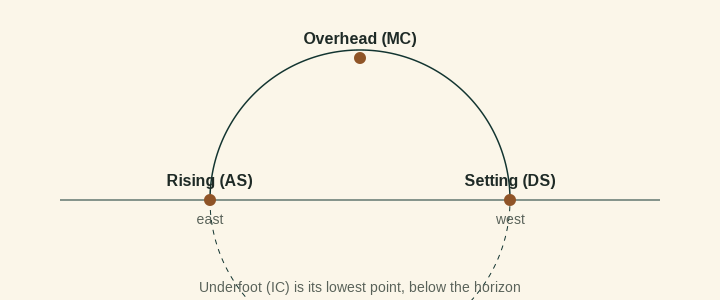
The body sets the theme, and the angle sets the part of life where it shows up. Some sites call the angles ASC, MC, DSC and IC. They are the same four lines. For Mars, astrologers tie the four angles to these things:
- Mars rising (ASC): a direct, energetic way of meeting people, with a quick start on new things and a taste for taking the lead
- Mars setting (DSC): drive and competition in one-to-one dealings, such as partners, clients and rivals, with a lively give and take
- Mars overhead (MC): effort and ambition in your public side, which astrologers link with work that rewards initiative, speed and stamina
- Mars underfoot (IC): energy and restlessness at home, with a push to rebuild or defend your space, and sometimes friction with the people who share it
Astrologers do not all agree on which of the four is easiest to live with. Many look at the overhead line first, since drive and ambition have a clear outlet in work. The underfoot line is the one people most often describe as hard to relax in, because it puts the theme in the place where most of us want to rest. Neither reading is a rule. For the other eleven bodies on all four angles, see Line Meanings.
What Mars is tied to in a reading
Mars is the body astrologers use to talk about action, so a Mars line is a natural place to ask how much push you want in a place. These are the themes they connect with it:
- getting started, and the courage to try something
- competition, and the wish to win or to measure yourself against others
- physical energy, such as sport, training and staying active
- anger and impatience, and how you handle them
- standing up for yourself and defending what is yours
Some of those themes are useful and some are uncomfortable, and one person can feel both. A person who wants a busy, ambitious stretch of life may like a Mars line near the city they are considering. A person who wants rest may choose to keep their distance. A line cannot tell you which of you that is. It gives you a question to hold.
Is a Mars line good or bad?
Astrologers do not sort Mars lines into good and bad. Mars is tied to drive, and drive has a useful side and a rough side. Which one you meet depends on what you bring to the place.
The useful side is energy, courage and a push to finish things. The rough side is impatience, friction and a short temper. A person who has felt stuck may enjoy a Mars line, because it gives a place a bit of momentum. A person who is already stretched may find the same line wearing.
This site's scoring gives Mars a small weight for love (0.25), a middling one for career (0.4) and a negative one for home (-0.6). That is our own choice, set from the astrological link between Mars and restless energy. It is not a verdict on a city.
How close a Mars line has to be
Distance matters as much as the line itself. On this site, a line passing through a city counts in full, and the share counted falls quickly as you move away. At 100 km (62 mi) it still counts for 92%. At 350 km (217 mi) it counts for 37%, and past 1,000 km (621 mi) it is not counted at all.
So a Mars line 20 km (12 mi) from a city is part of that city's character, as astrologers see it. A Mars line 600 km (373 mi) away is a faint background note, counted at about 5%. When you read a place, take the closest line first and ask how far it really is. How we calculate shows the full table.
How Mars lines count in your city ranking
Mars is the one body with a positive weight for love and career and a negative weight for home. The weights are our own, set with astrological tradition as the guide, and they are published in full on the method page:
| Goal | Mars weight |
|---|---|
| Love | 0.25 |
| Career | 0.4 |
| Home | -0.6 |
For career, Mars has the fourth largest weight of any body, behind Jupiter, the Sun and Mercury. For love it is a small positive weight. For home it is negative, and only Pluto shares the same number.
A negative weight means a Mars line takes a little away from a city's home score. That is a choice in how this site scores, not a warning about any place. It reflects the astrological habit of linking Mars with restless energy, which some people do not look for in the place where they rest. Someone who likes a lively home may reasonably weigh it the other way.
The angle then adjusts how much that weight matters. The angle weights are 1 for rising, 1.2 for setting, 0.5 for overhead and 0.7 for underfoot on love; 0.8, 0.5, 1.3 and 0.3 on career; and 0.8, 0.6, 0.3 and 1.3 on home. Multiply the two numbers and you get the most a Mars line can add to or take from a city before distance is taken into account:
| Line | Love | Career | Home |
|---|---|---|---|
| Mars rising | 0.25 | 0.32 | -0.48 |
| Mars setting | 0.3 | 0.2 | -0.36 |
| Mars overhead | 0.125 | 0.52 | -0.18 |
| Mars underfoot | 0.175 | 0.12 | -0.78 |
Read the table by goal. For career, the overhead line is the largest entry, at 0.52, which matches the astrological habit of looking at the overhead line for work and public life. For love, the setting line leads at 0.3, since astrologers tie that angle to one-to-one ties. For home, the underfoot line has the largest number in size, at -0.78, because that angle carries the most weight on the home goal. The overall ranking is the average of the three goals, so a Mars line moves the final list less than these single numbers suggest.
This is a scoring choice, not a promise about any place. A city that the ranking puts lower may still suit you better, and the list works best as a set of themes to think about. To see how the goals compare, the guide to choosing where to live walks through them one by one.
Mars overhead for business and bold careers
Many astrologers look at the overhead line first for work. With Mars, they connect it with starting things, competing and working fast. So a Mars overhead line is often discussed by people who want to launch a business, lead a team or work in a field that rewards stamina, such as sport.
The rising line gets a different reading. It is about how you meet people, so Mars rising is described as a direct, energetic first impression. Where Mars overhead points to the work you are known for, Mars rising points to the manner you bring into a room. Some athletes and performers look at the rising line for that reason.
On this site, the overhead line is also the largest Mars entry for career, at 0.52 before distance is applied. That is a scoring choice. A new business depends on money, timing and the people around you much more than on a line. For the overhead angle in general, whichever body sits on it, see the MC line page.
An example from Maya's map
Maya was born on June 10, 1990, at 2:30 PM in New York. Her Mars setting line is 295 km (183 mi) from New York, and it is one of the 6 lines in the list for that city.
At 295 km, the line counts for about 49%. On the love goal that comes to roughly 0.25 × 1.2 × 0.49 = 0.15. On the career goal it comes to 0.4 × 0.5 × 0.49 = 0.10, and on the home goal to -0.6 × 0.6 × 0.49 = -0.18. Averaged over the 3 goals, the Mars setting line adds about 0.02 to New York's overall score, so on the overall list it nearly cancels out.
In the reading guide, the Mars setting line is described as drive and competition in one-to-one dealings. It sits in a blend with Neptune underfoot at 218 km (135 mi) and Uranus underfoot at 273 km (170 mi), which are nearer. The example shows what a Mars line usually does in a reading. It adds one note to a place where nearer lines set the tone. Do not stop at whether a Mars line is present. Read how far away it runs and which goal you care about.
When a Mars line sits next to other lines
Mars often shares a place with other lines, and the combination is worth reading as a pair. Here is a way to read a few common pairings, one at a time:
- Mars with Venus: drive beside affection and enjoyment, which astrologers read as passion and a lively social life
- Mars with Jupiter: effort beside growth and new chances, a mix astrologers tie to ambition that has room to grow
- Mars with the Sun: energy joined to confidence and a strong sense of self, so your own presence may stand out
- Mars with Saturn: drive beside patience and structure, which astrologers read as steady effort on long projects
- Mars with the Moon: action beside feeling, which some people find motivating and others find edgy
When the two lines are about the same distance from a city, give each equal weight. If one is much nearer, it leads and the other is a background note. The Jupiter lines and Saturn lines pages cover two of those partners at length.
Why your Mars lines can differ between maps
This site draws lines in mundo by default, which follows the body's real position in the sky. The other method, Zodiacal, uses only its degree along the zodiac. For the Sun the two agree. For Mars, as for the Moon through Mars, the gap on our sample map is usually under about 300 km (186 mi).
That is small next to a distance table that falls from 92% at 100 km (62 mi) to 37% at 350 km (217 mi), but it can still move a Mars line past a city. Another site may show your Mars line in a slightly different place even if both are correct for the method each uses. Pick one method and keep it when you compare cities. You can switch between the two on this site and see the gap for yourself. How we calculate explains the difference.
A short visit or a long stay
Astrologers do not agree on how long to stay near a Mars line. Many suggest that Mars suits shorter stays better than long ones. The idea is that drive feels exciting at first, and it can become tiring when it is there every day. Others say some people thrive on it for years.
A short trip is a simple test. Ask whether you feel energized or on edge, and whether you sleep and rest well. If a Mars line comes up in a place you plan to visit, the astrology travel page shows how to plan around lines.
Mars lines, conflict and accidents
Some writers link Mars lines with arguments, accidents and risk. Mars is the body astrologers tie to force, speed and conflict, so the idea comes from the symbol. It is not something a line can show about a real place.
No scientific evidence shows that living near a Mars line makes accidents or fights more likely. A line is a theme to notice, and it cannot say what will happen to anyone. How safe a place is depends on things a map of lines cannot see, such as local conditions, traffic and your own habits.
Reading a Mars line with care
Mars themes are easy to misread, because drive and energy sound useful in almost any place. A Mars line is not a sign that you will work harder or win more there. It is a theme that astrologers pay attention to, and it gives you a question to hold, not a prediction.
It also helps to separate a theme from a plan. A Mars line near a city is a reason to look at it more closely. It does not replace what you know about work, cost of living, language, visas and the people you would live near. Those things are outside what a map of lines can see, and they matter more than any line.
If you have no Mars line near a place, that tells you only that Mars's themes are not especially stressed there. Astrologers would not read it as good or bad. Your birth chart carries on as it always has.
Your Mars line and your Mars sign
Think of the sign as how Mars behaves in you, and the line as where on Earth it points. Your Mars sign is fixed at birth and stays the same in every city. Astrologers use it to describe how you act and speak when you are pushed. The line depends on the place you look at. Someone with a blunt Mars sign may feel a line more strongly, and someone with a gentle one may notice it less. Astrologers read the two together.
To see how Mars sits in a particular city, a relocation chart shows your rising sign and Mars's house there. It gives a view of the same place from the chart itself and not from a line.
How to look at your own Mars lines
To see where yours run, you need your birth date, time and place. The time matters. A difference of 4 minutes moves every line by about one degree, roughly 111 km (69 mi) at the equator, so a rounded birth time can move a Mars line past a city.
Then follow these steps:
- Draw your map and turn on only the Mars lines, using the switch for each body. Mars is drawn in dark maroon
- Select a city that matters to you, such as where you live now or a place you are thinking about
- Check which Mars line is closest, which angle it is, and how many kilometers away
- Read what astrologers connect that line with, and ask whether the theme fits what you want
- Look at the Venus, Jupiter and Sun lines nearby to see what else is in the picture
Venus is drawn in raspberry red, close to Mars, so check the name in the line list when two reds run together. If you are more interested in how your chart changes in a new city, a relocation chart shows your new rising sign and houses there.
Questions to ask yourself
A line gives you a theme. These questions turn it into something you can use:
- do I want a place that gives me energy and a push, or one that lets me slow down?
- is there a goal I want to chase, and would a busy place help?
- how do I feel in competitive settings: sharper, or worn out?
- would I want a Mars city for a visit, for a year or for good?
- when I visit, do I feel motivated, or restless?
Your answers matter more than the line does. If you want a place that supports ambitious work, a Mars overhead line near a city may be a reason to visit and take a look. If you want rest and ease at home, you may prefer a Moon or Venus line, and the Moon lines page compares the home side in more detail.
FAQ
What does a Mars line mean in astrocartography?
Astrologers connect it with drive, effort, competition and physical energy. The angle decides the part of life: rising for how you come across, setting for one-to-one dealings, overhead for work and public life, underfoot for home. It is a symbolic theme, not a forecast.
Is a Mars line good for work?
Astrologers often look at Mars overhead first for work that rewards initiative and stamina. On this site Mars has a career weight of 0.4, and the overhead line is its largest at 0.52 before distance. It is a scoring choice, not a promise.
Why does Mars have a negative weight for home?
Mars has a home weight of -0.6, so a Mars line takes a little from a city's home score. This is how our rankings score, set from the astrological link between Mars and restless energy. It is not a warning about any place.
How much does Mars count in the city rankings?
Mars has a weight of 0.25 for love, 0.4 for career and -0.6 for home. Its career weight is the fourth largest of any body, behind Jupiter, the Sun and Mercury. The weights are our own and are published on the method page.
How close does a Mars line need to be?
The closer, the more it counts. On this site a line through a city counts in full, 100 km (62 mi) away it counts for 92%, and 350 km (217 mi) away for 37%. Past 1,000 km (621 mi) it is not counted at all.
Which Mars line is the strongest in the rankings?
For career, Mars overhead, at 0.52 before distance is applied. For love, Mars setting, at 0.3. For home, Mars underfoot has the largest number in size, at -0.78, which takes the most from a city's home score.
Why do other sites show my Mars line somewhere else?
This site draws in mundo by default and can switch to Zodiacal. For Mars the two usually differ by under about 300 km (186 mi) on our sample map. A rounded birth time can also shift a line. Keep one method when you compare cities.
Can I see only my Mars lines on the map?
Yes. Lines can be switched on and off body by body, so you can leave just Mars, or just Mars and Jupiter. Selecting a place also lists every line within 1,000 km (621 mi) with its distance.
Do Mars lines cause accidents or conflict?
No scientific evidence shows that they do. Astrologers tie Mars to force, speed and friction, so some writers link the lines with risk. It is a symbol and not a forecast. For real safety, check official travel advice for the place.
Is a Mars line good or bad?
Astrologers treat it as neither. Mars is tied to drive, which can feel energizing or tiring. Many people enjoy the push, and others prefer a calmer pace. The line gives you a theme to think about.
Is Mars overhead good for starting a business?
Astrologers tie Mars to the first step and to speed, so some look at Mars overhead for the start of a venture, such as opening a shop or going freelance. They add that Mars is not tied to patience, and that staying power matters more than a fast start. A business depends far more on money, timing, local rules and the people around you than on any line.
How long should I stay near a Mars line?
Astrologers differ. Many suggest shorter stays, since the theme of drive can feel tiring when it is there every day. Others say some people thrive on it for years. A short visit is a simple way to see how it feels.
Where should your next chapter unfold?
Match your current priorities with your natal planetary lines in under a minute.
What are you optimizing for right now?
Related tools
Line Meanings
Every line is a pairing of one body and one angle, and this page explains both halves, with examples from a real map.
MC Lines
Your MC lines mark the places where each planet stood at its highest point in the sky when you were born. Astrologers, who also call this the Midheaven line, connect it with career, public image and reputation. This page covers what each planet on the MC points to, how close a line has to run, and how MC lines count in the rankings. Then you can draw your own map above.
How to Read Your Map
Draw your own map above, then follow 5 steps that turn a tangle of lines into a plain reading of any one place.
How we calculate
Here is how each line is calculated, what our tests found, and how a city earns its place, with the numbers left in.
AC Lines
Each AC line marks the places where one planet was rising over the eastern horizon when you were born. Also called the Ascendant or rising line, it is one that astrologers connect with self-image, first impressions and how you start things. This page covers what each planet on the AC points to, how close a line has to run, and how AC lines count in the rankings. Draw your own map above to see where yours fall.
Astrocartography Calculator
This astrocartography calculator takes your birth date, time and place. It draws your 48 planetary lines on a world map and names the city your lines point to first, with the reasons. It is free and needs no account. You can also look up any place to see the lines near it.
Career Map
Enter your birth details and the map sorts cities by the lines astrologers tie to work, with the overhead line counting most. You do not need to know what any line means, because the result names your first city and the lines behind it.
Love Map
Enter your birth details and the map sorts itself by the lines astrologers tie to affection. You do not need to know what any line means.