Astrocartography symbols: what the lines, colors and codes mean
Each line on an astrocartography map is a pairing of a body and an angle, and the symbols tell you which. On this map, color names the body, solid or dashed names the angle, and AS, DS, MC and IC are the 4 angle codes. Draw your own map to see them on your birth details.
How it works
Draw your map
Enter your birth date, time and place. The map shows all 48 lines, 4 for each of 12 bodies, each body in its own color.Name the body and the angle
Match the color to a body in the key under the map. Then check if the line is solid or dashed and straight or curved to name the angle.Select a place for the meaning
Select a spot on the map or look up a city. You see each line within 1,000 km (621 mi), its distance and what astrologers connect it with.
Astrocartography symbols are a shorthand for a body and an angle. On this map, a line's color tells you the body, such as the Sun or Venus, and solid or dashed tells you the angle. The codes AS, DS, MC and IC stand for the rising, setting, overhead and underfoot lines. Lines carry no text, so use the color key under the map and select a place to see what each one means.
Two things to read on every line
Every line on an astrocartography map says two things. The first is which body it belongs to: the Sun, the Moon, a planet, the North Node or Chiron. The second is which of 4 moments it marks: rising, setting, overhead or underfoot. Once you can tell those two apart, the rest of the map follows. Symbols are the shorthand for them. A planet symbol, called a glyph, names the body. A short code such as MC names the moment.
Maps from different makers show these in different ways. Some print a glyph and a code at the end of each line. Others use only colors and line styles and leave you to work out the rest. This page explains the symbols that are standard in astrology, and then describes exactly how this site's map draws them, so you can read it without a key.
How this map draws its lines
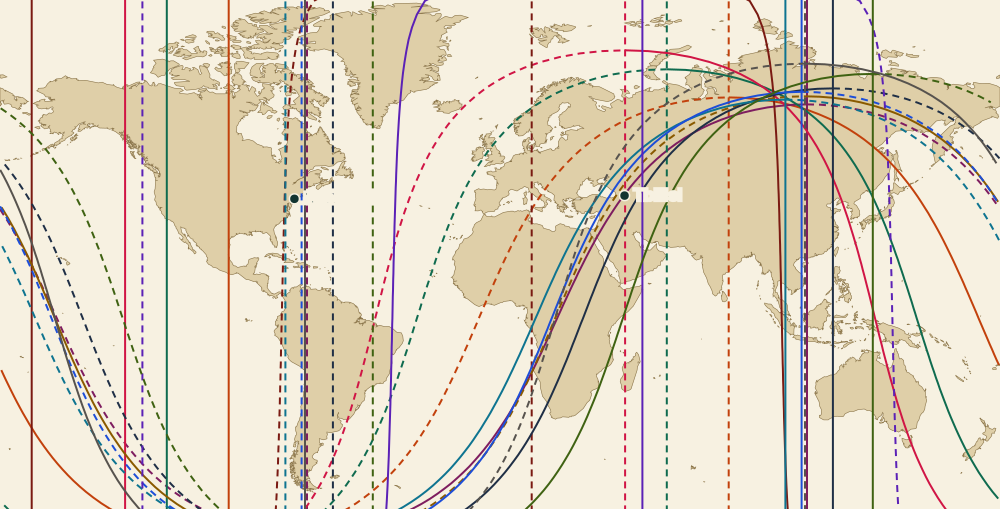
On this site the map does not print glyphs or words along the lines. A line is told apart by 3 things you can see:
- color, which tells you the body
- solid or dashed, which tells you the angle
- thickness and fade, which tell you what you are looking at right now
Each of the 12 bodies has its own color, and its 4 lines all share it. A body's rising and overhead lines are solid. Its setting and underfoot lines are dashed. So a dashed red line and a solid red line are the same body at 2 different angles.
The only words on the map itself are the pins. A pin is a dark dot with a name beside it, such as a city you looked up, or Here for a place you selected.
What the line styles mean
| Line style | Angle | Code | Shape on a flat map |
|---|---|---|---|
| Solid, curved | Rising line | AS | A long curve that bends across the map |
| Dashed, curved | Setting line | DS | A long curve that bends across the map |
| Solid, straight | Overhead line | MC | A straight north-to-south line |
| Dashed, straight | Underfoot line | IC | A straight north-to-south line |
The shape gives you a second check. If a line runs straight up and down, it is an overhead or underfoot line. If it curves, it is a rising or setting line. Solid or dashed then settles which of the two it is. The reason for the shapes is simple. At any moment a body is at its highest point along one north-south strip of the Earth, so those lines are straight. Rising and setting depend on the horizon, which sweeps around the globe in a curve.
What the colors mean
Colors are grouped loosely by kind of body. The Sun and Jupiter are warm. The Moon, Venus and Mars lean to reds and plum. Mercury and the North Node are greens. The slower outer bodies are cool. Here is every color on the map:
| Body | Color on this map |
|---|---|
| Sun | Burnt orange |
| Moon | Plum |
| Mercury | Green |
| Venus | Raspberry red |
| Mars | Dark maroon |
| Jupiter | Brown gold |
| Saturn | Dark navy |
| Uranus | Teal |
| Neptune | Blue |
| Pluto | Violet |
| North Node | Olive green |
| Chiron | Gray |
Some of these sit close together. Venus and Mars are both red, and Saturn and Neptune are both deep blue. That is why the map has a color key under it, and why it lets you pick one body at a time. More on that in a moment.
The 4 angle codes: AS, DS, MC and IC
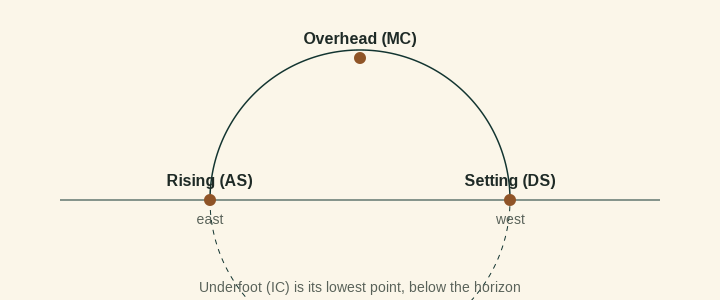
The codes come from the birth chart, where the same 4 points mark the edges of the sky at the moment of birth. A map line is the set of places where a body sits on one of those points. Here is what each code stands for, and what astrologers connect it with:
| Code | Short for | This site calls it | Astrologers connect it with |
|---|---|---|---|
| AS | Ascendant | Rising line | First impressions and how you meet new situations |
| DS | Descendant | Setting line | One-to-one ties with partners, clients and friends |
| MC | Medium Coeli (middle of the sky) | Overhead line | Your public side and the goals you aim at |
| IC | Imum Coeli (bottom of the sky) | Underfoot line | Roots, home and your private base |
You will also see AC for the Ascendant and DC for the Descendant on other maps and in other books. They mean the same thing. This site uses AS and DS.
Many readers like to picture the sky as a clock face. The AS sits on the eastern edge, where bodies come up. The MC is the top, where they stand highest. The DS is on the western edge, where they go down. The IC is the bottom, beneath your feet. The four-angle diagram above shows this layout.
Planet symbols and how they match the colors
Astrologers write each body with a small glyph. The glyphs are the same on every map and in every birth chart. This site does not draw them on the lines, so the table links each glyph to the name and color you will see here:
| Glyph | Body | Color on this map |
|---|---|---|
| ☉ | Sun | Burnt orange |
| ☽ | Moon | Plum |
| ☿ | Mercury | Green |
| ♀ | Venus | Raspberry red |
| ♂ | Mars | Dark maroon |
| ♃ | Jupiter | Brown gold |
| ♄ | Saturn | Dark navy |
| ♅ | Uranus | Teal |
| ♆ | Neptune | Blue |
| ♇ | Pluto | Violet |
| ☊ | North Node | Olive green |
| ⚷ | Chiron | Gray |
The North Node is not a planet but a calculated point. It sits where the Moon's orbit crosses the ecliptic as the Moon moves north. Chiron is a small object whose orbit lies mostly between Saturn and Uranus. Both get lines here, so you will find 12 colors and 48 lines in all. For what astrologers connect with each body, see Line Meanings.
Reading one line with the key
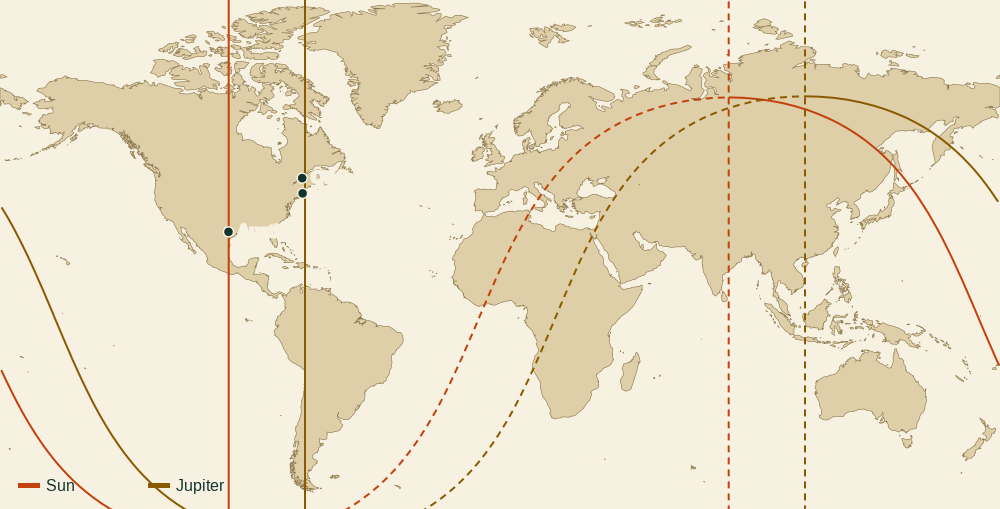
Take Maya, whose birth details are 2:30 PM on June 10, 1990, in New York. Say you spot a burnt-orange line that runs straight north and south, and it is solid. Orange tells you it is the Sun. Straight means it is an overhead or underfoot line, and solid makes it the overhead line, or MC. So you are looking at the Sun on the MC. On Maya's map, that line passes 9 km (6 mi) from Austin. Astrologers connect the Sun with vitality and confidence, and the MC with the public side, so they would describe this as a place where being seen and recognized stands out.
Now look at a brown-gold line, also straight and solid. That is Jupiter on the MC. Maya's Jupiter overhead line is 72 km (45 mi) from Boston and 21 km (13 mi) from Antofagasta. Astrologers connect Jupiter with growth and new chances. Together with the MC, that is the pairing they often look at first when thinking about career.
A plum line that is straight and dashed is the Moon on the IC, the underfoot line. Maya's passes 13 km (8 mi) from Barquisimeto. Astrologers connect the Moon with feeling safe and the IC with home, so this is the combination they read as a place that can feel like home.
Notice that none of this needed words on the line. Color gave the body, the line style gave the angle, and the two halves joined into one sentence. The map also writes that sentence for you when you select a place. For a full walk through, see How to Read Your Map.
Using the map to find what a symbol means
You do not have to decode the whole map by eye. Two things on the page do the work:
- select any place on the map, or look up a city, and you get a list of every line within 1,000 km (621 mi), with the distance to each one and what astrologers connect it with
- select a body in the color key under the map, and its lines get thicker while the others fade
The second one is the quickest way to learn the colors. Select Venus and only the Venus lines stand out. Select it again to go back to all of them. Under Map options you can also tick bodies off to hide their lines altogether.
If you set a goal, such as love, career or home, the map highlights the bodies that matter most for it. Love highlights Venus and the Moon. Career highlights the Sun and Jupiter. Home highlights the Moon, Venus and Jupiter. The other lines stay on the map but fade, so you can still see them.
Other marks you may notice
A few other things appear on the map under some settings:
- faded lines, which are the bodies that are not in focus right now
- a soft shaded band on each side of a line, which appears when you say how sure you are of your birth time and shows where the line could fall
- thin dark dashed lines running east to west, which are parans, the latitudes where 2 highlighted bodies reach their lines at the same moment
- lines drawn a little paler when you do not know your birth time, since that map is an illustration for 12:00 PM (noon) local time
The shaded band and the paran lines are not the same as a planetary line. A band is the same color as its body and very light. A paran line is dark, thin and runs straight across the map. If you are unsure which you are looking at, the color tells you whether it belongs to a body.
Why another map may not look like this one
If you compare this map with another, you will probably find the symbols do not match. There is no single standard for colors or line styles. One map may show Venus in green or pink where this one shows raspberry red. One may mark every line with a glyph and a code. One may use solid lines for every angle and tell them apart only by label.
So treat each map's own key as the guide. Match by body and by angle, and ignore the color itself. The planet glyphs and the AS, DS, MC and IC codes are the parts that carry across.
A different drawing method can also shift where a line sits. This map uses in mundo by default, which follows where the body stood in the sky. Zodiacal uses only its position along the zodiac. The gap between them is nothing for the Sun and the North Node, and can pass 1,000 km for Pluto on the sample map. When you compare 2 maps, check that they use the same method, the same birth time and the same time zone before you decide the lines disagree. How we calculate lists what moves a line and by how much.
A short way to remember it
If the symbols feel like a lot, keep to a simple routine each time you open the map:
- Find the color and name the body
- Check whether the line is solid or dashed, and straight or curved, and name the angle
- Select a place near it and read the distance
- Say the pairing as one sentence, for example the Moon on the IC: feeling safe, at home
After a few lines this becomes quick. You will find yourself reading the map like a legend you already know. Remember also that the meanings are a symbolic tradition. The astronomy behind each line can be tested, and the meaning cannot. The map is a prompt to think about a place, and you are the one who decides what fits.
FAQ
What do the lines on an astrocartography map mean?
Each line shows where on Earth one body was rising, setting, overhead or underfoot at your birth. On this map the color gives the body and the line style gives the angle. Astrologers connect the body with a theme and the angle with where in life it shows up.
What do AS, DS, MC and IC stand for?
They stand for the Ascendant, Descendant, Medium Coeli (middle of the sky) and Imum Coeli (bottom of the sky). On this map they are the rising, setting, overhead and underfoot lines. Some maps write AC and DC for the first 2.
What is the difference between solid and dashed lines?
On this map, solid lines are the rising (AS) and overhead (MC) lines, and dashed lines are the setting (DS) and underfoot (IC) lines. The shape helps too. Straight lines are overhead or underfoot, and curved lines are rising or setting.
What do the colors on the map mean?
Each color belongs to one body, so all 4 lines of the Sun share one color, all 4 of Venus share another, and so on. Use the color key under the map to check, and select a body in it to see only its lines. Other sites use other colors.
Does the map show planet symbols on the lines?
No. The lines carry no text or glyphs here. You tell them apart by color and line style, and a key under the map lists each body. The glyph table above shows how the standard symbols match those names and colors.
What do the shaded bands and dashed horizontal lines mean?
A soft band beside a line shows where it could fall if your birth time is uncertain, and it appears when you say how sure you are of the time. A thin dark horizontal dashed line is a paran, a latitude where 2 highlighted bodies reach their lines together.
What are astro lines?
Astro lines are the same thing as planetary lines or astrocartography lines. Each is a curve or a straight line on a world map. It marks the places where a planet or point was on one of the 4 angles at your birth. This map draws 48 of them.
Why do my lines look different on another site?
Colors and styles are not standardized, and the birth time, time zone and drawing method can all differ. Match lines by body and angle instead of by color. If the same body and angle sit in very different places, check those 3 settings first.
Where should your next chapter unfold?
Match your current priorities with your natal planetary lines in under a minute.
What are you optimizing for right now?
Related tools
How to Read Your Map
Draw your own map above, then follow 5 steps that turn a tangle of lines into a plain reading of any one place.
Line Meanings
Every line is a pairing of one body and one angle, and this page explains both halves, with examples from a real map.
Astrocartography Calculator
This astrocartography calculator takes your birth date, time and place. It draws your 48 planetary lines on a world map and names the city your lines point to first, with the reasons. It is free and needs no account. You can also look up any place to see the lines near it.
How we calculate
Here is how each line is calculated, what our tests found, and how a city earns its place, with the numbers left in.
AC Lines
Each AC line marks the places where one planet was rising over the eastern horizon when you were born. Also called the Ascendant or rising line, it is one that astrologers connect with self-image, first impressions and how you start things. This page covers what each planet on the AC points to, how close a line has to run, and how AC lines count in the rankings. Draw your own map above to see where yours fall.
Career Map
Enter your birth details and the map sorts cities by the lines astrologers tie to work, with the overhead line counting most. You do not need to know what any line means, because the result names your first city and the lines behind it.
Love Map
Enter your birth details and the map sorts itself by the lines astrologers tie to affection. You do not need to know what any line means.
Chiron Lines
Your Chiron lines mark the places where Chiron, a small body between Saturn and Uranus, was rising, setting, overhead or underfoot at your birth. Astrologers connect them with sensitive spots and what you learn from them. This page explains each line, how far away it can be and still count, and why this site's rankings count Chiron a little against a city. Then you can draw your own map above.