Jupiter line in astrocartography: what each of the 4 lines points to
Your Jupiter lines mark the places where Jupiter was rising, setting, overhead or underfoot at your birth. Astrologers connect them with growth, new chances and a wider outlook. This page explains each line, how far away it can be and still count, and how to read it next to a Venus or Sun line. Then you can draw your own map above.
How it works
Draw your map
Enter your birth date, time and place. All 48 lines appear, and you can switch the lines on and off body by body to leave only Jupiter.Select a place and read the nearest line
Choose a city that matters to you. See which Jupiter line is closest, which angle it is and how many kilometers away it runs.Compare with the other lines nearby
Check for a Venus, Sun or Moon line close to the same place, and read the closest line first. The tool writes out what astrologers connect each one with.
An astrocartography Jupiter line marks places where Jupiter was on one of the 4 angles at your birth. Astrologers connect these lines with growth, new chances and a wider outlook. Jupiter rising points to an open, confident start, Jupiter setting to growth through other people, Jupiter overhead to a wider public side and Jupiter underfoot to a roomy home life. How close the line runs matters, and a Venus or Sun line nearby adds its own note.
What a Jupiter line is
Jupiter has 4 lines on your map, one for each angle: rising, setting, overhead and underfoot. Each marks the places on Earth where Jupiter was at that point in the sky when you were born. The positions are astronomy. The meanings come from astrological tradition, and nothing scientific shows that living near a line changes anything in your life.
Astrologers connect Jupiter with growth, optimism and new chances, and with the beliefs and journeys that widen your world. Near a Jupiter line, they tend to say, those themes come forward, and a place can feel open and roomy. Many people like that feeling. Astrologers also add a note of balance, since more of something is not always better, and the useful skill is choosing which opportunities to take up.
Nothing on this page says what will happen to you. It tells you what astrologers connect each line with, so that you can decide how much weight to give it.
The 4 Jupiter lines, one at a time
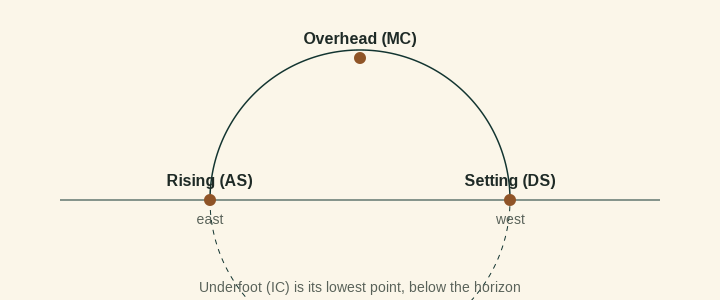
The body sets the theme, and the angle sets the part of life where it shows up. For Jupiter, astrologers tie the four angles to these things:
- Jupiter rising: a more confident, open way of meeting new situations, so you may start things with more ease there
- Jupiter setting: growth that comes toward you through other people, such as clients, collaborators and close partners
- Jupiter overhead: a wider public side, with career direction, reputation and room to advance
- Jupiter underfoot: a roomy, growing home life, with family, roots and a private base that feels generous
The overhead line is the one many astrologers look at first for career, and the underfoot line is the quietest of the four. It is felt more in how settled you are than in anything other people see. For the other eleven bodies, see Line Meanings, which covers all 12 in the same way.
Your Jupiter sign is not your Jupiter line
Two different things share the name Jupiter, and it is easy to mix them up. The sign Jupiter occupied at the moment of your birth is called your Jupiter sign. It is one fact about you, and it is the same wherever you live.
A Jupiter line is a place on the map. It marks where on Earth Jupiter was rising, setting, overhead or underfoot at that moment. So your sign tells you nothing about where a line runs. You cannot find the lines from the sign, and you need your birth date, time and place to draw them.
Astrologers read the two together. The sign describes the style of Jupiter's growth for you, such as cautious or lavish. The line points to the places where that theme is said to come forward. In a new city, a relocation chart also shows which house Jupiter falls in there.
How close a Jupiter line has to be
Distance matters as much as the line itself. On this site, a line passing through a city counts in full, and the share counted falls quickly as you move away. At 100 km (62 mi) it still counts for 92%. At 350 km (217 mi) it counts for 37%, and past 1,000 km (621 mi) it is not counted at all.
So a Jupiter line 20 km (12 mi) from a city is part of that city's character, as astrologers see it. A Jupiter line 600 km (373 mi) away is a faint background note. When you read a place, take the closest line first and ask how far it really is. How we calculate shows the full table.
Jupiter lines for study and travel
Astrologers tie Jupiter to learning, teaching and long journeys, and to the beliefs that go with them. In the traditional house system, that belongs to the ninth house. So a Jupiter line near a city is often mentioned by people thinking about a course, a degree or a year abroad.
The angle changes the picture a little:
- rising: a bold, curious approach to a new place, which suits the first weeks of a move
- overhead: study that leads somewhere public, such as a qualification or a career step
- setting: teachers, mentors and study partners, often read as people who widen your view
- underfoot: a home base that feels roomy, which may help if you plan a long stay
For a trip, a Jupiter line is an easy theme to test. Many astrologers suggest asking what you want to learn there, and whether the place makes you curious. A Jupiter line is a reason to look closer at a city, and it does not replace the usual checks on cost, language and visas. The astrology travel page covers how to plan around lines.
How Jupiter lines count in your city ranking
Jupiter is a helpful star in all 3 of the site's rankings. It has the largest career weight of any body, and its home weight is second only to the Moon's. The weights are our own, set with astrological tradition as the guide, and they are published in full on the method page:
| Goal | Jupiter weight |
|---|---|
| Love | 0.45 |
| Career | 1 |
| Home | 0.7 |
The angle then adjusts how much that weight matters. Multiply the two numbers and you get the most a Jupiter line can add to a city before distance is taken into account:
| Line | Love | Career | Home |
|---|---|---|---|
| Jupiter rising | 0.45 | 0.8 | 0.56 |
| Jupiter setting | 0.54 | 0.5 | 0.42 |
| Jupiter overhead | 0.23 | 1.3 | 0.21 |
| Jupiter underfoot | 0.32 | 0.3 | 0.91 |
Read the table by goal. For career, the overhead line is by far the largest entry, which matches the astrological habit of looking at the overhead line for public life. For home, the underfoot line leads. For love, the setting line leads, since astrologers tie that angle to one-to-one ties. The overall ranking is the average of the three goals.
This is a scoring choice, not a promise about any place. A city that the ranking puts lower may still suit you better, and the list works best as a set of themes to think about.
Examples from Maya's map
Maya was born on June 10, 1990, at 2:30 PM in New York. Her map has several Jupiter lines that show up in the sample figures on this site.
Her Jupiter overhead line runs 72 km (45 mi) from Boston, and that line puts Boston first on her career list. It also passes 21 km (13 mi) from Antofagasta in Chile, and it is 322 km (200 mi) from New York, so it does not run through her home city. Seen by an astrologer, the line pairs growth and new chances with a public side, which is why it is read first for career.
Her Jupiter setting line runs 214 km (133 mi) from Tbilisi, Georgia, her first city overall. It is not the main reason Tbilisi comes first. Two lines are much closer, Venus underfoot at 18 km (11 mi) and Moon rising at 22 km (14 mi). The Jupiter line still adds to the love score, and the worked example on the method page shows how: 0.45 × 1.2 × 0.688 = 0.37.
The two examples show two ways to use a Jupiter line. In Boston it is the closest and strongest line for the goal. In Tbilisi it is a supporting line that sits behind two nearer ones. Do not stop at whether a Jupiter line is present. Read how far away it runs and which goal you care about.
Jupiter on the setting line: partners and allies
The setting line is the Jupiter angle that faces other people. Astrologers connect it with growth that arrives through someone else, such as a client, a business partner or a close friend. They describe it as a place where helpful people may be easier to meet.
It can also speak to a relationship. Jupiter is tied to generosity and shared beliefs, so a setting line is read as a place where a partner may bring optimism and a wider outlook. As with any line, there is a flip side. A partner who is generous may also promise more than they can give, and astrologers sometimes mention that.
On this site, the setting line adds most for love among the four Jupiter lines, at 0.54 before distance is applied. Maya's setting line runs 214 km (133 mi) from Tbilisi, as the example above shows. The setting angle in general, with any body on it, is described on the DC line page.
When a Jupiter line meets a Venus or Sun line
Jupiter often shares a place with other friendly bodies, and the combination is worth reading as a pair. Astrologers tie Venus to affection and enjoying life, and the Sun to confidence and feeling like yourself. Jupiter is tied to growth, so the pairing tends to be read as one theme with more room around it.
Here is a way to read that, one pairing at a time:
- Jupiter with Venus on different angles: warmth and ease in one part of life, with growth in another. Maya's Tbilisi shows this, with Venus underfoot and Jupiter setting, which pairs a feeling of home with openness to others
- Jupiter overhead with Sun overhead: a public side that is both confident and expanding. Both of Maya's overhead lines run through the Americas, and her top 5 career cities all sit there
- Jupiter and Venus on the same angle: the two themes arrive together, so read the closer line first and treat the other as a supporting note
- Jupiter with a Saturn line: growth beside structure. Astrologers often read this as a mix of room to grow and the patience to build, and you can compare it on the Saturn line page
When the two lines are about the same distance from a city, give each equal weight. If one is much nearer, it leads. For the love side of this reading, the love chart page shows how Venus is weighed.
Reading a Jupiter line with care
Astrologers often describe Jupiter as a generous body, and a few add a caution: its themes can reach past what is useful. A place with a lot of openings may ask you to say no more often than usual. This is a tendency in the tradition, and it gives you a question to hold, not a prediction.
It also helps to separate a theme from a plan. A Jupiter line near a city is a reason to look at it more closely. It does not replace what you know about work, cost of living, language, visas and the people you would live near. Those things are outside what a map of lines can see, and they matter more than any line.
If you have no Jupiter line near a place, that says only that Jupiter's themes are not especially stressed there. Astrologers would not read it as good or bad, and the rest of your chart carries on as it always has.
If you do not have an exact birth time
A Jupiter line needs a birth time, because the lines shift by about one degree for every 4 minutes. With only a rounded time, the lines are approximate. They can still show you which regions Jupiter touches, though the distances to individual cities may be off by hundreds of kilometers.
With no birth time at all, the map draws the lines for 12 noon as an example only and does not rank cities. In that case, treat what you see as a demonstration of how lines look, and not as your own. Your birth certificate or hospital record is the best place to look for the time, and a family member may remember it too.
How to look at your own Jupiter lines
To see where yours run, you need your birth date, time and place. The time matters here. A difference of 4 minutes moves every line by about one degree, roughly 111 km (69 mi) at the equator, so a rounded birth time can move a Jupiter line past a city.
Then follow these steps:
- Draw your map and turn on only the Jupiter lines, using the switch for each body
- Select a city that matters to you, such as where you live now or a place you are thinking about
- Check which Jupiter line is closest, which angle it is, and how many kilometers away
- Read what astrologers connect that line with, and ask whether the theme fits what you want
- Look at the Venus, Sun and Moon lines nearby to see what else is in the picture
If you are more interested in how your chart changes in a new city, a relocation chart shows your new rising sign and which house Jupiter falls in there. For Maya, Jupiter sits in house 10 in New York.
Questions to ask yourself
A line gives you a theme. These questions turn it into something you can use:
- what would I like more room for right now, such as work, study, travel or friendships?
- is there a plan that needs a wider setting than where I live today?
- would I want a Jupiter city for a year, for a season or for good?
- if many doors opened at once, how would I choose between them?
- when I visit, do I feel open and curious, or stretched too thin?
Your answers matter more than the line does. If you want a place that supports growth in your work, a Jupiter overhead line near a city may be a reason to visit and take a look. If you want a place to rest and settle, you may prefer a Moon or Venus line, and the guide to choosing where to live shows how the goals compare. To learn what your overhead lines mean at the top of your chart, read about the Midheaven.
FAQ
What does a Jupiter line mean in astrocartography?
Astrologers connect it with growth, optimism and new chances. The angle decides the part of life: rising for how you meet new situations, setting for close ties, overhead for public life, underfoot for home. It is a symbolic theme, not a forecast.
Which Jupiter line do astrologers look at first for career?
Many look at the overhead line first, since it is tied to public life, reputation and direction. In this site's career ranking, Jupiter has the largest body weight and the overhead angle counts most. Opinions differ, so test it against your own experience.
Is a Jupiter line always good to live on?
No line is simply good or bad. Astrologers read Jupiter as open and generous, and some add that too many openings can stretch a person thin. The line gives you a theme to think about, and your own reaction to a place counts for more.
How close does a Jupiter line need to be?
The closer, the more it counts. On this site a line through a city counts in full, 100 km (62 mi) away it counts for 92%, and 350 km (217 mi) away for 37%. Past 1,000 km (621 mi) it is not counted at all.
How does a Jupiter line count in the city rankings?
It adds to a city's score for all 3 goals. Its weights are 0.45 for love, 1 for career and 0.7 for home, and the angle then adjusts each one. The full table is on the [method page](/method).
How do I read a Jupiter line next to a Venus line?
Read the closer one first, then the other as a supporting note. Astrologers tie Venus to affection and enjoying life, and Jupiter to growth and new chances. Together they can read as warmth with room to grow.
Why is a Jupiter line near my first city?
A first city can have a Jupiter line nearby when other close lines are strong too. Only the nearest lines count in full, and a Jupiter line 300 km (186 mi) away counts for about half, one 600 km (373 mi) away for far less. Select the city to see each line and its distance.
Can I see only my Jupiter lines on the map?
Yes. Lines can be switched on and off body by body, so you can leave just Jupiter, or just Jupiter and Venus. Selecting a place also lists every line within 1,000 km (621 mi) with its distance.
Can I find my Jupiter line without an exact birth time?
Not reliably. A line moves about 1 degree for every 4 minutes, so a rounded time can shift it by hundreds of kilometers. Without any birth time, this site draws the lines for 12 noon as an example only and does not rank cities.
Is my Jupiter sign the same as my Jupiter line?
No. Your Jupiter sign comes from your birth moment alone, so moving does not change it. A Jupiter line is a place on the map, drawn from your birth date, time and place. Astrologers read the two together.
What does Jupiter on the setting line mean?
Astrologers connect it with growth that comes through other people, such as partners, clients and close friends, and with generosity in one-to-one ties. It is a symbolic theme, and no line can promise a particular person or deal.
Is a Jupiter line good for study or travel?
Astrologers tie Jupiter to learning, teaching and long journeys, so many look at it when they think about a course or time abroad. It is a theme to test, not a forecast, and it does not replace practical checks on cost, language and visas.
Where should your next chapter unfold?
Match your current priorities with your natal planetary lines in under a minute.
What are you optimizing for right now?
Related tools
Line Meanings
Every line is a pairing of one body and one angle, and this page explains both halves, with examples from a real map.
How to Read Your Map
Draw your own map above, then follow 5 steps that turn a tangle of lines into a plain reading of any one place.
Saturn Lines
Your Saturn lines mark the places where Saturn was rising, setting, overhead or underfoot at your birth. Astrologers connect them with patience, structure and results that take time. This page explains each line, how far away it can be and still count, and how to read it next to a Moon line. Then you can draw your own map above.
How we calculate
Here is how each line is calculated, what our tests found, and how a city earns its place, with the numbers left in.
AC Lines
Each AC line marks the places where one planet was rising over the eastern horizon when you were born. Also called the Ascendant or rising line, it is one that astrologers connect with self-image, first impressions and how you start things. This page covers what each planet on the AC points to, how close a line has to run, and how AC lines count in the rankings. Draw your own map above to see where yours fall.
Astrocartography Calculator
This astrocartography calculator takes your birth date, time and place. It draws your 48 planetary lines on a world map and names the city your lines point to first, with the reasons. It is free and needs no account. You can also look up any place to see the lines near it.
Career Map
Enter your birth details and the map sorts cities by the lines astrologers tie to work, with the overhead line counting most. You do not need to know what any line means, because the result names your first city and the lines behind it.
Love Map
Enter your birth details and the map sorts itself by the lines astrologers tie to affection. You do not need to know what any line means.