Neptune line in astrocartography: what each of the 4 lines points to
Your Neptune lines mark the places where Neptune was rising, setting, overhead or underfoot at your birth. Astrologers connect them with imagination, intuition and a dreamy, boundary-blurring mood. This page explains each line, how far away it can be and still count, and why this site's rankings count Neptune a little against a city. Then you can draw your own map above.
How it works
Draw your map
Enter your birth date, time and place. All 48 lines appear, and you can switch the lines on and off body by body to leave only Neptune.Select a place and read the nearest line
Choose a city that matters to you. See which Neptune line is closest, which angle it is and how many kilometers away it runs.Compare with the other lines nearby
Check for a Moon, Venus, Jupiter or Saturn line close to the same place, and read the closest line first. The tool writes out what astrologers connect each one with.
A Neptune line in astrocartography marks places where Neptune was on one of the 4 angles at your birth. Astrologers connect these lines with imagination, intuition, compassion and blurred boundaries. Neptune rising points to a sensitive way of meeting new situations, Neptune setting to idealistic one-to-one ties, Neptune overhead to a public side shaped by art and care for others and Neptune underfoot to a dreamy idea of home. How close the line runs matters, and this site's rankings count Neptune slightly against a city for love, career and home.
What a Neptune line is
Neptune has 4 lines on your map, one for each angle: rising, setting, overhead and underfoot. Each marks the places on Earth where Neptune was at that point in the sky when you were born. The positions are astronomy. The meanings come from astrological tradition, and nothing scientific shows that living near a line changes anything in your life.
Astrologers connect Neptune with imagination, intuition, compassion and the longing for something bigger than everyday life. They also connect it with blurred edges: dreaminess, wishful thinking and a tendency to see people and plans as better than they are. Near a Neptune line, they tend to say, those themes come forward. Some people describe such a place as soft, creative or quietly spiritual. Others find it vague and prefer somewhere with clearer outlines. Both are fair readings of the same line.
Nothing on this page says what will happen to you. It tells you what astrologers connect each line with, so that you can decide how much weight to give it.
The 4 Neptune lines, one at a time
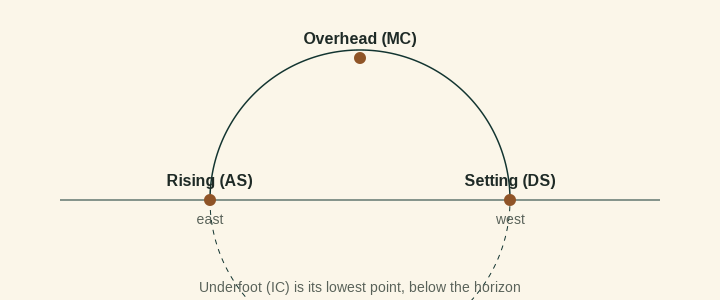
The body sets the theme, and the angle sets the part of life where it shows up. For Neptune, astrologers tie the four angles to these things:
- Neptune rising: a sensitive, impressionable way of meeting new situations, with an artistic streak and a first impression that can seem hard to pin down
- Neptune setting: gentle, idealistic one-to-one ties, with a wish to see the best in partners, clients and collaborators, and a reminder to ask for clear terms
- Neptune overhead: a public side shaped by imagination, with a link to art, music, film, healing work and care for others, and sometimes a fuzzy sense of direction
- Neptune underfoot: a dreamy idea of home, tied to quiet, water and privacy, with a wish to retreat and a risk of blurred boundaries in the household
Astrologers do not all agree on which of the four is easiest to live with. The overhead line is the one many look at first for creative or caring work. The underfoot line is the quietest, because it shows up in private life more than in anything other people see. For the other eleven bodies, see Line Meanings, which covers all 12 in the same way.
What it can feel like near a Neptune line
People who describe a Neptune place often use soft words. The light seems gentle, the days run together and plans stay loose. Some feel inspired and take up music, painting or quiet study. Others lose track of time and wonder where the week went.
Astrologers read both as the same theme. Neptune blurs edges, which is welcome when you want to rest or create and unhelpful when you need firm dates and clear answers. In practice that means money, contracts and promises deserve an extra look in a Neptune place, so it helps to put them in writing.
How close a Neptune line has to be
Distance matters as much as the line itself. On this site, a line passing through a city counts in full, and the share counted falls quickly as you move away. At 100 km (62 mi) it still counts for 92%. At 350 km (217 mi) it counts for 37%, and past 1,000 km (621 mi) it is not counted at all.
So a Neptune line 20 km (12 mi) from a city is part of that city's character, as astrologers see it. A Neptune line 600 km (373 mi) away is a faint background note, counted at about 5%. When you read a place, take the closest line first and ask how far it really is. How we calculate shows the full table.
How Neptune lines count in your city ranking
Neptune has a negative weight in all 3 of the site's rankings, a small one. A negative weight means a Neptune line takes a little away from a city's score. The weights are our own, set with astrological tradition as the guide, and they are published in full on the method page:
| Goal | Neptune weight |
|---|---|
| Love | -0.2 |
| Career | -0.2 |
| Home | -0.25 |
The angle then adjusts how much that weight matters. Multiply the two numbers and you get the most a Neptune line can take from a city before distance is taken into account:
| Line | Love | Career | Home |
|---|---|---|---|
| Neptune rising | -0.2 | -0.16 | -0.2 |
| Neptune setting | -0.24 | -0.1 | -0.15 |
| Neptune overhead | -0.1 | -0.26 | -0.075 |
| Neptune underfoot | -0.14 | -0.06 | -0.325 |
Read the table by goal. For love, the setting line is the largest entry, since astrologers tie that angle to one-to-one ties. For career, the overhead line is the largest, at -0.26. For home, the underfoot line is the largest, at -0.325. The overall ranking is the average of the three goals.
Compared with the other outer planets, these are modest numbers. Pluto's home weight is -0.6 and Saturn's love weight is -0.6, while Neptune is at most -0.25. A single Neptune line near a city nudges its score down a little. It does not decide the order on its own.
This is a scoring choice, not a warning about any place. We count Neptune slightly against a city because astrologers link it with idealizing and with haziness, which many people would rather not add to a place where they need clear plans. Someone who wants a creative or contemplative life may want exactly that, and may reasonably prefer a city that the ranking puts lower. If that is you, look at the list as a list of themes, not a verdict.
An example from Maya's map
Maya was born on June 10, 1990, at 2:30 PM in New York. Her map has a Neptune underfoot line that shows up in the sample figures on this site.
That line passes 16 km (10 mi) from Québec. At that distance it counts for about 100%. On the home goal it comes to roughly -0.25 × 1.3 × 1.0 = -0.32, before the other lines near Québec are added. Astrologers would read it there as a dreamy, quiet idea of home, with a link to water and privacy.
The same line runs 218 km (135 mi) from New York, where she was born. At that distance it counts for about 68%, so on the home goal it comes to roughly -0.25 × 1.3 × 0.68 = -0.22. In the reading guide, it is the nearest of 6 lines to New York, read as imagination and idealism in home and private life.
The two examples show two ways to use the number. In Québec, Neptune sits almost on the city and sets the tone for home. In New York, it is one line among several, present and worth a look, but with a share of about two thirds. Do not stop at whether a Neptune line is present. Read how far away it runs.
When a Neptune line sits next to other lines
Neptune rarely runs alone near a city. Here is a way to read a few common pairings, one at a time:
- Neptune with Venus: affection and enjoyment meet idealism, so astrologers read the place as romantic and artistic, with a reminder to see people as they are
- Neptune with the Moon: feelings and the sense of home meet intuition, which some people find soothing and some find too sensitive
- Neptune with Jupiter: imagination meets growth, and astrologers often read it as room for big creative or spiritual plans
- Neptune with Saturn: dreams beside structure, which astrologers read as a chance to give a vision a practical shape
If two lines are at different distances, read the closer one first and treat the further one as a background note. If they are about the same distance, give each equal weight and ask which theme you want more of. The Pluto lines page walks through a body with a similar slow, quiet character.
Why your Neptune lines can differ between maps
Birth time, time zone handling and the drawing method all move a line. The default on this site, called in mundo, follows the body's real position in the sky. The other, Zodiacal, uses only its degree along the zodiac. The gap between the two depends on the body, so a Neptune line on another site may sit in a different place from yours here even if both are correct for the method each uses.
Pick one method and keep it when you compare cities. You can switch between the two on this site and watch the Neptune lines move. How we calculate explains the difference and the checks we ran.
A clarity check before you commit to a Neptune city
Because Neptune is tied to idealizing, a simple habit helps. Write down what the place seems to promise, what evidence you have, and when you will check it.
- The promise: for example, "I will finally finish my book there"
- The evidence: a plan, a room to work in, a person who has done it, a budget that lasts
- The check point: a date a few weeks in, when you ask whether the promise is coming true
If the promise has no evidence yet, treat it as a wish and not a plan. A wish is not a bad thing to have, and the check point is there so that you can enjoy it without being carried off by it.
Four common illusions near a Neptune line
These are four ways the Neptune theme can mislead. Each one is a reason to slow down, not a reason to avoid a place.
- "It feels like home right away." The first days in a new city are bright, and the feeling may not last
- "We were meant to meet here." A strong pull toward a person or a place is worth enjoying, and worth testing over time
- "This place will unlock my creativity." A setting can help, and the work still has to be done at a desk
- "I can leave my stress behind." Stress usually travels with you, and a quiet place can show it more clearly
None of these says a Neptune line is bad. They describe how the theme can look from inside.
How to look at your own Neptune lines
To see where yours run, you need your birth date, time and place. The time matters. A difference of 4 minutes moves every line by about one degree, roughly 111 km (69 mi) at the equator, so a rounded birth time can move a Neptune line past a city.
Then follow these steps:
- Draw your map and turn on only the Neptune lines, using the switch for each body
- Select a city that matters to you, such as where you live now or a place you are thinking about
- Check which Neptune line is closest, which angle it is, and how many kilometers away
- Read what astrologers connect that line with, and ask whether the theme fits what you want
- Look at the Moon, Venus and Jupiter lines nearby to see what else is in the picture
If you have no Neptune line near a place, that tells you only that Neptune's themes are not especially stressed there. Astrologers would not read it as good or bad. Your birth chart carries on as it always has.
Neptune underfoot as a retreat
The underfoot line is where Neptune and home meet. Astrologers read a quiet, private base, often with water or a sense of shelter, and a wish to withdraw from the world. That can be restful. It can also drift into avoiding people, bills and decisions.
A useful question: are you retreating toward something or away from something? A week to read and sleep is a retreat. Months of putting off ordinary tasks is closer to disappearing. At -0.325 before distance, Neptune underfoot is the largest of this body's entries on the home goal, so the ranking leans the same way as the caution.
Visit, residency, retreat or move
How much weight a Neptune line deserves depends on how long you plan to stay. These are four ways to use it.
- A visit: a Neptune line near a city is a fair reason to go for a few days of rest, art or time near water, with a return ticket
- A creative residency: a few weeks suits a Neptune place well, because there is a clear end and a project to bring back
- A retreat: a quiet stay for contemplation fits the theme, as long as someone knows where you are and when you will return
- A move: take the longest view here. Stay for a season first, check money and work, and ask whether you still like the place when the novelty is gone
The same line can be a good week and a poor decade. The distance and the angle tell you where to look, and your own plans tell you how long to stay.
Questions to ask yourself
A line gives you a theme. These questions turn it into something you can use:
- do I want a place that feels soft and creative, or one that feels clear and practical?
- do I need quiet and time alone right now?
- how do I feel when plans stay loose and open?
- would I want a Neptune city for a visit, for a year or for good?
- when I visit, do I feel inspired, or do I lose track of what I came to do?
Your answers matter more than the line does. If you are looking for a place to write, paint or slow down, a Neptune line near a city may be a reason to visit. If you want firm plans and a crisp routine, you may prefer to look for a Saturn or Sun line instead. To compare your own city with your chart, a relocation chart shows your new rising sign and houses there.
FAQ
What does a Neptune line mean in astrocartography?
Astrologers connect it with imagination, intuition, compassion and a longing for something bigger than everyday life, along with blurred boundaries. The angle decides the part of life: rising for how you meet new situations, setting for close ties, overhead for public life, underfoot for home. It is a symbolic theme, not a forecast.
Is a Neptune line bad to live on?
No, it is a tendency with two sides. Some people look for a soft, creative or quiet place and find a Neptune line a good fit. Others prefer clear outlines. This site's rankings count Neptune slightly against a city as a scoring choice, not as a warning about any place.
Why does Neptune count against a city in the rankings?
Neptune has a weight of -0.2 for love, -0.2 for career and -0.25 for home. Astrologers link it with idealizing and haziness, which many people would rather not add to a place where they need clear plans. The weights are our own and are published on the method page.
How close does a Neptune line need to be?
The closer, the more it counts. On this site a line through a city counts in full, 100 km (62 mi) away it counts for 92%, and 350 km (217 mi) away for 37%. Past 1,000 km (621 mi) it is not counted at all.
Which Neptune line takes the most from a city score?
For home, Neptune underfoot, at -0.325 before distance is applied. For career, Neptune overhead, at -0.26. For love, Neptune setting, at -0.24. These are scoring choices, not predictions, and all are small next to the weights of Pluto or Saturn.
Why do other sites show my Neptune line somewhere else?
Check the birth time and time zone first, then the drawing method. This site draws in mundo by default and can switch to Zodiacal, and the gap between them depends on the body. Keep one method when you compare cities.
Does the angle change what a Neptune line means?
Yes. The body gives the theme and the angle gives the setting. Neptune rising is about how you come across, Neptune setting about one-to-one dealings, Neptune overhead about public life and Neptune underfoot about home and private foundations.
Can I see only my Neptune lines on the map?
Yes. Lines can be switched on and off body by body, so you can leave just Neptune, or just Neptune and the Moon. Selecting a place also lists every line within 1,000 km (621 mi) with its distance.
Can a Neptune line make a city feel unreal or confusing?
Astrologers connect Neptune with blurred edges, so some people describe a place near the line as dreamlike or hard to pin down. Others find it soft and calming. Nothing scientific shows that a line changes how a place feels, so treat it as a theme to watch.
Is Neptune a good line for artists and creative work?
Astrologers often name Neptune for art, music, film and imaginative work, mostly on the overhead line. On this site Neptune is counted slightly against a city, so a creative person may reasonably prefer a place the ranking puts lower.
Should I move to a city on my Neptune line?
A line cannot answer that. Astrologers suggest a visit or a short stay first, then a check on money, work and plans once the first glow fades. Weigh the distance and angle, and the cost of a stay, before any move.
Where should your next chapter unfold?
Match your current priorities with your natal planetary lines in under a minute.
What are you optimizing for right now?
Related tools
Pluto Lines
Your Pluto lines mark the places where Pluto was rising, setting, overhead or underfoot at your birth. Astrologers connect them with deep change, renewal and intensity. This page explains each line, how far away it can be and still count, and why this site's rankings count Pluto against a city. Then you can draw your own map above.
Line Meanings
Every line is a pairing of one body and one angle, and this page explains both halves, with examples from a real map.
How to Read Your Map
Draw your own map above, then follow 5 steps that turn a tangle of lines into a plain reading of any one place.
How we calculate
Here is how each line is calculated, what our tests found, and how a city earns its place, with the numbers left in.
AC Lines
Each AC line marks the places where one planet was rising over the eastern horizon when you were born. Also called the Ascendant or rising line, it is one that astrologers connect with self-image, first impressions and how you start things. This page covers what each planet on the AC points to, how close a line has to run, and how AC lines count in the rankings. Draw your own map above to see where yours fall.
Astrocartography Calculator
This astrocartography calculator takes your birth date, time and place. It draws your 48 planetary lines on a world map and names the city your lines point to first, with the reasons. It is free and needs no account. You can also look up any place to see the lines near it.
Career Map
Enter your birth details and the map sorts cities by the lines astrologers tie to work, with the overhead line counting most. You do not need to know what any line means, because the result names your first city and the lines behind it.
Love Map
Enter your birth details and the map sorts itself by the lines astrologers tie to affection. You do not need to know what any line means.