Is astrocartography real?
Half of it is. The lines on an astrocartography map are real astronomy: they mark where each body was rising, setting, overhead or underfoot when you were born, and that can be checked. What those lines mean for a place is astrological tradition, with no scientific evidence behind it. This page separates the 2 halves, shows what makes a map accurate, and offers a way to use it without believing anything.
How it works
Enter your birth details
Type your birth date, birth time and birth place. The time zone is worked out for you, and no name or account is needed.Read your first cities
See the cities your lines point to first for overall, love, career and home, with the nearest lines and how far each one runs.Treat them as a list to explore
Use your first cities, plus any places you already had in mind, as places to read about or visit, then judge the fit by your own experience and practical needs.
Astrocartography is real in one way and unproven in another. The lines are astronomy and can be tested: ours differed from a standard reference by at most 0.633 km (0.4 mi). Their meanings are a symbolic tradition, and no scientific evidence shows that places act on people along those lines. The map is most accurate when your birth time is, since 4 minutes of error moves a line about 111 km at the equator.
The short version, in 2 halves
Astrocartography has 2 halves, and they stand on different ground. The first half is the map. Where a body such as the Sun or Venus was rising, setting, overhead or underfoot at the minute you were born is a question of geometry, and it has a checkable answer. The second half is the meaning. What a line is said to do for a person who lives near it comes from astrological tradition, and no scientific evidence shows that places act on people along those lines.
So the honest answer to "is astrocartography real" is yes and no, depending on which half you mean. The lines are real in the sense that they sit where the sky says they sit. The meanings are real in the sense that astrologers connect them with these themes as an established astrological practice. Nothing shows that they predict how your life will go. This site stands behind the first half and words the second half as "astrologers connect this with", because that is the part we can defend.
What is real: the lines
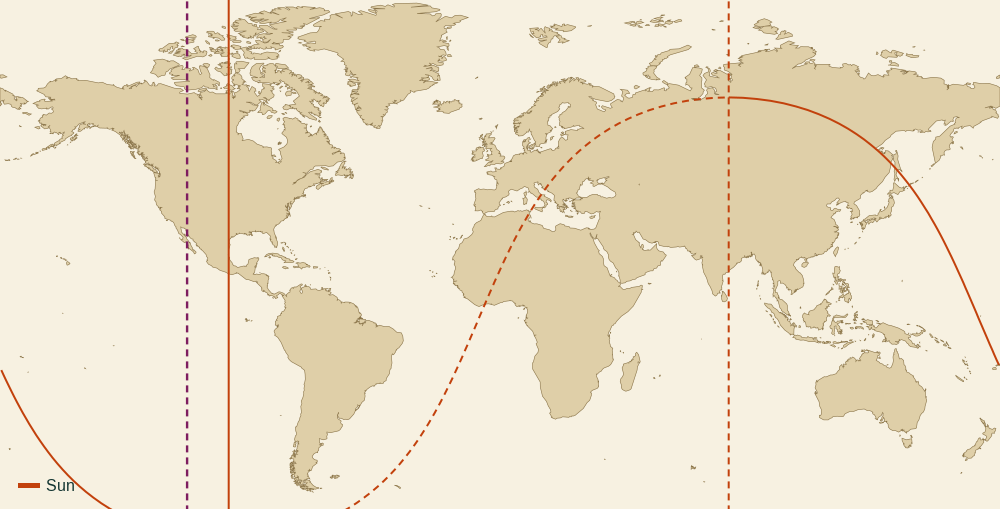
Take the sky at your birth moment and ask, for each of 12 bodies, where on Earth it was on the eastern horizon, on the western horizon, at its highest point and at its lowest point. Joining those places gives 4 lines per body, 48 in all. Anyone with the same birth moment and the same method gets the same lines, which is what makes this half testable.
We tested ours. In a run dated November 7, 2026, we compared the map with a standard reference in astrology software, across 3,001 moments, 52 lines and 7 cities. The largest difference in the distance from a city to a line was 0.633 km (0.4 mi). The full numbers are on How we calculate.
That result matters, and it also has a limit. It shows that the astronomy is computed correctly. It says nothing about whether a line means anything. A perfectly drawn line can still be a line that carries no effect, and a reader should keep those two ideas apart.
What is not proven: the meanings
Each line comes with a theme. Astrologers connect a Venus line with affection and enjoyment, a Jupiter line with growth and new chances, a Saturn line with effort and structure, and so on for the other bodies. The themes grow out of how astrologers have described each body for a long time. They are a symbolic language.
We know of no scientific evidence that living near a line changes anything in a life, and this site does not claim any. Be careful with the stories you read online too. A person who moves to a city and feels at home will often notice the matching line afterwards, and a person who has a hard year near another line may not look at all. That pattern is how a good story forms around any symbol, and it is not evidence. We do not publish success figures, because we have none to publish.
There is nothing wrong with enjoying a symbolic system as long as it is held as one. People read tarot, keep zodiac signs in mind and pick lucky numbers without confusing them with measurement. Astrocartography can sit in the same place: interesting, personal, and not binding.
Where the method comes from
Most accounts credit Jim Lewis, an American astrologer who lived from 1941 to 1995, with bringing astrocartography to a wide audience in the 1970s. Those accounts also say he did not invent every form of location astrology. Astrologers had long known that the horizon and the sky overhead change as you travel.
His contribution, as they tell it, was to turn that idea into a map you could study, with written interpretations. We read these dates on other astrology sites and did not check them against a primary source, so treat them as background.
This site is its own tool and not his service. The line positions come from astronomy that we test against a reference. The meanings come from astrological tradition, as described above.
When the map is accurate
Here, "accurate" has a narrow meaning: the lines are drawn where they should be for the birth moment you gave. Three things decide that, and the birth time is the largest by far.
Birth time
The Earth turns about one degree every 4 minutes, and one degree is about 111 km at the equator. If your recorded birth time is 4 minutes late, your lines sit about 111 km away from where they belong. If it is rounded to the nearest quarter hour, it can be up to 7.5 minutes off, which shifts a line nearly twice that. Maya, our sample person, was born in New York at 2:30 PM on June 10, 1990. Moving her time one hour later, to 3:30 PM, changes her first city from Tbilisi to Istanbul. The planets did not change. Only the Earth's turn between the 2 moments did.
Time zone and daylight saving
The time you enter is local time, and it has to be turned into a universal moment. That needs the time zone rules in force at your birthplace in your birth year, including daylight saving. The map does this for you. Records from before 1970 are best-effort, though, so for older births a place can be off by an hour or more. If a map looks strange, check this early.
Drawing method
There are 2 common ways to draw the lines. In mundo follows the body's real position in the sky. Zodiacal uses only the body's degree along the zodiac, which flattens out the tilt of its path, a tilt that is large for Pluto. They agree for the Sun and the North Node. For the Moon through Mars they usually sit within about 300 km (186 mi) of each other on our sample map, and for Pluto they differ by more than 1,000 km (621 mi) in places. Neither is wrong, and this map defaults to in mundo and lets you switch. What matters is using one method when you compare places.
If you do not know your birth time
Many people have a date and a place but no time. You have 2 reasonable routes. First, ask: a birth certificate, a hospital record or a family member's memory can often give a time, and a record is better than a guess. Second, if you cannot find one, use the map in its no-time mode. The lines are then drawn for 12:00 PM (noon) local time and shown as an illustration only, and the map gives no city rankings, because they would rest on a time that is probably wrong. Treat that view as a way to see how the idea works, not as your reading.
Using the map as a reflection tool
If you take the evidence as it stands, the most useful way to use astrocartography is as a prompt for your own thinking. Here is a way to do that without needing to believe anything about the lines:
- Make your map and look at your first cities for overall, love, career and home.
- For each city, read the nearest lines and the themes astrologers connect with them.
- Ask yourself which of those themes you would want more of, and which you would not.
- Compare your answers with the practical side of each place, such as cost, work, people and climate.
Step 3 is where the value is. The map hands you a vocabulary, and you decide whether any of it fits you. Someone who reads "Moon underfoot" and thinks "I do want somewhere that feels like home" has learned something about what they want, whatever the Moon is doing. Someone who reads it and shrugs has learned that too.
The map does not know your budget, your visa position, your language, your health needs or the people you would want nearby. It does not replace advice on immigration, tax or law. Those facts should lead any decision about moving, and the map should come after them.
Three common ways to misread a map
People tend to go wrong in 3 ways. The first is treating the map as a final answer. A line is a theme, and one city can carry a helpful line and a hard one together.
The second is ignoring real limits such as money, visas, work and family. No line changes those.
The third is asking a question that is too vague, such as where you will be happy. A narrower one gets a better reading, such as what the lines near Lisbon say about work.
Start with a real place and a real question. Compare a small number of cities, and add practical checks before you decide anything. A line can show where a theme is emphasized. It cannot tell you whether that theme will play out.
A way to use it that needs no belief
Here is a plain, low-stakes habit. Treat your first cities as a list of places to look into, nothing more. Open a travel guide for each. Read about the neighborhoods, the seasons and what a month there would cost. If one of them makes you curious, plan a short visit. If none does, you have lost nothing and gained a way to spend an hour thinking about where you might like to be.
That habit works whether or not astrocartography is true. The map gives you a few names to start from, one first city for each goal, and your own experience of the place gives the verdict. A short stay tells you more than any ranking, ours included. If you want to see how the ranking is built, every weight is published on How we calculate, so you can disagree with specifics.
Where to go next
If you are new to the idea, start with What is astrocartography for the basics, then How to read your map to work through a map line by line. If you are weighing a move, Where should I live based on astrology sorts about 400 cities against your lines and names a first city for each goal. Whatever you read, hold the lines loosely and the practical facts firmly.
FAQ
Is astrocartography real?
The lines are real astronomy: a body truly was rising, setting, overhead or underfoot at those places at that moment, and that can be checked. What the lines are said to mean comes from astrological tradition, and no scientific evidence shows that living near a line changes a life. It is fair to enjoy the map as a way of thinking about places.
How does astrocartography work?
It takes the sky at your birth moment and marks, for 12 bodies, the places where each one was rising, setting, overhead or underfoot. That gives 4 lines per body, 48 in all. Astrologers then read a place near a line as somewhere that body's theme stands out. Our page [What is astrocartography](/what-is-astrocartography) walks through it.
Is astrocartography accurate?
The lines can be accurate in position. Ours differed from a standard reference (details on [How we calculate](/method)) by at most 0.633 km (0.4 mi) across 3,001 moments, 52 lines and 7 cities. Whether the meanings hold for a person is a different matter, and nothing scientific supports it. In practice, your birth time is the largest source of error.
Is astrocartography legit?
It is an established astrological practice, so it is legit in that sense. It is not a tested way to predict your life. A fair way to hold it is as a symbolic prompt for thinking about places, checked against your own experience and practical needs.
Astrocartography explained: what do the lines show?
Each line marks where a body was in one of 4 positions at your birth: rising, setting, overhead or underfoot. The body sets the subject and the position sets the part of life, according to astrologers. On this site, lines within 1,000 km (621 mi) of a place are counted, and closer lines count for much more.
How much does my birth time change the map?
A lot. The Earth turns about one degree every 4 minutes, and one degree is about 111 km at the equator. A time 4 minutes off moves your lines by about that far, and one hour off moves everything. For Maya, one hour later changes her first city from Tbilisi to Istanbul.
What if I do not know my birth time?
Look for a birth certificate or hospital record first, since a record beats a guess. If you cannot find one, the map draws lines for 12:00 PM (noon) local time as an illustration only and gives no city rankings. Use that view to see how the idea works, not as your reading.
Should I move somewhere because of my astrocartography map?
No map should make that decision for you. Use it to build a short list of places to look into, then weigh cost, work, visas, language and the people around you. A short visit tells you more than any ranking. For immigration, tax or legal questions, ask a qualified adviser.
Who invented astrocartography?
Most accounts credit American astrologer Jim Lewis, who brought it to a wide audience in the 1970s. Earlier astrologers had already worked with place, so he is not the only source of location astrology. We have not checked these dates against a primary source.
Where should your next chapter unfold?
Match your current priorities with your natal planetary lines in under a minute.
What are you optimizing for right now?
Related tools
How we calculate
Here is how each line is calculated, what our tests found, and how a city earns its place, with the numbers left in.
What Is Astrocartography
What is astrocartography? It is a way of drawing your birth moment on a world map. For each of 12 sky bodies it marks 4 lines, the places where that body was rising, setting, overhead or underfoot when you were born. Astrologers connect each line with a theme. This page explains the idea, how to read the lines, and what the map can and cannot tell you.
How to Read Your Map
Draw your own map above, then follow 5 steps that turn a tangle of lines into a plain reading of any one place.
Where Should I Live
Enter your birth date, time and place, and the map names the city your lines point to first, with the reasons behind it.
AC Lines
Each AC line marks the places where one planet was rising over the eastern horizon when you were born. Also called the Ascendant or rising line, it is one that astrologers connect with self-image, first impressions and how you start things. This page covers what each planet on the AC points to, how close a line has to run, and how AC lines count in the rankings. Draw your own map above to see where yours fall.
Astrocartography Calculator
This astrocartography calculator takes your birth date, time and place. It draws your 48 planetary lines on a world map and names the city your lines point to first, with the reasons. It is free and needs no account. You can also look up any place to see the lines near it.
Career Map
Enter your birth details and the map sorts cities by the lines astrologers tie to work, with the overhead line counting most. You do not need to know what any line means, because the result names your first city and the lines behind it.
Love Map
Enter your birth details and the map sorts itself by the lines astrologers tie to affection. You do not need to know what any line means.